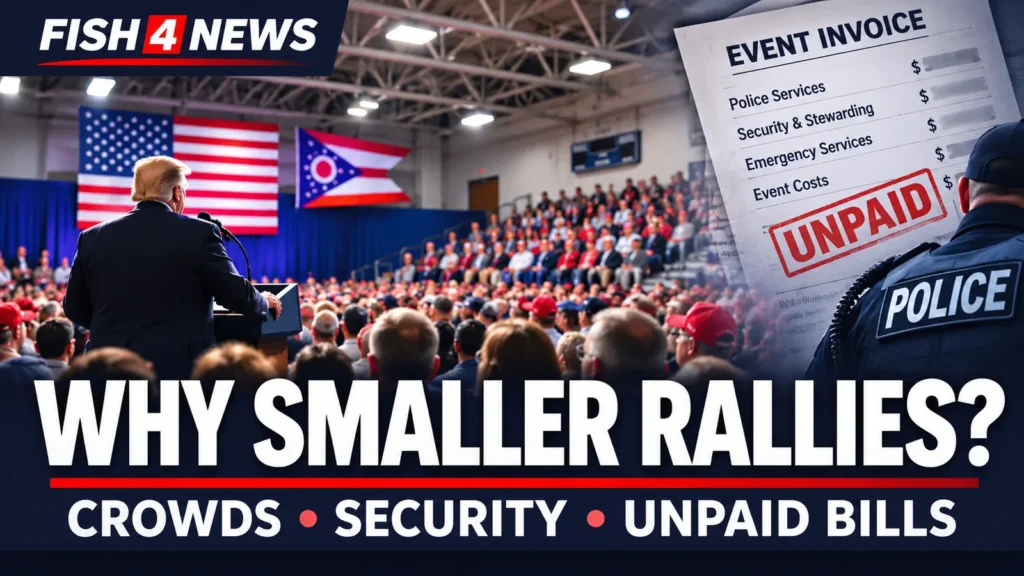
Donald Trump addressed a packed university sports hall in Ohio shortly before the 2026 US midterm elections. The unusually small venue prompted questions about rally crowds, but local reporting shows that the empty-seat photograph circulating online does not tell the whole story. Security, election strategy and a history of disputed police bills offer other possible considerations, although none has been established as the reason for choosing that particular building.
The 28 October event was held at the Shoemaker Center at Ohio University Chillicothe, a campus sports facility with room for about 2,400 spectators. NBC News correspondent Garrett Haake, who has covered numerous Trump events, said he could not remember the president speaking in such a small arena. His estimate that perhaps 1,000 people would fit was not the venue’s reported capacity.
A social-media graphic showing rows of empty chairs before the rally has been shared as evidence of weak support. But WOUB Public Media’s on-the-ground coverage reported a lengthy queue, a filled venue and supporters watching the speeches on a screen outside. A photograph taken before an event fills cannot demonstrate the eventual attendance.
A smaller audience at another Ohio rally
There is, however, more substantial evidence that attendance at some of Trump’s events has changed. At the Covelli Centre in Youngstown on 12 October, the local Vindicator estimated a crowd of 2,500 to 3,000. The same newspaper put attendance at approximately 7,000 when Trump appeared at that arena in 2017 and 5,500 in 2022.
Those comparisons involve the same venue, making them more informative than photographs of empty chairs taken before doors close. The figures are local media estimates, not independently audited counts, and a single city’s experience cannot establish a nationwide collapse in Trump’s rally following. The newspaper also reported that about half the permanent seats were closed off in advance of the 2026 event.
Reporting by Reuters during the October campaign described uneven attendance at other Trump events. That is consistent with variation between locations, but not proof that smaller venues were booked to disguise low demand.
Trump’s own explanation: indoor security
Trump gave a direct explanation for at least part of the change in rally format. During his 28 October Chillicothe speech, he said: “One of the reasons we confine ourselves to indoors, it’s a little bit safer.” He also referred to the people watching outside.
Security is not an invented pretext. After the 2024 assassination attempt in Butler, Pennsylvania, The Washington Post reported that Secret Service officials had encouraged his campaign to move away from large outdoor rallies. Indoor venues can simplify parts of the security operation, although they do not have to be small: large indoor arenas can accommodate many thousands of people.
Security therefore helps explain the preference for indoor locations, but does not by itself explain why the campaign chose a hall with roughly 2,400 places instead of a larger indoor arena.
Could local campaigning explain the choice?
Chillicothe is a smaller regional city, and the visit was billed as a midterm rally for Ohio Republicans. The Republican organisers’ event listing confirms the venue and date. The gathering featured support for Senate candidate Jon Husted and governor candidate Vivek Ramaswamy.
A strategically chosen regional stop can reach voters and local news outlets without requiring a large metropolitan stadium. Scheduling, travel, staffing, rental costs and the availability of a suitable secure building are all practical factors organisers may consider. But these remain plausible explanations, not verified accounts of the decision to book the Shoemaker Center.
The campaign’s history of unpaid police and security bills
Another question concerns the cost of bringing a presidential campaign to town. The issue is not imaginary. In 2020, the Center for Public Integrity found 14 municipal governments seeking a combined $1.82 million in unpaid public-safety charges linked to Trump campaign events. That was the sum claimed at the time, not a verified outstanding balance in November 2026.
In Texas, El Paso said in May 2026 that it was still seeking $569,204.63 following Trump’s 2019 rally. The total includes a delinquency charge. A local investigation established that the city had not reached an advance agreement with the campaign over public-service costs, which raises questions about whether the city can legally enforce the invoice.
In Minnesota, St Cloud said it had not received roughly $209,000 for city services linked to a July 2024 rally. The campaign separately paid a $35,000 university bill, according to Minnesota Public Radio. After the dispute, the city adopted broader special-event charging rules in June 2025.
Some local authorities have required money in advance. ABC News reported that Tucson, Arizona, secured $145,222 upfront for a September 2024 visit, including approximately $116,000 in policing costs. El Paso’s council voted in June 2026 to have officials develop an advance-deposit policy for campaign visits.
Have unpaid bills actually blocked a venue?
There is a disputed example. In October 2024, Trump’s campaign sought to use the Albuquerque Convention Center in New Mexico but ultimately held its event elsewhere. Albuquerque mayor Tim Keller cited outstanding costs from earlier events. However, the convention centre’s manager said planned water-line repairs made the requested date unavailable. The competing explanations were reported by the Albuquerque Journal. It would be wrong to present the unpaid bill as the sole established reason the booking failed.
The wider legal issue is complicated. Police officers are paid by their employing authorities; the dispute is whether the campaign must reimburse those authorities. The Trump campaign has referred questions about local policing bills to the Secret Service. The agency has previously said it lacked a reimbursement mechanism for local governments. Not every invoice was backed by a signed agreement, and other political campaigns have also disputed security costs. The original Public Integrity investigation explains these distinctions.
What the evidence does not show
Fish 4 News has found no verified evidence that Ohio University or the Shoemaker Center refused a larger Trump rally, demanded a special deposit because of historic debts, or chose the facility because organisers feared failing to fill a bigger arena. We have not established the event’s booking price, its final local-policing bill or whether there were other viable larger venues available on 28 October.
Those questions would require the venue contract, local-authority cost records and an explanation from the organisers. Nor do the available reports support treating the early photograph of empty chairs as proof of an empty rally.
The conclusion is narrower but more revealing: attendance at Youngstown was markedly below previous reported crowds in the same arena; Chillicothe’s smaller hall was nevertheless full; Trump cited indoor security; and previous campaign billing disputes have prompted some municipalities to toughen their booking arrangements. Each is documented, but the evidence does not justify reducing the Ohio venue decision to a single motive.
Sources
- Republican Party official Chillicothe event listing, 28 October 2026
- WOUB Public Media, on-the-ground report and images, 29 October 2026
- Roll Call Factba.se, transcript of Chillicothe remarks, 28 October 2026
- The Vindicator, Youngstown attendance comparison, 13 October 2026
- Center for Public Integrity, municipal invoices investigation, 16 April 2020
- KVIA/ABC-7, El Paso invoice investigation, May 2026
- Minnesota Public Radio, St Cloud policy change, 29 June 2025
- Albuquerque Journal, contested convention-centre booking, October 2024