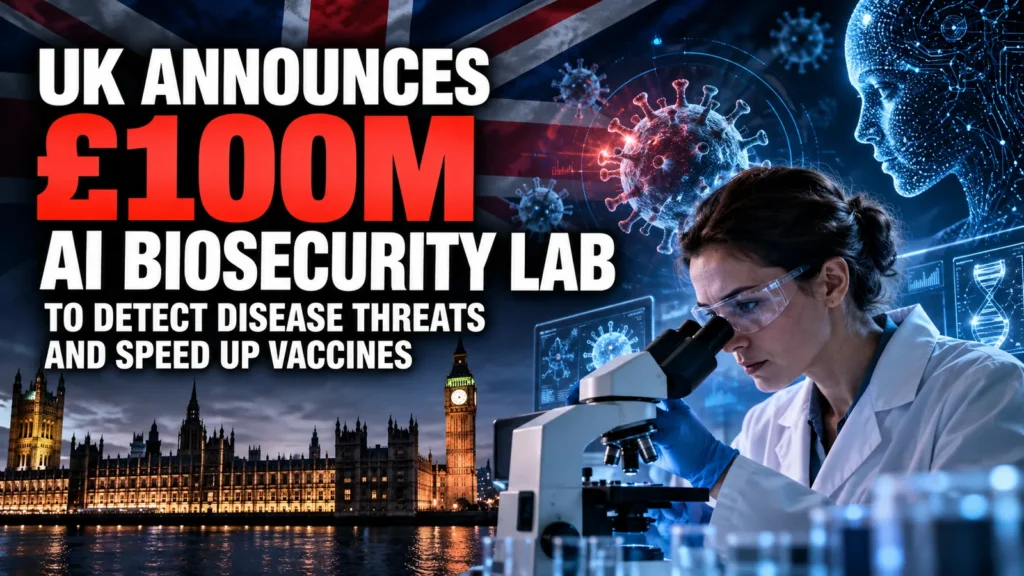
The UK government has announced plans to establish a £100 million AI Biosecurity Lab to help detect emerging biological threats, accelerate the development of vaccines and treatments, and strengthen protection against future disease outbreaks. Announced by the Cabinet Office on 24 October 2026, the initiative will also receive up to £200 million in technology commitments from artificial intelligence companies OpenAI and Anthropic.
A new approach to preventing biological threats
The AI Biosecurity Lab (AIBL) will bring together specialists in artificial intelligence, biological science and national security to develop technologies designed to identify and respond to biological risks.
The government describes the proposed organisation as the world’s first dedicated AI biosecurity institution.
Its initial work will concentrate on two priorities: improving the early detection of emerging biological threats and accelerating the development of vaccines, treatments and other medical countermeasures.
By combining advanced AI systems with specialist scientific expertise, the laboratory aims to help researchers analyse biological information, investigate potential threats and identify promising medical responses more quickly.
The objective is to improve preparedness before an outbreak becomes a major public health emergency, rather than relying entirely on measures introduced after a crisis has developed.
However, the announcement describes planned capabilities rather than an operational laboratory with demonstrated results.
Where is the £300 million coming from?
Although the initiative has been described as having backing worth up to £300 million, the funding is divided between government investment and technology company commitments.
The government has pledged £100 million in public funding to establish the laboratory.
OpenAI will contribute £100 million in computing and model credits, alongside trusted access to relevant advanced AI models through its Rosalind Biodefense programme.
Anthropic has committed up to £100 million in model credits, access to its AI systems and dedicated technical support.
Importantly, the companies’ contributions are not equivalent to an additional £200 million in cash. They principally represent access to computing resources, AI models and expertise.
Two other major technology partners will also participate.
Google DeepMind plans to collaborate on scientific research and explore providing trusted access to its Gemini and specialised scientific AI models.
UK-based Basecamp Research will contribute access to its AI-biology models and technical expertise.
The laboratory forms part of a wider £165 million National AI Biosecurity Initiative, which includes an additional £65 million for biological surveillance and the development of medical countermeasures against priority pathogens.
Why artificial intelligence matters for biosecurity
Artificial intelligence is increasingly capable of assisting scientists with complex biological research.
Advanced systems can help researchers examine large datasets, identify patterns and generate potential directions for further investigation.
Applied responsibly, these capabilities could support earlier identification of biological threats and assist in discovering new treatments.
For example, AI-assisted analysis could help scientists prioritise promising vaccine candidates for further laboratory testing.
However, AI-generated findings still require scientific validation, clinical assessment where appropriate and regulatory scrutiny. Advanced AI cannot eliminate the need for these safeguards.
The potential benefits also come with significant concerns.
As AI systems become more capable of supporting biological research, they may also make certain forms of dangerous knowledge or technical assistance more accessible to people seeking to cause harm.
The UK’s AI Security Institute has already documented substantial improvements in advanced AI systems’ capabilities in biology and chemistry, alongside weaknesses in safeguards designed to prevent misuse.
The new Biosecurity Lab is intended to address both sides of that challenge: using AI to strengthen biological defences while improving resilience against threats associated with AI itself.
Working alongside existing UK security and health organisations
The laboratory is intended to operate as an independent, non-profit organisation rather than as a conventional government department.
It will maintain partnerships with established public bodies and scientific institutions.
These include the UK Health Security Agency (UKHSA), the Animal and Plant Health Agency (APHA) and the Defence Science and Technology Laboratory (Dstl).
It will also work with the Medicines and Healthcare products Regulatory Agency (MHRA) on preparations for health emergencies and regulatory questions involving AI-designed medicines.
A scientific advisory committee will draw on expertise from academia, industry and the third sector.
The government has said further details of that committee will be announced subsequently.
The initiative also builds on the UK’s existing Biological Security Strategy, published in June 2023, which addresses threats including infectious disease outbreaks, antimicrobial resistance, biological accidents and deliberate attacks.
Government says Britain must prepare for emerging risks
AI Minister Kanishka Narayan has described the planned laboratory as a major international institution intended to bring together leading scientific expertise.
Speaking as part of the wider government AI announcement, Narayan said the UK needed to stay ahead of threats involving both cyber security and biological risks.
The Biosecurity Lab is one element of a broader investment package covering AI security, cyber defence and British technological capabilities.
That package also includes an additional £120 million for the AI Security Institute and new investment in AI-enabled national cyber defences.
The announcements reflect the government’s intention to treat advanced AI as both an economic opportunity and an issue of national security.
Questions remain over delivery and oversight
The announcement establishes the government’s ambitions, but several practical details have yet to be confirmed.
These include the timetable for the laboratory becoming fully operational, the appointment of its leadership and scientific advisers, and how progress will be independently assessed.
There are also questions surrounding the governance of an organisation designed to be independent while relying partly on access to technology provided by major commercial AI developers.
Clear arrangements for scientific oversight, access to sensitive research and the secure use of advanced AI systems will be important as the initiative develops.
The government has outlined the laboratory’s mission and partnerships but has not yet published detailed performance targets or evidence demonstrating the effectiveness of its proposed capabilities.
A test of AI’s role in protecting public health
The establishment of the AI Biosecurity Lab represents a potentially important development in the UK’s approach to biological security.
The ambition is to use increasingly sophisticated artificial intelligence to identify dangers sooner and support faster scientific responses to emerging diseases.
At the same time, the project highlights a central challenge facing governments and researchers: the technologies that could help defend against biological threats may also introduce new risks if misused.
Whether the laboratory delivers on its ambitions will depend on its scientific achievements, effective safeguards and the transparency of its operations.
For now, the announcement represents a substantial commitment to exploring how AI can contribute to public health protection and national security, rather than proof that those capabilities have already been achieved.