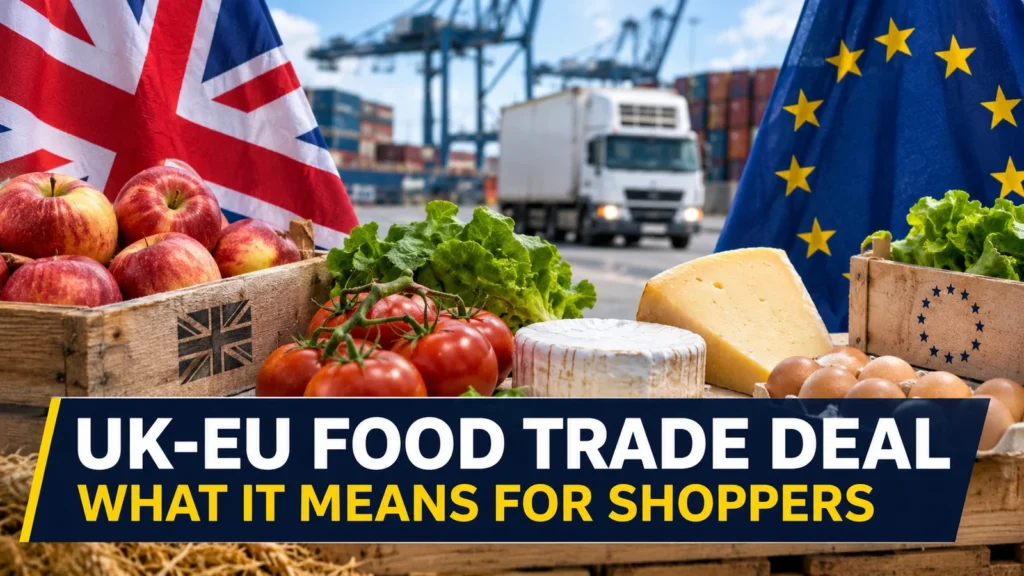
The UK and European Union have agreed the terms of a draft deal designed to remove many post-Brexit checks on food, plants and animal products. But it is not yet in force, and any savings at supermarket checkouts remain uncertain.
What has been agreed?
The proposed sanitary and phytosanitary (SPS) agreement would reduce paperwork and border checks on agricultural and food products traded between the UK and EU. On 3 November, Sky News reported, citing the BBC’s initial reporting, that the terms of a roughly 200-page draft had been agreed and circulated to EU member states. That is a significant negotiating step, but it is not the same as a fully ratified agreement.
The changes are intended to make it easier for farmers, food producers, retailers and hauliers to move goods across borders. The government has described the EU as the UK’s biggest agricultural food trading partner.
Which checks could disappear?
The draft is reported to remove requirements for many export health certificates, phytosanitary certificates and associated inspections. Sky News cited typical charges of around £200 for export health certificates and £25 for phytosanitary certificates, although actual costs vary. The precise exceptions and transition arrangements still need to be confirmed in the final legal text.
The proposed arrangements cover products including meat, dairy, seafood, fruit, vegetables, plants and animal products. They would not mean the end of every customs form or every border requirement associated with trading with the EU.
Will food prices fall?
Lower administrative costs and fewer delays could make some food imports cheaper to handle and improve product availability. That may ease pressure on prices over time, particularly for perishable goods. But there is no guarantee that supermarkets will pass on the savings, and prices will continue to depend on energy, wages, transport, exchange rates and other factors.
The government has cited an eventual £5.1 billion annual economic benefit from the proposed agreement. That is an estimate of wider economic gains, not £5.1 billion in guaranteed savings for shoppers or a forecast of how much individual grocery bills will fall.
What does Britain give up in return?
The central trade-off is regulatory alignment. Under the government’s published guidance, relevant EU food safety, labelling and product-authorisation rules would apply in Great Britain, including changes made to those rules in future. That would affect some UK businesses even if they do not export.
The Food Standards Agency has warned that existing British authorisations for some regulated food products could cease to apply as EU authorisations become applicable. The details matter to manufacturers as well as to importers and exporters.
When will the deal start?
There is no confirmed commencement date. Government business guidance updated in July 2026 still refers to an intention to begin in mid-2027. An official plant-health update dated 22 October extended temporary easements on certain fruit and vegetable checks until 31 January 2028, while continuing to say businesses should benefit from the agreement in 2027. Reports suggesting a move towards early 2028 should therefore be treated as provisional until the parties announce an agreed timetable.
What happens next?
The draft must pass the remaining political and legal steps on both sides. The UK-EU summit scheduled for 20 November is an important next milestone, but no individual element should be described as operational before its entry into force is confirmed.
For shoppers, the immediate answer is that nothing changes at the till today. For food businesses, the prospect of fewer checks is significant, but the final scope, start date and compliance obligations will determine the real-world benefits.