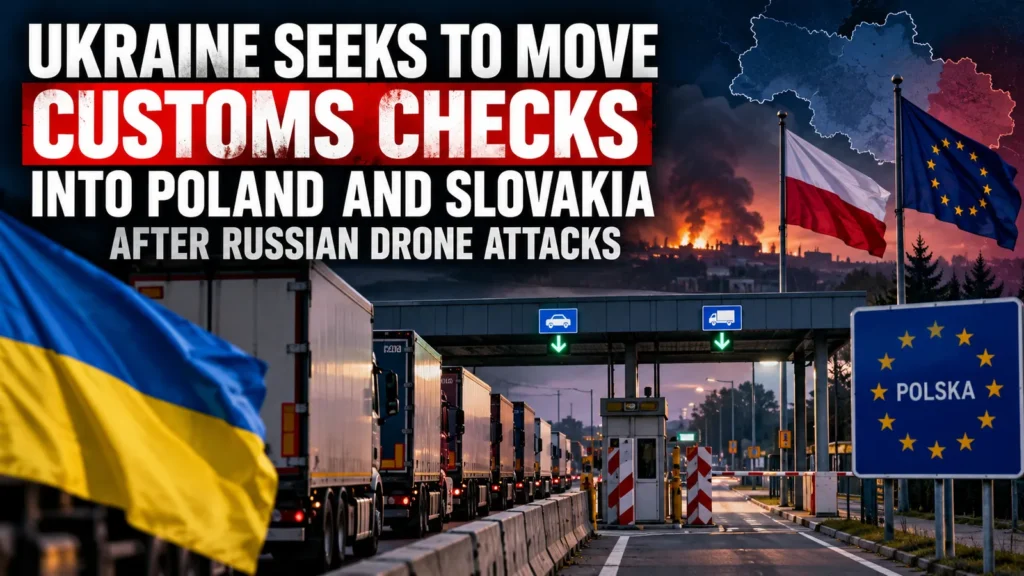
Ukraine is holding talks with Poland and Slovakia about moving customs inspections for grain-export lorries away from vulnerable border crossings and onto EU territory. The proposal follows repeated Russian drone attacks on Ukrainian transport infrastructure and comes as Poland confirms that attacks are already disrupting freight traffic along its eastern frontier.
According to a Financial Times report published on 23 October 2026, Kyiv wants to relocate some customs procedures to locations inside Poland and Slovakia, reducing the time lorries spend waiting in areas exposed to Russian attacks.
The discussions were also reported by Reuters, which cited Ukrainian Foreign Ministry spokesperson Heorhii Tykhyi.
The proposal would represent a significant change in how Ukraine manages agricultural exports through its western borders, although the precise arrangements remain under negotiation.
Russia’s Attacks Are Already Disrupting Border Crossings
The security concerns behind Ukraine’s proposal are supported by official Polish border reports.
On 23 October, Poland’s government-run border information service confirmed significant disruption to freight inspections at four crossings:
- Dorohusk and Hrebenne, in Poland’s Lublin province.
- Korczowa and Medyka, in the Podkarpackie province.
Additional disruption was possible at Zosin and Dołhobyczów.
Polish authorities identified Russian attacks on western Ukraine, including regions directly bordering Poland, as the principal cause.
When attacks threaten Ukrainian border facilities, officials temporarily suspend inspections. Because the two countries’ crossing procedures depend on one another, interruptions on the Ukrainian side also affect operations in Poland.
In some cases, security threats have forced border facilities to be evacuated on both sides.
Every interruption adds to queues of waiting vehicles, increasing delays and leaving drivers and cargo exposed to further disruption.
Poland Open to Joint Inspections, but No Agreement Yet
Poland has signalled that it could consider transferring border checks onto its own territory if deteriorating security conditions make existing arrangements too dangerous.
On 20 October, Poland’s Interior Ministry told the Polish Press Agency that such an arrangement would have to involve joint operations by Polish and Ukrainian officials.
As reported by Polsat News, the ministry also stressed that no decision had been made.
There are important legal considerations.
Poland belongs to the European Union’s Schengen Area, which imposes rules governing external border controls. Ukrainian border officials cannot independently conduct those controls on Polish territory under existing arrangements.
Any change would require coordination with the European Commission and compliance with the relevant European rules.
On 23 October, Polish Interior Ministry spokesperson Karolina Gałecka confirmed that Polish and Ukrainian border officials had discussed the security situation and possible inspection arrangements.
However, she emphasised that no political decision had been taken.
That distinction matters. Poland’s willingness to consider the proposal does not mean the new system has been approved or introduced.
Although Slovakia is also named in the reported negotiations, there has been no independently confirmed Slovak government agreement to implement the proposed changes.
Why Moving Customs Checks Could Make a Difference
Under the proposed approach, some inspection procedures would take place farther inside neighbouring EU countries rather than at facilities immediately alongside the Ukrainian border.
The objective is to reduce concentrations of stationary freight vehicles at locations vulnerable to Russian strikes.
Moving inspections could also help keep cross-border freight moving if infrastructure on the Ukrainian side is damaged or temporarily closed.
Ukraine has already established joint border control arrangements with Moldova and wants to expand cooperation with other neighbouring countries.
However, relocating customs procedures would not eliminate the danger of crossing the border itself.
Vehicles would still need to travel through vulnerable areas, while border security, immigration checks and customs inspections would have to be coordinated under any new system.
The practical benefits would depend on the locations selected, the procedures agreed and whether the changes genuinely reduce delays.
Ukraine’s Agricultural Exports Under Severe Pressure
The proposed changes come as Ukraine faces major difficulties exporting agricultural products because of Russia’s continuing attacks and restrictions affecting its traditional Black Sea shipping routes.
On 2 October, Ukraine’s Ministry of Agrarian Policy and Food reported that the country had exported 2.4 million tonnes of agricultural products during September, representing just 46% of the volume officials considered necessary.
Of that total, grain exports accounted for approximately 1.4 million tonnes.
According to the Ukrainian government’s official figures, September agricultural exports were transported primarily through alternative routes.
Approximately 54% passed through Danube ports, 41% travelled by rail and 5% by road.
Although road freight represents a relatively small share of agricultural export tonnage, maintaining functioning land crossings remains important for Ukraine’s trade and supply chains.
Agriculture Minister Taras Vysotskyi warned that without full access to Black Sea ports, Ukraine’s available export routes were operating at roughly 45% to 50% of required capacity.
He stressed the importance of preserving alternative transport routes and working with European partners to address additional logistics costs.
European Union Transport Routes Have Become Essential
The EU’s Solidarity Lanes initiative, established in May 2022 following Russia’s full-scale invasion, has become increasingly important to Ukraine’s economy.
The programme supports trade through European road networks, railways and inland waterways, providing alternatives to disrupted maritime routes.
According to European Commission figures published on 19 October, approximately 90% of Ukrainian exports of grain, oilseeds and related products travelled through Solidarity Lanes in September 2026.
Only around 10% used Black Sea routes.
These figures illustrate the extent to which Ukraine has become dependent on alternative connections through neighbouring European countries.
However, moving customs checks alone would not restore lost shipping capacity or resolve broader transport bottlenecks.
What Happens Next?
Ukraine wants to reach an agreement with Poland as soon as possible, according to statements attributed to its Foreign Ministry.
But several important questions remain unresolved.
Neither Poland nor Slovakia has announced a timetable for implementing new customs inspection arrangements, and no confirmed locations for relocated checks have been published.
The two sides must also establish how customs officers would operate, which inspections could be transferred and how the arrangements would comply with European legislation.
For Ukraine, the immediate priority is maintaining access to export routes while reducing the danger faced by drivers and border personnel.
For Poland and Slovakia, the challenge is balancing security and trade continuity with their legal responsibilities at the European Union’s external border.
The proposal reflects a wider consequence of Russia’s attacks on Ukrainian infrastructure: the disruption is increasingly affecting the transport systems connecting Ukraine with the rest of Europe.
Whether the negotiations produce a workable agreement will determine if relocating inspections becomes a practical way to reduce those risks.