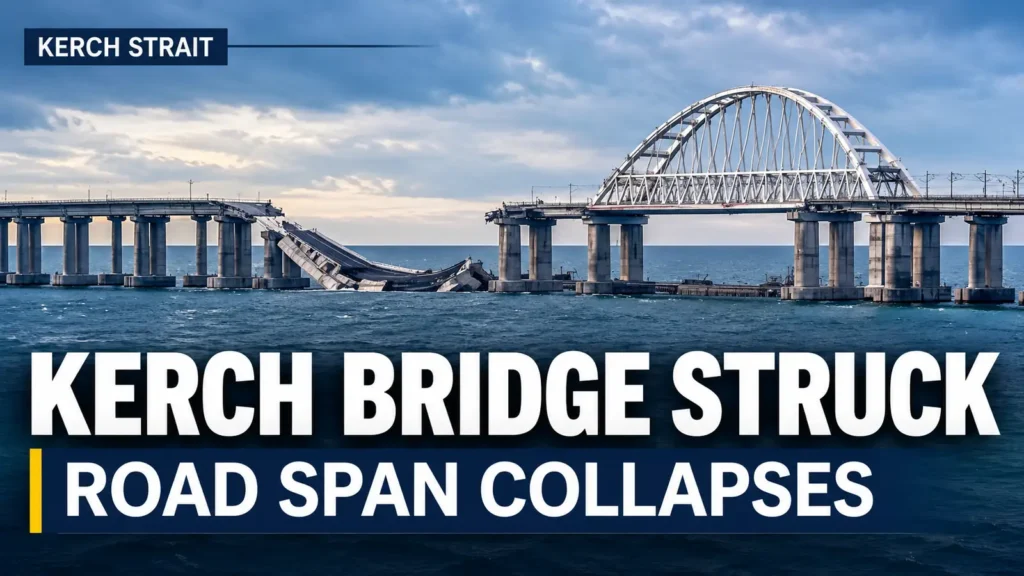
Ukraine has destroyed a central road arch and span of the Kerch Bridge linking Russia with occupied Crimea, leaving the road crossing unusable and damaging the adjacent railway section after strikes on 16 and 17 November 2026.
Ukraine’s Security Service (SBU) and General Staff say the collapse followed a weeks-long operation using several domestically produced weapons, including Palianytsia missile-drones, Neptune missiles and the FP-5 Flamingo. Russia has acknowledged structural damage to the bridge, while passenger rail services reportedly resumed on Tuesday.
Reuters has verified images and video published by Ukraine showing the bridge’s main road arch collapsed into the Kerch Strait. The entire 19-kilometre crossing has not been destroyed, and Crimea has not been completely cut off.
What happened to the Kerch Bridge?
Russian-installed officials reported attacks on the crossing on Monday 16 November and again overnight into Tuesday 17 November. The Kremlin initially described Monday’s damage as minor. By Tuesday, an arch and a section of the road deck had fallen into the sea.
The Ukrainian General Staff said the road section was out of service and vehicles could no longer use the bridge. The parallel railway structure remained standing but had also suffered damage. Russian railway operator Grand Service Express subsequently said some train services had resumed.
The crossing is sometimes called the Crimean Bridge. It connects Russia’s Krasnodar region with Crimea, which Moscow annexed in 2014 in a move not internationally recognised as lawful.
How Ukraine says the attack was carried out
According to an SBU statement published on 17 November, the operation lasted about a month and involved seven stages. Ukrainian forces say they first targeted Russian air-defence systems, radar and electronic-warfare equipment before attacking the bridge.
The SBU attributes the collapse of the road span specifically to Palianytsia missile-drones used by its Alpha special forces. President Volodymyr Zelenskyy said the adjacent rail section was struck with Neptune missiles and Ruta and FP-5 Flamingo weapons.
Zelenskyy described the Flamingo strike as precision-guided and said its communications link remained operational until the final moments. The detailed guidance method, the number of direct hits and the structural condition of every part of the crossing have not been independently established.
Video: Ukraine releases footage of the operation
The following video is linked from the Ukrainian Security Service’s official account of the operation. It shows material released by Ukraine and should not be treated as independent verification of every military claim.
Is the entire bridge destroyed?
No. The central road arch and its span have collapsed, making the road crossing unusable at the time of reporting. The separate railway structure is still standing and some services have resumed despite reported damage. Claims circulating online that the whole bridge has been completely destroyed are inaccurate.
The collapse also appears to obstruct the main shipping channel between the Black Sea and the Sea of Azov. The extent of the obstruction and the timetable for clearing debris remain uncertain.
What this means for Crimea and Russian supplies
The 19-kilometre crossing, opened to road traffic in 2018 and passenger trains in 2019, has been an important route for civilian traffic and for moving supplies to Russian forces in Crimea and southern Ukraine. Its damage is a significant logistical problem for Russia, as well as a symbolic blow to one of President Vladimir Putin’s most prominent infrastructure projects.
However, the bridge is not Crimea’s only connection to Russian-controlled territory. Russia also uses a land corridor through occupied parts of southern Ukraine, and ferries have been used across the strait. The latest damage may place greater pressure on those alternatives rather than isolate the peninsula entirely.
The fallen structure may complicate commercial shipping through the Kerch Strait. The impact on Sea of Azov trade will depend on whether and when the navigable channel can be cleared.
Russia’s response and reported casualties
Russia’s Investigative Committee opened an investigation into the attack. Kremlin spokesman Dmitry Peskov said the bridge would be rebuilt, while officials began assessing alternative transport links and repairs.
Crimea’s Russian-installed governor, Sergei Aksyonov, reported that two people were killed in an overnight drone attack in the peninsula’s Leninsky district. That report does not establish that the deaths occurred on the bridge itself.
The attacks coincided with Russian strikes on bridges and other infrastructure in Kyiv. Kyiv’s mayor reported damage to the city’s North and South bridges and disruption to transport, power and water supplies.
What happens next?
The key questions are how long the road crossing remains closed, whether the railway can sustain regular traffic safely, and whether the collapsed span can be removed from the shipping channel. Russian authorities have not provided a reliably established timetable for full restoration.
For now, the confirmed development is the destruction of the central road span, not the destruction of the entire bridge. Further military claims, damage assessments and transport announcements will require separate verification.
Further development, 19 November: The bridge was attacked again and traffic was temporarily suspended while authorities assessed the latest damage. Read our follow-up report on the third attack and unconfirmed railway damage.
Sources
- Security Service of Ukraine: official operation statement and video, 17 November 2026
- Interfax-Ukraine: Ukrainian General Staff statement, 17 November 2026
- Reuters: verified footage, damage, Russian response and transport disruption, 17 November 2026
- Associated Press: Ukrainian strikes, reported damage and Russian response, 17 November 2026
- The Guardian: road-span collapse and impact on shipping, 17 November 2026