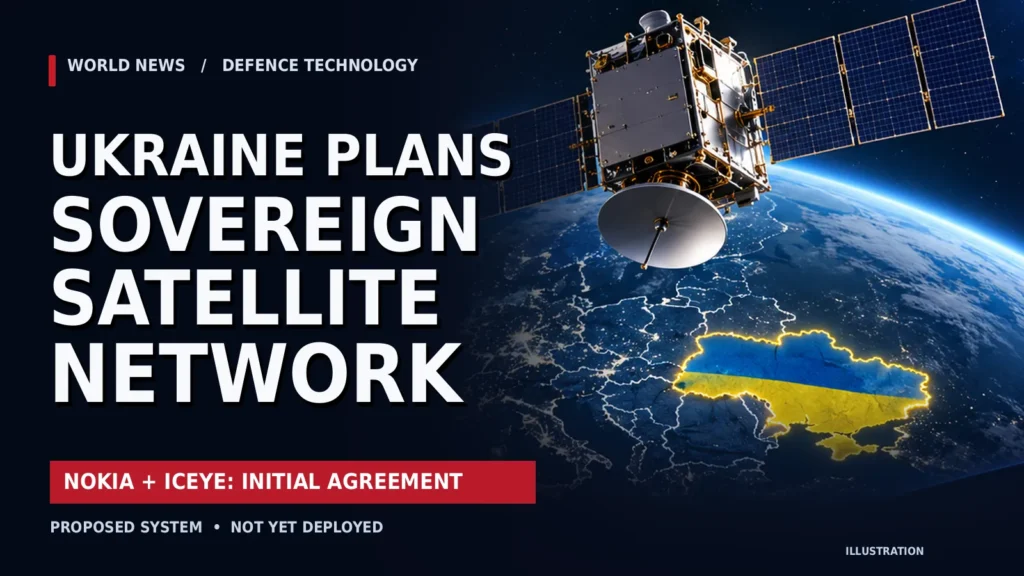
Ukraine’s Ministry of Defence has signed an agreement with Finnish technology companies Nokia and ICEYE to explore developing a sovereign satellite communications network, following restrictions affecting SpaceX’s Starlink and Starshield services. Announced in Kyiv on 22 October 2026 during a visit by Finnish Prime Minister Petteri Orpo, the initiative could eventually give Ukraine direct control over critical military communications infrastructure.
Ukraine Seeks Greater Control Over Military Communications
The agreement represents an important development in Ukraine’s efforts to reduce its dependence on satellite communications infrastructure owned and operated by foreign companies.
Under the proposed arrangement, Nokia and ICEYE would explore providing Ukraine with a satellite communications system incorporating European technology.
Unlike a conventional subscription-based satellite service, the proposed sovereign model would allow a participating government to own and control its satellites, associated ground infrastructure and user terminals.
ICEYE chief executive Rafal Modrzewski said Ukraine needed secure satellite communications systems it could control. In the official Nokia announcement, he highlighted ICEYE’s previous support for Ukraine and the company’s experience delivering sovereign space missions.
The agreement is currently a letter of intent rather than a confirmed purchase contract.
Neither company has announced a specific Ukrainian deployment schedule, the number of satellites involved or the projected cost.
Nevertheless, it establishes a formal basis for discussions about developing a communications capability under Ukrainian control.
Starlink Restrictions Exposed a Military Vulnerability
The announcement comes amid renewed concerns about Ukraine’s reliance on Starlink and Starshield, the satellite communications services developed by Elon Musk’s SpaceX.
These systems have played an important role in maintaining battlefield communications, coordinating military operations and supporting drone technology throughout Russia’s invasion.
However, restrictions introduced during October disrupted some Ukrainian military operations, particularly those involving equipment travelling at higher speeds.
According to Reuters, affected connections had been restricted to movement speeds of approximately 160 kilometres per hour, creating difficulties for certain drone operations.
On 24 October, Ukraine’s Ministry of Defence announced that normal operating speeds had been restored.
The ministry said its monitoring systems recorded stable Starlink and Starshield connectivity on equipment travelling at more than 400 kilometres per hour.
The official Ukrainian Defence Ministry statement described the restoration as important for frontline personnel, drone operations, logistics and military communications.
Despite that improvement, the disruption demonstrated how changes to an externally controlled communications service can affect military capabilities.
The dispute has also raised questions about responsibility for the restrictions.
Musk accused Ukraine of breaching Starlink’s terms of service through offensive drone operations. Ukrainian officials disputed those allegations, arguing that the commercial network’s limitations prevented the alleged long-range use.
The competing accounts do not change the wider strategic issue: Ukraine remains heavily dependent on communications infrastructure over which it does not have full operational control.
How Would the Nokia and ICEYE Satellite System Work?
Nokia and ICEYE first announced their wider satellite communications partnership on 1 October 2026.
The companies intend to develop high-performance broadband networks using satellites operating in low Earth orbit.
These satellites orbit considerably closer to Earth than traditional geostationary communications satellites, allowing systems to offer lower-latency connections suitable for demanding applications.
The partnership combines two areas of expertise.
ICEYE specialises in satellite technology and space-based intelligence. The Finnish company is particularly known for synthetic aperture radar satellites, which can produce images of the Earth’s surface during darkness and through cloud cover.
Nokia contributes communications networking technology and experience in developing secure telecommunications infrastructure.
Together, the companies plan to integrate satellites, ground stations and durable user terminals designed for defence and government applications.
The resulting systems could support military operations, border security, emergency services and disaster response.
Crucially, the companies say governments would be able to own and operate these systems rather than depend entirely on a foreign commercial provider.
In their original partnership announcement, Nokia and ICEYE said they expected the first communications satellites to launch in 2028.
That date applies to the wider commercial and government programme. It is not a confirmed launch schedule for Ukraine.
Does This Mean Finland Has Banned Starlink?
No. Claims circulating online that Finland has removed Starlink from the European Union or that Nokia has already replaced the American satellite network are not supported by the announcements.
The Nokia and ICEYE partnership concerns the development of an alternative communications capability. It does not prohibit Starlink from operating in Finland or elsewhere in Europe.
The companies also explicitly describe their proposed networks as complementing existing military and commercial communications rather than replacing them entirely.
There is a separate European policy debate concerning satellite communications sovereignty.
The European Commission has proposed changes to the allocation of the 2 GHz mobile satellite services frequency band, including capacity reserved for European-controlled operators.
However, this regulatory proposal is not a ban on Starlink and should not be confused with the Nokia–ICEYE agreement.
The distinction is important because creating alternative infrastructure and excluding an existing provider are fundamentally different policies.
Why Sovereign Satellite Communications Matter
Satellite communications have become essential to military operations, particularly where conventional telephone lines, mobile networks and terrestrial infrastructure have been damaged or destroyed.
Russia’s invasion has demonstrated how valuable reliable connectivity can be for coordinating military units and maintaining communications across contested territory.
It has also highlighted the risks of relying heavily on a single outside provider.
A sovereign satellite network could give Ukraine greater authority over operating rules, service availability and the infrastructure supporting critical communications.
Such ownership would not automatically make the system immune to cyberattacks, electronic interference, technical failures or other forms of disruption.
Nor would it necessarily eliminate every dependency on foreign suppliers or launch providers.
However, it could reduce the risk of a private commercial operator making unilateral decisions that affect Ukraine’s communications capabilities.
For European governments, similar considerations extend beyond the battlefield.
Emergency responders, border protection agencies and civil authorities also depend on reliable communications during crises.
The Nokia–ICEYE partnership is therefore positioned as a broader European technological development rather than exclusively a Ukrainian military project.
What Happens Next?
The immediate next step is for Ukraine, Nokia and ICEYE to determine whether the proposed satellite communications system can be developed into a practical procurement and deployment programme.
That would require decisions about funding, satellite requirements, ground infrastructure, security arrangements and operational responsibilities.
As of 25 October 2026, no firm contract for a Ukrainian satellite constellation has been announced.
The wider Nokia–ICEYE programme is targeting its first satellite launches in 2028, but Ukraine’s participation remains at an exploratory stage.
In the meantime, Ukraine continues to depend on existing satellite communications services, including Starlink and Starshield.
The restored operating speeds announced on 24 October have addressed the immediate disruption reported by Ukrainian authorities.
The broader question of who ultimately controls critical military communications infrastructure remains unresolved.
For Ukraine, the Finnish agreement offers a possible route towards greater independence. For Nokia and ICEYE, it represents an opportunity to develop European-controlled satellite technology for governments seeking more direct authority over their communications systems.
Whether that ambition becomes an operational network will depend on the contracts, investment and technical development that follow.
Sources
Nokia: ICEYE and Nokia sign letter of intent with Ukraine, 22 October 2026
Nokia: Sovereign satellite communications partnership, 1 October 2026
Ukraine Ministry of Defence: Starlink and Starshield speeds restored, 24 October 2026
Reuters: Ukraine reports restoration of Starlink and Starshield speeds, 24 October 2026
European Commission: Proposed satellite spectrum authorisation, 27 May 2026
Associated Press: Ukraine disputes Musk’s terms-of-service allegation, 25 October 2026
Video: Claims About Finland, Starlink and European Independence
The following commentary video discusses the Nokia–ICEYE announcement alongside wider claims about Europe’s technological independence from the United States. Its headline claim that Finland has removed Starlink from the European Union is not supported by the available evidence.