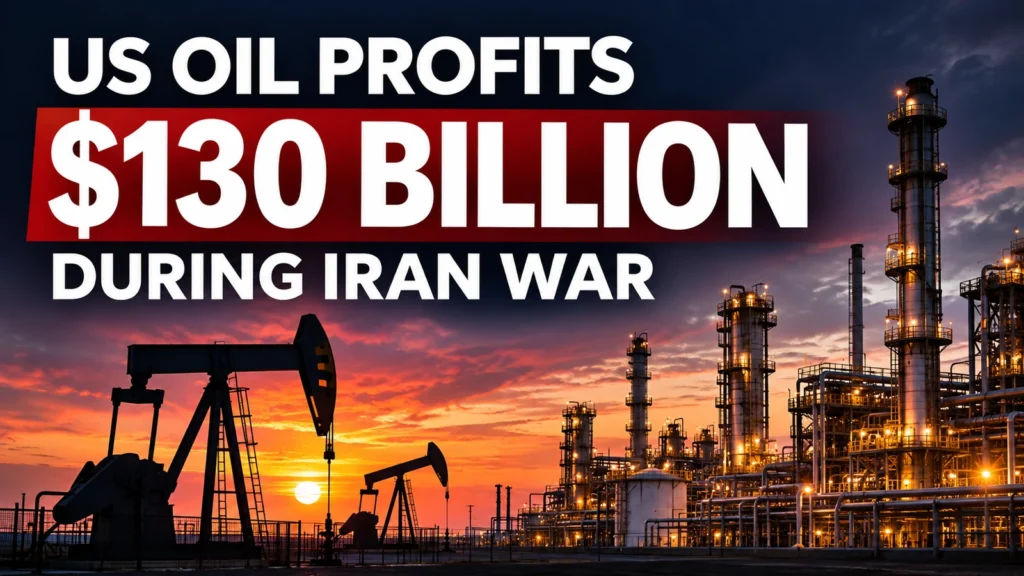
More than 50 major US oil and gas companies earned over $130 billion in profits during six months of the Iran war, according to a new financial analysis. The windfall comes as American motorists pay much more for fuel and scrutiny grows over donations to Donald Trump, energy policy decisions and the president’s own investments.
The figures show the contrasting economic consequences of a disrupted energy market. They do not prove that the war alone caused all the profits, or that campaign contributions purchased specific government decisions.
Oil companies’ profits nearly tripled
An analysis published by The New York Times and republished by GV Wire on 30 October put combined profits at more than $130 billion for over 50 large US oil and gas businesses between April and September 2026. The same group earned less than $47 billion in those six months of 2025.
The estimate excludes the first month of the war, March, and October. These are total profits earned during the conflict, not a calculation of profits attributable entirely to it. Output, operating costs and weak comparisons in the previous year also affect the result.
Quarterly company disclosures support the picture of unusually strong earnings. ExxonMobil reported $15.4 billion in third-quarter earnings under US accounting rules and Chevron reported $9.9 billion. Both also published higher adjusted earnings, a different accounting measure. Reuters linked strong refining margins to the effective closure of the Strait of Hormuz and damage to fuel production capacity in the Middle East and Russia.
The cost to American motorists
Brown University’s Climate Solutions Lab estimates that Americans have spent more than $145 billion extra on petrol and diesel since the war began on 28 February, compared with a modelled world without the conflict. A 30 October report cited approximately $147 billion. The live tracker changes as fuel-price and consumption data are updated.
Its published methodology compares observed prices with an estimated no-war price trajectory. It is a model, not a direct count of household bills. Consumer costs and company earnings are also different measures and cannot be added together or interpreted as a dollar-for-dollar transfer.
Donations and the $1 billion request
In 2024, POLITICO reported that Trump asked energy executives to raise $1 billion towards his election effort at a private meeting where pro-industry policy proposals were discussed. That account relied on people familiar with the meeting. An attendee disputed claims that the discussion involved an explicit exchange of donations for policy.
A Center for American Progress investigation published on 2 November 2026 identified $65.7 million in contributions from 11 fossil-fuel-related people and entities to Trump-linked political organisations, projects and businesses. This includes donations beyond the 2024 election and is not a tally of money raised at the 2024 meeting.
The progressive research organisation calculated that the fossil-fuel industry as a whole could benefit by at least $31.2 billion from policy and tax changes, with some benefits spread across the coming decade. That is not a proven payout to those 11 donors, and it must not be confused with the $130 billion industry-profit estimate.
What decisions benefited the sector?
The report describes expanded tax advantages, reduced royalties, delayed methane-related fees and changes affecting individual energy projects. It identifies donors whose businesses benefited from particular decisions. Its financial calculations and interpretation of those links are the organisation’s assessments, rather than an independent finding of corruption.
A separate investigation by Democratic senators also alleged that campaign donors benefited from tax breaks and environmental deregulation. Reuters reported their findings in September. The Trump administration argues that reducing regulation promotes investment, domestic energy production and lower compliance costs. A policy that benefits a donor is not sufficient evidence, by itself, that a government decision was bought.
Trump’s personal oil investments
An October 26 assessment by Democrats on the Congressional Joint Economic Committee estimated Trump’s oil and gas shareholdings were worth $22.5 million to $81.6 million as of 19 October. It said the portfolio’s value had increased by as much as $35.8 million during 2026, including purchases and market appreciation.
The calculations use publicly disclosed value ranges, so exact totals are unknown. An increase in market value does not establish that a gain has been realised or that the president personally ordered the trades. The report is from the committee’s Democratic minority, not a bipartisan committee finding.
The White House says Trump’s stock and bond holdings are managed through independent third-party institutions and model portfolios, and that neither the president nor his family directs the transactions. Its response was reported by CBS News. The financial interests remain relevant to conflict-of-interest scrutiny, but the claim that Trump directed purchases has not been established.
What the evidence does and does not show
- Confirmed or reported from company accounts: an exceptionally profitable period for many US oil and gas businesses, particularly fuel refiners.
- Estimated: extra fuel costs facing Americans under Brown University’s no-war comparison and the market value of Trump’s disclosed energy holdings.
- Documented with attributed analysis: energy-sector political donations and government decisions that affect the sector.
- Not established: that donations bought particular decisions, that Trump directed the stock trades or that all reported profits were generated because of the war.
The legitimate public-interest question is how the administration manages potential conflicts involving donors, industry policy and the president’s investments while households face higher costs. Answering it requires clear evidence, not a presumption of criminal wrongdoing.
Sources
- The New York Times investigation, republished by GV Wire
- ExxonMobil third-quarter 2026 results
- Chevron third-quarter 2026 results
- Brown University energy cost tracker and methodology
- Center for American Progress, 2 November donor report
- Congressional Joint Economic Committee Democrats, 26 October
- POLITICO’s 2024 reporting on the fundraising meeting
- CBS News and the White House investment response