A United Nations mission that has operated in Western Sahara for 35 years faces an uncertain future after the Security Council failed to agree on an extension. The dispute concerns more than diplomatic procedure: it affects monitoring of a continuing conflict and the unresolved question of who should determine the territory’s future.
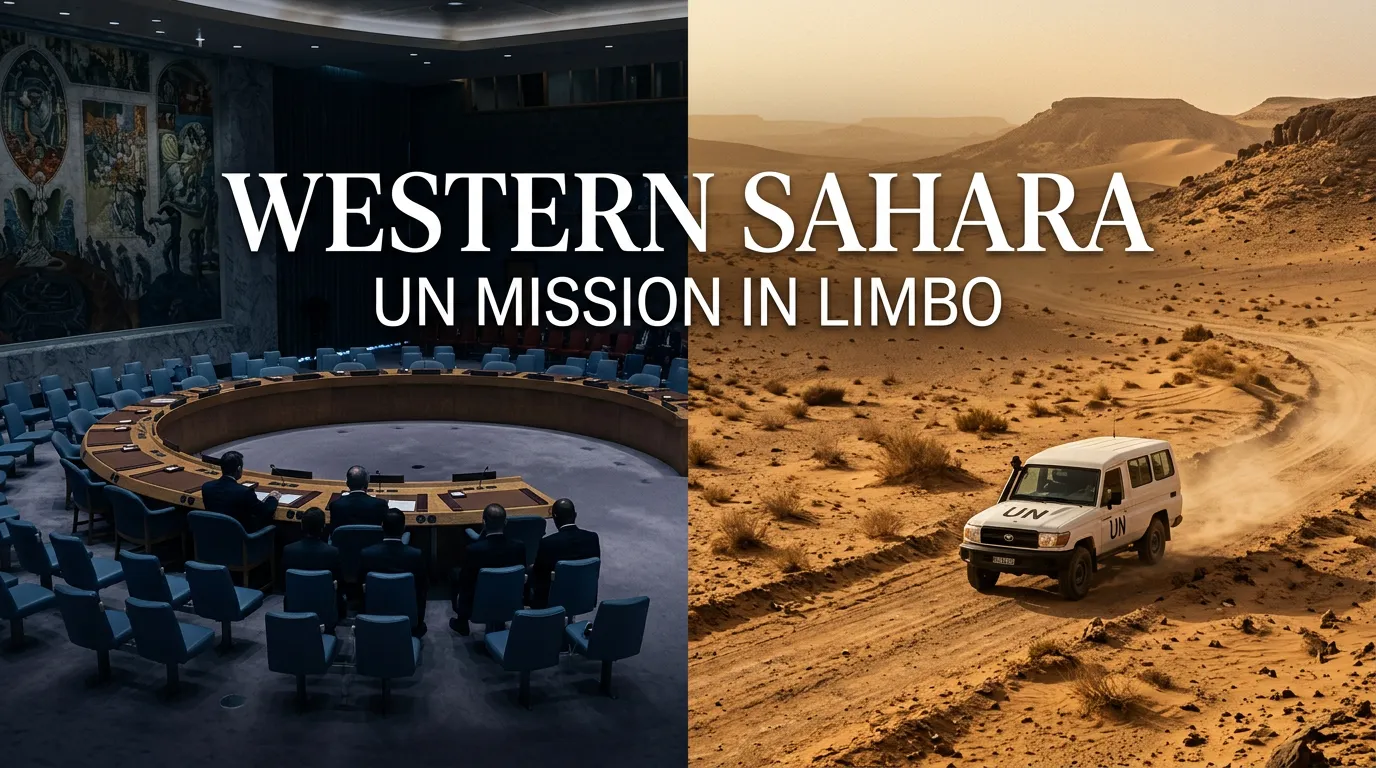
Russia vetoed a United States-sponsored resolution on Friday 30 October 2026. A rival Russian proposal also failed, leaving the mandate of the UN Mission for the Referendum in Western Sahara (MINURSO) due to expire on Saturday 31 October unless the Council reaches a new agreement.
What happened at the UN?
The US draft received 11 votes in favour, one against and three abstentions. Russia, a permanent Security Council member, used its veto to block it. Russia then put forward a shorter draft extending the existing mission for another year. That received three votes in favour, one against and 11 abstentions. It failed to reach the nine affirmative votes needed for adoption, irrespective of the US negative vote.
The disagreement was not simply over whether UN personnel should stay. It was over the political approach that should underpin the mission and negotiations over Western Sahara’s future.
Why did the United States and Russia disagree?
Washington’s final proposal would have extended the operation until 31 October 2027, renamed it the UN Mission in Western Sahara (MINUSO), removing the word ‘Referendum’, and asked the UN Secretary-General for proposals on its future structure and resources. It made Morocco’s updated autonomy proposal the sole basis for continuing discussions.
An earlier US draft went further, envisaging the end of the existing peacekeeping mandate in April 2027 and a transition to a political mission. Those specific termination provisions were removed from the final text. The distinction matters: the resolution vetoed on Friday was not the same as the first draft circulated during negotiations.
Russia said that focusing negotiations on Morocco’s plan in that way risked predetermining the outcome and failing to give sufficient weight to the Polisario Front’s position. Its own proposal would have preserved MINURSO’s name and existing mandate for another year while continuing political negotiations under UN auspices.
The British government supported the US resolution. UK ambassador Dame Sarah MacIntosh said the veto endangered the UN mission and could impede progress towards a settlement. Russia argued that an imposed outcome would not deliver a durable agreement.
Why is Western Sahara disputed?
Western Sahara, on Africa’s Atlantic coast, was formerly administered by Spain. After Spain’s withdrawal in 1975, Morocco asserted control over much of the territory, while the Polisario Front pursued independence on behalf of the Sahrawi people. Algeria supports Polisario and hosts large communities of Sahrawi refugees around Tindouf.
The United Nations lists Western Sahara as a Non-Self-Governing Territory. That status is important: Morocco administers most of the territory, but the dispute over its ultimate political status has not been resolved through the UN process.
A 1991 settlement envisaged a ceasefire and referendum on the territory’s future. The referendum never took place, with disagreements including who would be eligible to vote. The ceasefire broke down in 2020 and sporadic hostilities have continued.
What does the UN mission actually do?
MINURSO was created in 1991 with the referendum in its name and original mandate. Although no referendum has been held, the UN says its personnel have continued observing military developments, investigating incidents, reporting on security conditions and helping to de-escalate tensions between the parties. The operation also supports work to reduce the danger from mines and unexploded ordnance.
The mission is therefore more than an unfulfilled promise of a ballot. Its practical monitoring and communication role has continued even after the 2020 ceasefire breakdown.
What does this mean for civilians and refugees?
The immediate concern is whether the loss of the existing mandate could disrupt monitoring and channels used to prevent incidents escalating. It would be misleading, however, to say that UN peacekeepers have already withdrawn simply because the Security Council failed to agree an extension.
Aid charity Oxfam warned on 30 October that losing MINURSO’s monitoring and de-escalation functions could undermine stability and civilian safety. It also urged sustained assistance for Sahrawi refugees, including access to food, water and shelter. Those are warnings about potential consequences, not confirmation that fresh violence has occurred because of Friday’s votes.
What do Morocco and the Polisario Front say?
Morocco’s Royal Office welcomed the failure to renew MINURSO’s mandate and said it expected the mission’s personnel, equipment and symbols to leave territory under Moroccan administration in the coming days. That is Morocco’s stated expectation, not a verified report of a completed UN withdrawal or a final UN decision on departure arrangements.
The Polisario Front welcomed Russia’s veto, arguing that an agreement must preserve the Sahrawi people’s right to self-determination, including the possibility of independence. Morocco, by contrast, proposes autonomy within the Moroccan state rather than independence.
Where does Britain stand?
In June 2025, the UK backed Morocco’s 2007 autonomy proposal as the most credible and practical basis for negotiations. At the same time, the British position supported a mutually agreed solution through the UN process and referred to self-determination. Backing that autonomy plan is not the same as saying that Western Sahara’s final legal status has already been settled.
Britain’s intervention on 30 October followed that policy. Dame Sarah MacIntosh urged opponents of the US draft to seek a compromise using it as a basis, warning of consequences for regional stability and refugees.
What we know
- The Security Council did not adopt either resolution on 30 October 2026.
- Russia vetoed a US proposal supported by 11 Council members.
- The Russian proposal received only three affirmative votes and would have failed without the US negative vote.
- Under the last adopted resolution, MINURSO’s mandate runs to 31 October 2026.
- Morocco and the Polisario Front remain divided over the territory’s future.
What we don’t know
- Whether Council members will reach a last-minute agreement to extend or replace the mandate.
- Whether, when or how UN personnel would leave if no agreement is reached.
- What security monitoring arrangements would replace MINURSO’s existing functions.
- Whether the diplomatic deadlock will change conditions on the ground or the prospects for a negotiated settlement.
What happens next?
The next decisive development is whether the Security Council takes further action before or after the existing mandate expires. The UN would also have to address the operational and legal consequences of any lapse, including personnel and security arrangements. At the time of writing on the morning of 31 October 2026, the failed votes are confirmed, but an actual withdrawal or permanent closure has not been established.
For the Sahrawi people, the question reaches beyond the mission’s name or its yearly renewal. More than five decades after the dispute began, the parties have yet to agree on a process that settles Western Sahara’s future.
Sources
- UN Security Council, Western Sahara meeting (30 October 2026)
- UN resolution 2797 (2025), existing MINURSO mandate
- Security Council Report, analysis of the US and Russian drafts (30 October 2026)
- MINURSO, mission mandate and continuing functions
- UK statement after the failed votes (30 October 2026)
- UK-Morocco joint communiqué (1 June 2025)
- Russian delegation, explanation of vote (30 October 2026)
- Moroccan Royal Office statement (30 October 2026)
- Oxfam response and humanitarian warning (30 October 2026)
- Associated Press, vote and parties’ reactions (30 October 2026)

