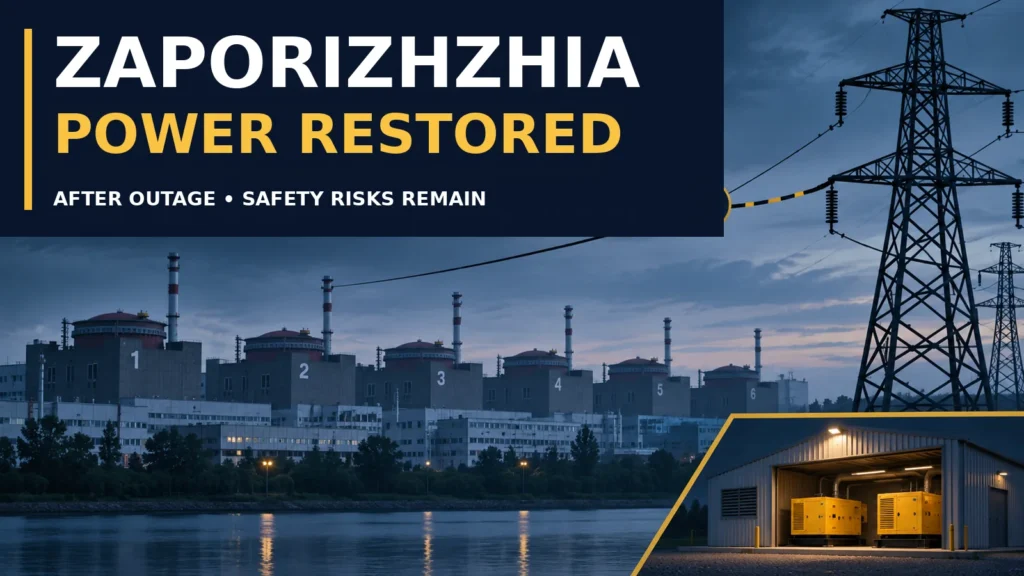
External electricity was restored to Ukraine’s Russian-occupied Zaporizhzhia nuclear power plant on Sunday 8 November, according to Ukraine’s nuclear operator, after an outage forced the site to rely on emergency diesel generators.
Energoatom said the 330-kilovolt Ferosplavna-1 line was reconnected at 17:41 local time. That is an important update to earlier reports of a complete loss of off-site power. The restoration was reported by Ukraine’s state news agency Ukrinform, citing Energoatom; an independent confirmation from the International Atomic Energy Agency (IAEA) had not been located when this article was prepared.
The outage had begun at about 02:36 local time, when the site’s only functioning external supply line disconnected. The IAEA and Reuters reported that emergency generators were supplying essential systems. Russian-installed plant management said radiation measurements remained normal. Neither the outage nor the switch to generators was evidence that a nuclear accident had occurred.
What happened to the plant’s power supply?
Zaporizhzhia was once supplied by multiple grid connections, but damage during the war has left it reliant on the 330 kV Ferosplavna-1 line. Its main 750 kV Dniprovska line was already out of service. The IAEA said in its 23 October update that new severe damage had been identified on that line, complicating repair efforts.
On 8 November the remaining Ferosplavna-1 connection tripped. Russian-installed management attributed the shutdown to an automatic protection system, but the IAEA said the precise cause and location of the latest disconnection were not yet known. It would therefore be premature to assign responsibility for this particular line failure.
Energoatom subsequently reported that Ukrainian energy workers had restored the Ferosplavna-1 connection. That reduces the immediate dependence on diesel generation, but it does not restore the redundancy that the site would normally require.
Why does a shut-down nuclear plant still need electricity?
All six reactors at Zaporizhzhia have been shut down and the plant is not generating electricity. Stopping a nuclear chain reaction, however, does not immediately stop heat production. Radioactive materials in the fuel continue to release residual, or decay, heat long after a reactor stops operating.
Electricity runs pumps and controls that circulate cooling water around reactor fuel and spent-fuel storage pools, as well as monitoring and other essential safety systems. If the grid fails, diesel generators can supply that equipment. If both external power and backup generation were lost for long enough, temperatures could rise and cooling could eventually become inadequate.
The long shutdown considerably lowers the amount of heat that must be removed compared with an operating reactor. That means a complete loss of cooling would not automatically cause immediate fuel damage. The timing and consequences would depend on the condition of the cooling systems, water supplies and the availability of alternative measures. The Dutch nuclear regulator’s published explanation also stresses that there would be time to intervene even in a prolonged power failure.
What did the IAEA say about diesel fuel?
During the 8 November outage, the IAEA said the plant held enough diesel to operate a limited number of emergency generators for approximately two weeks. That is an estimate of fuel endurance at a restricted operating level, not a prediction that a nuclear accident would occur in two weeks.
The IAEA had already warned on 6 November that it had not been informed of any new diesel deliveries since March 2026, and that stocks were under pressure ahead of winter. The agency also reported diesel being needed for steam generation to treat radioactive wastewater, while the plant was working on electric boilers to reduce fuel use for heating.
The key safety issue is reliability: repeated outages increase wear and reliance on backup systems. Maintaining generator fuel and restoring more than one dependable grid connection are both important safeguards.
Is a nuclear accident imminent?
No evidence currently cited by the IAEA or plant management establishes an imminent accident. During the outage, backup power was operating and plant management reported normal radiation levels. The subsequent report of a restored grid connection is further positive news, although independent IAEA confirmation of that restoration is still awaited.
A prolonged loss of both grid electricity and functioning backup power would be serious because pumps, controls and other protection systems could eventually fail. This is a real technical risk, not proof that reactor fuel has been damaged or radiation has escaped. Assertions of an imminent meltdown go beyond the available evidence.
Why the broader situation remains fragile
Russian forces have controlled the plant since March 2022. The IAEA has kept observers on site and has negotiated local ceasefires to allow repair crews to work on power infrastructure. It reported completing repairs under an eighth such ceasefire in October, but the plant still lacked its main line.
In its 6 November statement, the agency said attacks and military activity near nuclear facilities and electrical substations were continuing. IAEA Director General Rafael Mariano Grossi again urged restraint around nuclear sites and infrastructure essential to their safety. Russia and Ukraine have blamed each other for various threats to the site; individual claims about responsibility require separate verification.
The immediate outage appears to have ended according to Energoatom, but the underlying vulnerability has not. Further IAEA updates will matter most for confirmation that the line remains connected, the status of repairs to Dniprovska and the size and replenishment of emergency fuel reserves.
Sources
- Ukrinform, 8 November: Energoatom reports restoration of the Ferosplavna-1 line
- Reuters, 8 November: IAEA account of the initial loss of power
- IAEA, 6 November: latest full director general statement and diesel concerns
- IAEA, 23 October: power-line repairs and damage
- Netherlands Authority for Nuclear Safety and Radiation Protection: why a shut-down reactor still requires cooling