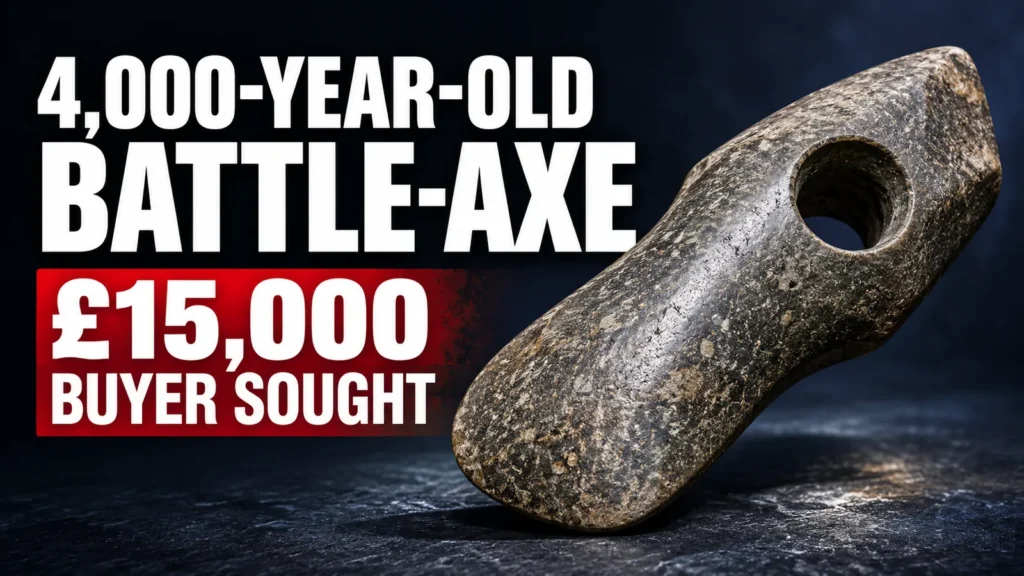
An exceptionally preserved Bronze Age battle-axe discovered in North Yorkshire has been temporarily prevented from leaving the UK, giving museums and potential buyers until 22 December to express interest in acquiring the historic artefact.
A rare 4,000-year-old stone battle-axe discovered near Tadcaster in North Yorkshire could leave Britain unless a buyer comes forward with £15,000. Heritage Minister Baroness Twycross has imposed a temporary export bar on the prehistoric artefact, giving British museums and other eligible purchasers an opportunity to secure it for future generations.
A remarkable survivor from Britain’s Bronze Age
Known as the Scarthingwell battle-axe head, the object dates from approximately 2050 to 1850 BC, making it nearly 4,000 years old.
It was discovered during agricultural work at Scarthingwell, near Tadcaster, in the winter of 1974. Despite spending thousands of years buried in the Yorkshire landscape, the axe remains in exceptionally good condition.
Measuring just 12 centimetres long and weighing 360 grams, it was crafted from diorite, a hard igneous rock with a distinctive speckled appearance.
Its carefully polished surface, elegant curved profile and precisely fashioned hole for attaching a wooden handle demonstrate the considerable skill of its prehistoric maker.
Experts believe its unusually good preservation suggests it remained relatively undisturbed until its discovery.
The artefact was subsequently recorded with the British Museum’s Portable Antiquities Scheme in 2012, under reference CORN-70CDC7.
Why was a stone axe important during the Bronze Age?
The Scarthingwell battle-axe dates from a significant period of transformation in Britain.
During the Early Bronze Age, communities were increasingly adopting metalworking techniques, creating new tools and weapons from copper and bronze.
However, stone battle-axes continued to hold considerable importance.
Rather than simply serving as practical weapons, experts believe these carefully crafted objects could communicate social status, personal identity, power and possibly religious or ceremonial significance.
Tim Pestell, a member of the Reviewing Committee on the Export of Works of Art and Objects of Cultural Interest, explained that the Scarthingwell example was particularly impressive because of its craftsmanship.
He estimated that its polished finish and distinctive shape would have taken hundreds of hours to produce, demonstrating the importance attached to such objects by the communities that created them.
The axe therefore offers archaeologists a valuable insight into how people expressed authority and identity at a time when British society was undergoing major technological and cultural changes.
Its original purpose and the identity of its owner remain unknown.
Government intervenes to prevent export
On 23 October 2026, the Government announced that Heritage Minister Baroness Twycross had deferred a decision on an application to export the battle-axe.
The intervention followed a recommendation from the independent Reviewing Committee on the Export of Works of Art and Objects of Cultural Interest.
The committee concluded that the artefact met all three of the nationally recognised Waverley criteria, which consider an object’s connection with British history, its artistic importance and its significance for academic study.
Baroness Twycross described the battle-axe as “an important part of the UK’s ancient story”.
She said its exceptional preservation and craftsmanship made it nationally significant, adding that securing the object for Britain would allow future generations to study and appreciate it.
The temporary restriction is intended to provide an opportunity for the axe to enter a public collection, where its preservation and accessibility could be assured.
What happens if nobody raises the £15,000?
The Government has established a recommended purchase price of £15,000 for the battle-axe.
The initial export deferral runs until 22 December 2026, giving interested purchasers time to register their intention to acquire it.
After this period, the current owners will have 15 business days to consider qualifying offers at the recommended price.
If an appropriate agreement is signed, a further three-month deferral period will allow the purchase process to proceed.
The export restriction does not automatically mean the artefact will remain in the UK permanently.
If no qualifying purchaser comes forward, an export licence would normally be granted, although the final decision remains subject to the relevant procedures.
Nor is the opportunity restricted entirely to museums. Under Britain’s cultural export system, private buyers may also qualify if they meet requirements concerning preservation, security and reasonable public access.
This means the future of the Scarthingwell battle-axe remains uncertain.
A small object with considerable historical significance
While £15,000 may seem relatively modest compared with the prices commanded by famous artworks and antiquities, the battle-axe’s importance extends far beyond its financial value.
Its construction, preservation and archaeological context provide evidence of the craftsmanship and cultural practices of communities living in Britain almost four millennia ago.
The artefact also illustrates how prehistoric objects can remain valuable to modern archaeological research, even decades after their discovery.
Whether the Scarthingwell battle-axe ultimately enters a British museum or is permitted to leave the country will depend on the outcome of the export deferral process.
For now, potential purchasers have until 22 December to express their interest in keeping this remarkable piece of Bronze Age history in Britain.
How interested buyers can help
Museums, organisations and eligible individuals interested in acquiring the battle-axe can contact the Reviewing Committee on the Export of Works of Art and Objects of Cultural Interest.
Email: rcewa@artscouncil.org.uk
Telephone: 020 7268 0534
Further details are available in the official Government announcement.