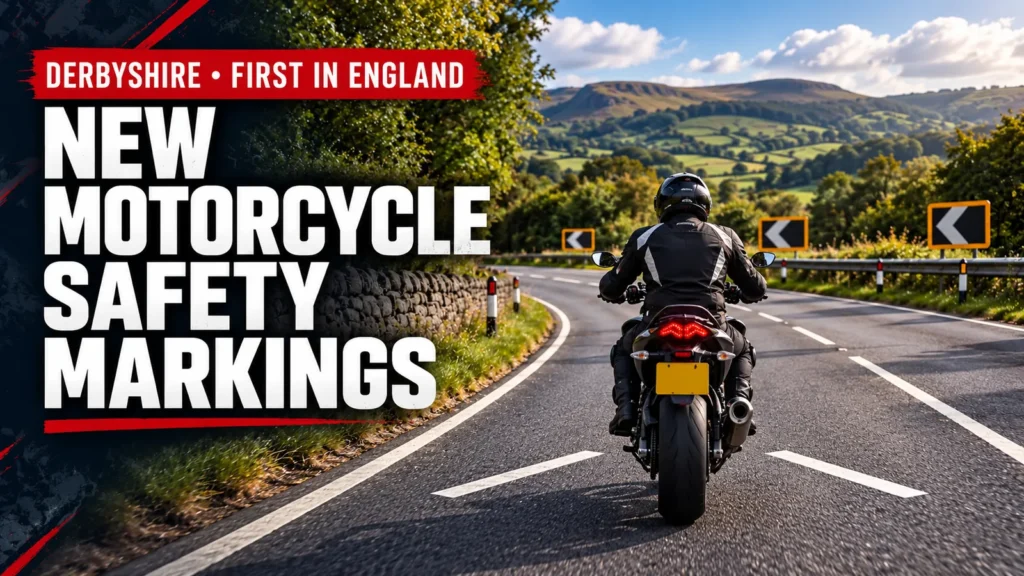
Derbyshire has become the first county in England to introduce specialist road markings designed to improve motorcycle safety on dangerous bends. The new PRIME system has been installed at two locations, with more routes approved, following Scottish research that recorded substantial reductions in motorcycle collisions.
What are the new motorcycle road markings?
The system is known as PRIME, which stands for Perceptual Rider Information for Maximising Expertise and Enjoyment.
Despite some descriptions suggesting dedicated motorcycle lanes, the markings do not create separate lanes exclusively for motorcycles.
Instead, they provide visual guidance that encourages riders to approach bends at an appropriate speed and position their motorcycles more safely.
The system uses specialist roadside signs alongside a series of white road markings arranged in pairs, creating what researchers call gateways.
Riders are encouraged to travel through the gaps between the markings as they approach a bend.
The aim is to help motorcyclists:
- Select a safer road position before entering a bend.
- Adjust their speed earlier rather than braking suddenly.
- Maintain a more controlled line around corners.
- Reduce the risk of losing control on difficult sections of road.
The markings are intended to support good riding technique, not replace a rider’s judgement about road conditions, visibility or other traffic.
Where have the markings been installed?
Derbyshire County Council announced the first installations on 21 October 2026.
The initial locations are:
B6015 Woodhead Road, Devil’s Elbow, near Glossop
A challenging section of road where the new guidance markings have been introduced.
A6 between Buxton and Bakewell
Another popular route through the Peak District, featuring bends that require careful judgement from motorcyclists.
The Department for Transport has also authorised further installations at approved locations on several other Derbyshire roads.
These include the A57 Snake Pass, A54 Macclesfield Main Road, A53 Axe Edge, A623 Peak Forest and B5035 near Middleton-by-Wirksworth.
The programme is being introduced in phases rather than across every road simultaneously.
According to Derbyshire County Council, the sites were selected after examining motorcycle collision records from 2015 to 2024.
Particular attention was given to rural roads where collisions were concentrated and where bends or loss of control appeared to be contributing factors.
Scottish trials recorded 61% fewer injury collisions
The Derbyshire initiative follows years of research and practical trials in Scotland.
Project PRIME began in 2020, initially examining how specialist road markings affected motorcyclists negotiating demanding bends on Scottish trunk roads.
The research eventually expanded to 35 locations, with more than 47,000 motorcycle movements observed across the programme.
In March 2026, Transport Scotland announced encouraging findings from its collision analysis.
Across the Scottish trial sites, researchers reported:
- 61% fewer motorcycle injury collisions, measured using annual averages.
- 46% fewer motorcycle collisions involving deaths or serious injuries, also measured using annual averages.
The research also found improvements in how riders positioned their motorcycles on bends, with speed reductions recorded at numerous locations.
An important distinction is that these figures describe observed changes across the Scottish sites. They do not establish that the markings alone caused every reduction in collisions.
Transport Scotland’s subsequent detailed research also found evidence that some improvements in rider behaviour continued several years after the markings were installed.
The research is available through Transport Scotland’s Project PRIME findings.
Why could simple road markings make a difference?
Motorcycle safety depends partly on decisions made before entering a bend.
A rider approaching too quickly, choosing a poor road position or braking unexpectedly during a corner can face an increased risk of losing control.
PRIME attempts to influence those decisions before they become dangerous.
Rather than relying solely on warnings telling riders to slow down, the markings provide an immediate visual guide to the approach and positioning required.
The approach draws on behavioural research, using the road environment itself to encourage safer decisions.
Transport Scotland’s trials found statistically significant improvements in road positioning at many sites, alongside reductions in speed at some bends.
The findings suggest that relatively straightforward changes to road infrastructure could complement rider training, enforcement and other safety measures.
Derbyshire Police to assess whether the scheme works
The new programme is being delivered through a partnership involving Derbyshire County Council, Derbyshire Constabulary and National Highways.
Derbyshire Police intends to use existing roadside camera equipment to examine how motorcyclists behave before and after the markings are introduced at selected locations.
Officers will assess factors including speed and road position to determine whether the positive findings reported in Scotland can be reproduced on Derbyshire’s roads.
Temporary Chief Constable Simon Blatchly, who leads the National Police Chiefs’ Council’s motorcycle portfolio, welcomed the initiative.
A motorcyclist himself, he encouraged riders using Derbyshire’s roads to follow the new guidance and said the programme would be evaluated alongside academic research.
The council also acknowledged the contribution of the late Professor Alex Stedmon, who played a central role in developing PRIME and researching its effects on rider behaviour.
Professor Stedmon lived in Derbyshire, making the introduction of the scheme particularly significant to those involved in his work.
Could these markings appear across England?
Derbyshire is the first English county to introduce PRIME, but the system has already been used elsewhere in Britain.
It was initially developed and tested in Scotland before being introduced at four locations in North and Mid Wales.
Its arrival in Derbyshire represents another stage in assessing whether the approach can be adopted more widely.
The current Department for Transport approval covers specified locations within the county.
Any expansion beyond those approved roads will depend on the findings of Derbyshire’s programme and subsequent decisions by the department.
If the scheme produces similar improvements to those seen in Scotland, other English highway authorities could have stronger evidence to support introducing the markings on their own roads.
A promising development, but not a substitute for safe riding
The Scottish research provides encouraging evidence that relatively simple road markings can influence the decisions motorcyclists make when approaching difficult bends.
The reported reductions in collisions are particularly significant, although the effectiveness of the system in Derbyshire still needs to be independently evaluated.
Motorcyclists remain responsible for selecting a speed and road position appropriate to the conditions, regardless of whether PRIME markings are present.
For now, Derbyshire’s introduction of the system is an important test of whether an established Scottish road safety innovation can deliver similar benefits on English roads.
And if the evidence continues to support the approach, these unusual white markings could eventually become a familiar feature of motorcycle routes across the country.
Sources
- Derbyshire County Council: Official PRIME announcement, 21 October 2026
- Transport Scotland: Motorcycle safety project results, 19 March 2026
- Transport Scotland: PRIME Trials 2023–2025 research report