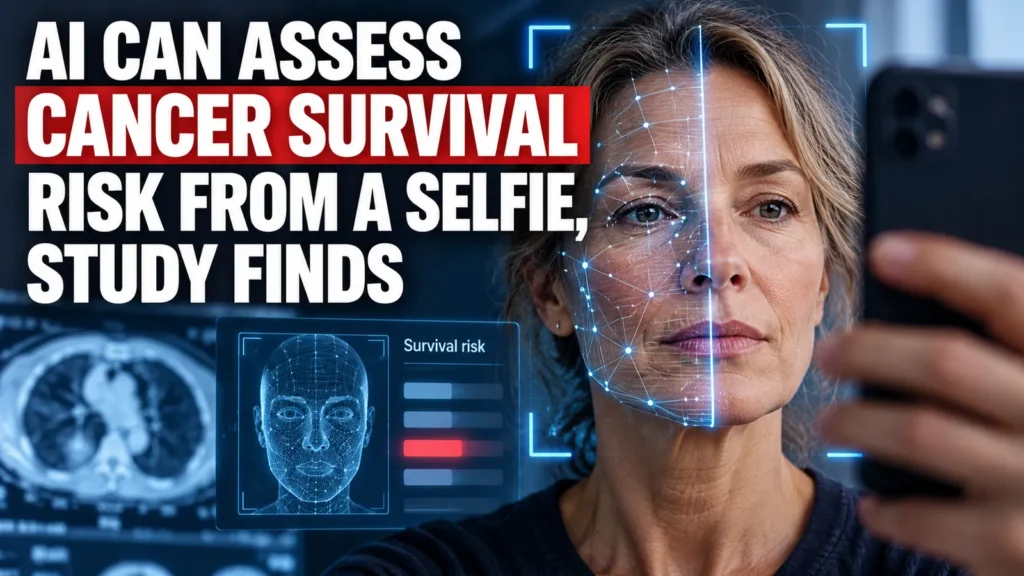
Scientists in the United States have developed an artificial intelligence system capable of analysing a single facial photograph to estimate survival risk among patients diagnosed with cancer. Developed by researchers at Mass General Brigham in Massachusetts, the technology was trained using more than 40 million facial images and could eventually help doctors make better-informed treatment decisions. The findings were published in The Lancet Digital Health on 19 October 2026.
Can a Photograph Really Predict Cancer Survival?
The idea that a simple selfie could reveal something about a person’s chances of surviving cancer sounds extraordinary. However, a new study suggests that artificial intelligence may be capable of recognising subtle facial characteristics associated with underlying health and mortality risk.
Researchers at Mass General Brigham, an academic healthcare organisation affiliated with Harvard Medical School, have developed a system called FAHR-Face, short for Foundation Artificial Intelligence for Health Recognition-Face.
Rather than diagnosing cancer, the system analyses facial features and identifies patterns associated with ageing, physical health and survival outcomes in people already diagnosed with the disease.
The technology could eventually provide doctors with an additional source of information when considering the most appropriate treatment for individual patients.
However, the research does not establish that AI can accurately predict how long any particular person has left to live.
How Does the AI Technology Work?
The researchers trained an AI foundation model on more than 40 million facial photographs, covering a broad range of ages and ethnic backgrounds.
They then adapted the model to perform two different tasks.
FAHR-FaceAge estimates a person’s age from their facial appearance. Researchers examine the difference between this estimated facial age and the person’s actual chronological age as a potential indicator of underlying health.
FAHR-FaceSurvival goes further. It is trained to identify facial patterns directly associated with mortality risk among patients with cancer, without first calculating their estimated age.
The survival model was fine-tuned using 34,363 photographs of cancer patients.
Although the two systems use the same underlying AI technology, the researchers discovered that they concentrate on different parts of the face.
FAHR-FaceAge pays particular attention to forehead features, temples and the folds running between the nose and mouth.
FAHR-FaceSurvival focuses more closely on areas beneath the eyes and around the bridge of the nose.
Importantly, the two models appear to capture different information. Researchers found that combining their results improved predictions of survival risk compared with relying on either measurement alone.
What Did the Study Discover?
The results suggest that facial appearance can provide statistically significant information about survival outcomes.
Among cancer patients receiving radiotherapy in the United States, those whose estimated facial age exceeded their actual age by at least five years had a 21% higher relative risk of death during an average four-year follow-up period.
Patients who appeared at least five years younger than their chronological age had a 17% lower relative risk.
The separate FAHR-FaceSurvival model produced an even stronger distinction between patient groups.
After adjustment for clinical prognostic factors, patients placed in the highest-risk quarter had an estimated mortality hazard approximately 3.23 times that of patients in the lowest-risk quarter.
The results were also examined using an independent cancer patient dataset.
These findings suggest that facial analysis can identify meaningful differences in risk, potentially providing information beyond conventional clinical assessments.
However, the figures describe statistical differences between groups, not a person’s individual probability of dying.
A 21% increase in relative risk, for example, does not mean somebody has a 21% chance of dying. Their actual prognosis depends on numerous factors, including cancer type, disease stage, treatment and general health.
Why Could This Matter for Cancer Treatment?
One of the most difficult decisions in cancer care involves balancing the potential benefits of treatment against the physical demands it places on the patient.
Two people of the same chronological age can have very different levels of fitness, resilience and ability to tolerate intensive treatment.
An otherwise healthy 80-year-old might cope better with certain procedures than a considerably younger patient with multiple health problems.
Doctors already assess factors such as frailty, physical performance and existing medical conditions when recommending chemotherapy, radiotherapy, surgery or other treatments.
The researchers believe AI-based facial analysis could eventually provide additional evidence to support those assessments.
Dr Raymond Mak, a radiation oncologist at Mass General Brigham and a corresponding author of the research, explained that the objective was to improve the consistency and scalability of health assessments.
He emphasised that the technology should support clinical decisions rather than replace doctors’ judgement.
If future studies demonstrate that the technology improves clinical decisions, a relatively inexpensive photograph could become another tool available to medical teams.
This could be particularly useful where more complex assessments are difficult to access.
Lifestyle Choices May Also Leave Detectable Patterns
The researchers found associations between estimated facial ageing and several lifestyle factors.
Smoking, heavy alcohol consumption and drug use were linked to facial appearances that the AI assessed as older.
Smoking showed a particularly consistent pattern, with current smokers generally receiving older facial-age estimates than former smokers, who in turn tended to appear older than people who had never smoked.
These results do not establish that a facial photograph can reliably identify an individual’s habits.
Nor do they mean that everyone who appears older than their chronological age is unhealthy.
Facial appearance is influenced by genetics, environment, illness and numerous other factors. The AI identifies statistical relationships rather than proving what caused them.
The researchers also tested how the age-estimation system responded to differences in lighting, facial expression, makeup and photographic angle, finding that its predictions were relatively consistent across these variations.
What Are the Limitations?
Despite the encouraging findings, there are important reasons for caution.
The research involved analysing patient photographs and recorded outcomes. It has not yet demonstrated that using AI facial predictions to guide real-world cancer treatment improves survival or quality of life.
The models assessed mortality risk among people with cancer, rather than exclusively predicting deaths caused by cancer itself.
Another important limitation concerns individual accuracy.
FAHR-FaceAge achieved an average absolute age-estimation error of approximately 5.1 years on public testing datasets. This was better than the comparison models examined, but it illustrates why an individual reading should not be treated as an exact measurement of biological age.
The research also raises questions about how consistently facial-analysis technology performs across different populations.
Although the study reported encouraging results across demographic subgroups, further independent testing will be needed to examine fairness, reliability and possible bias.
Finally, the precise biological mechanisms connecting facial features to survival outcomes are not fully understood.
An AI model may identify patterns that are statistically meaningful without establishing why those patterns exist.
That makes careful clinical validation particularly important before its predictions influence treatment decisions.
Could AI Facial Analysis Create Privacy Concerns?
The research also raises broader questions about the use of facial recognition technology in healthcare.
A photograph is usually treated as an image of a person’s appearance. But if increasingly sophisticated AI can extract information associated with health and mortality risk, facial photographs could become a potentially sensitive source of medical information.
This raises questions about consent, storage, security and whether such systems could eventually be used outside healthcare.
For example, safeguards would be needed to prevent unvalidated health predictions from being misused by employers, insurers or other organisations.
These are potential risks rather than documented abuses involving FAHR-Face, but they deserve consideration as the technology develops.
Researchers have already launched a public-facing FaceAge research project allowing volunteers to contribute photographs and receive research-based facial-age assessments.
Participation in such research is different from receiving a medically validated assessment of cancer prognosis.
When Might the Technology Be Used in Hospitals?
There is currently no confirmed timetable for routine clinical adoption.
Before the technology could become part of standard cancer care, researchers would need to demonstrate that its predictions remain reliable in broader patient populations and that using them leads to better treatment decisions.
Its performance would also need to be evaluated against established clinical assessment methods.
The potential attraction is clear: facial photographs are inexpensive, non-invasive and relatively easy to capture.
Unlike some medical tests, they do not require specialist imaging equipment, blood samples or laboratory processing.
However, convenience alone is not enough to justify clinical adoption.
The important question is whether the additional information genuinely improves patient care.
A Significant Development, but Not a Crystal Ball
Artificial intelligence is increasingly being investigated for applications in healthcare, from analysing medical scans to identifying patterns in complex patient records.
The FAHR-Face study suggests that even ordinary facial photographs may contain measurable information associated with a person’s health.
Its most significant finding may not be that AI can estimate cancer survival risk from a selfie, but that facial analysis could eventually complement traditional medical assessments using little more than a camera.
Nevertheless, there is a substantial difference between identifying statistical risk patterns and accurately predicting the future of an individual patient.
For people living with cancer, the research offers a potentially promising development, not a definitive prognosis.
The technology may one day help doctors make more personalised treatment decisions. For now, it remains an experimental approach that requires further validation before it can be relied upon in clinical practice.