Artificial intelligence is making it easier for people to challenge decisions, demand information and put complaints into writing. For the public bodies receiving those messages, the time saved by the sender can mean considerably more work for the person answering.
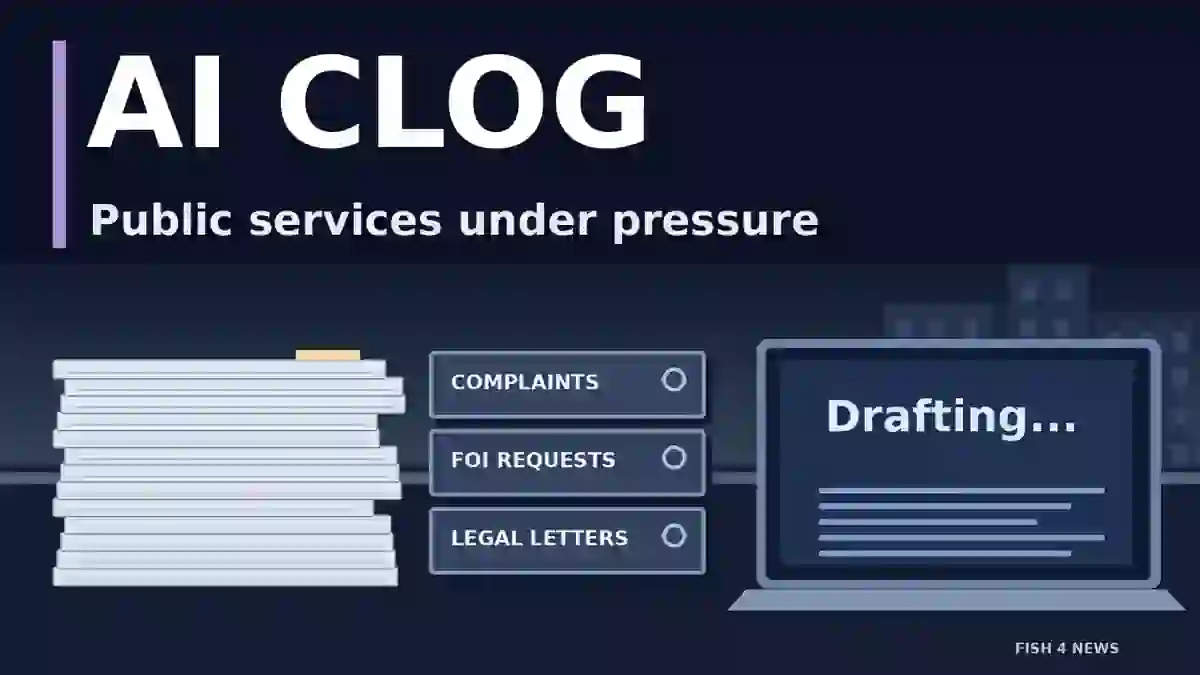
From council offices to MPs’ constituency teams, staff are reporting an increase in long, complex and sometimes inaccurate correspondence they believe was produced with AI chatbots. The phenomenon has been dubbed “AI clog”, but the evidence points to a more complicated story than an automated assault on public services.
Reporting by The Guardian on 8 November documents growing concern among local-government lawyers, caseworkers and other organisations. Official information-rights guidance confirms that AI-assisted requests can create practical difficulties. What remains unproven is how much of the overall increase in correspondence is caused by AI.
Why a simple complaint can become 20 pages
A resident can now describe a missed bin collection, a disputed parking ticket or a planning concern to a chatbot and receive an imposing letter containing legal language and numerous arguments. It may take moments to generate. Public officials still have to establish what happened, identify the actual request and check any legal claims before responding.
Deborah Evans, chief executive of Lawyers in Local Government, told The Guardian that complaints which previously averaged about two pages are now commonly around 20, with one example reaching roughly 200 pages. That is an account from professional experience, not an independently measured national average. Length and polished formatting do not, on their own, prove a message was created by AI.
The risks include irrelevant legal precedents, invented case references and requests so broad that officials must seek clarification. Yet an AI-assisted letter may also present a legitimate grievance that the person would otherwise struggle to express.
What the official figures actually show
Transport for London offers a measurable example. Its 2025/26 information-rights caseload was 4,771 requests, up from 4,005 the previous year, an increase of about 19%. TfL answered 4,769 of the 4,771 within the statutory deadline. These are different measures: 4,769 is the number answered on time, not the number received.
TfL also reported that internal reviews of its freedom of information and environmental information decisions rose from 154 to 224 between 2024/25 and 2025/26. Its Audit and Assurance Committee was told of more appeals apparently prepared using AI, including submissions making technical but inaccurate assertions. However, TfL’s figures do not identify how many requests or reviews were AI-generated, and the higher total cannot automatically be attributed to the technology. See TfL’s September 2026 committee papers and a specialist analysis of the figures.
An important counterpoint comes from Cabinet Office FOI statistics for April to June 2026. Monitored central government bodies received 19,628 requests, 17% fewer than in the same quarter in 2025. The proportion answered in time nevertheless fell from 92% to 87%. These statistics cover central government bodies, not every council or MP’s office, and they do not measure AI usage. They therefore neither confirm nor disprove growing pressure in specific services.
Separately, Ministry of Justice statistics show employment tribunal single claims increased 28% year on year in April to June 2026, with 14,000 received and 70,000 still open at the end of June. Those are verified caseload figures, not evidence that AI caused the increase.
The regulator says the law still applies
The Information Commissioner’s Office issued guidance on 6 May 2026 after hearing from FOI practitioners about longer, less focused requests and legal inaccuracies. It emphasised that its advice does not create new legal rules and that requests should be handled fairly regardless of how they were drafted.
Under existing freedom of information rules, authorities can ask for clarification, explain cost limits, provide advice about narrowing requests and, in appropriate circumstances, apply provisions relating to repeated or vexatious submissions. AI use alone is not a reason to reject a valid information request. The usual response deadline is 20 working days, subject to the law’s applicable exceptions.
The ICO’s detailed guidance also urges requesters to check facts and legal references, ask only for information they actually need and keep their wording clear. That protects the requester as well as the public body.
MPs’ offices are also reporting pressure
The Guardian interviewed parliamentary staff who described increasingly demanding AI-assisted correspondence. Hollie Wickens, a senior caseworker in a Labour MP’s office, estimated that half the office’s incoming emails now involved some form of AI. This is her assessment of one office, not a verified figure for Parliament.
Vonnie Sandlan, who runs the office of Labour MP Graeme Downie, reported staff exhaustion and said her office had stopped replying to automated campaign-email submissions to prioritise constituents’ cases. Such decisions raise a difficult accountability question: mass-produced messages can consume limited staff time, but individual campaigners still have a right to make their concerns heard.
What could reduce the workload?
Authorities are considering structured forms, clearer guidance, more proactive publication of frequently requested information and templates that ask people to specify the decision being challenged and the outcome sought. Some are also exploring AI to summarise material or assist with initial sorting.
Each option brings risks. Strict word limits might prevent someone with a complex social care or housing problem from explaining it fully. Automated filtering could overlook a valid complaint, while paying staff to verify AI-generated legal claims consumes money that cannot be spent on other services. Any use of AI on incoming correspondence requires proper safeguards for privacy, accuracy and human review.
Researchers Chris Schmitz, Lewis Hammond and Alan Chan examined 84 potential examples across 11 jurisdictions of what they call “agentic flooding”. Their study describes risks from increased volume and complexity, but the case collection is not a representative measurement of how frequently AI causes service disruption. They warn that fees or extra hurdles may particularly disadvantage people who need access to government services.
The unresolved question
Public bodies have good reason to want shorter, accurate and focused submissions. Complainants have equally good reason to expect their concerns to be considered on their merits, whether or not a chatbot helped them write them.
The missing evidence is a reliable comparison of request numbers, handling time, error rates and outcomes before and after AI adoption, ideally with a defensible way of identifying AI-assisted material. Until that exists, “AI clog” is a useful description of a reported administrative problem, not proof that legitimate public challenges are becoming an abuse of the system.
Sources
- The Guardian, 8 November 2026: reported experiences of councils, MPs’ offices and employers
- Information Commissioner’s Office: AI-generated FOI requests guidance announcement
- ICO: detailed FOI and artificial intelligence guidance
- Transport for London: September 2026 Audit and Assurance Committee papers
- Cabinet Office: April to June 2026 FOI statistics
- Ministry of Justice: April to June 2026 tribunal statistics
- Schmitz, Hammond and Chan: Characterizing Agentic Flooding of Government Services