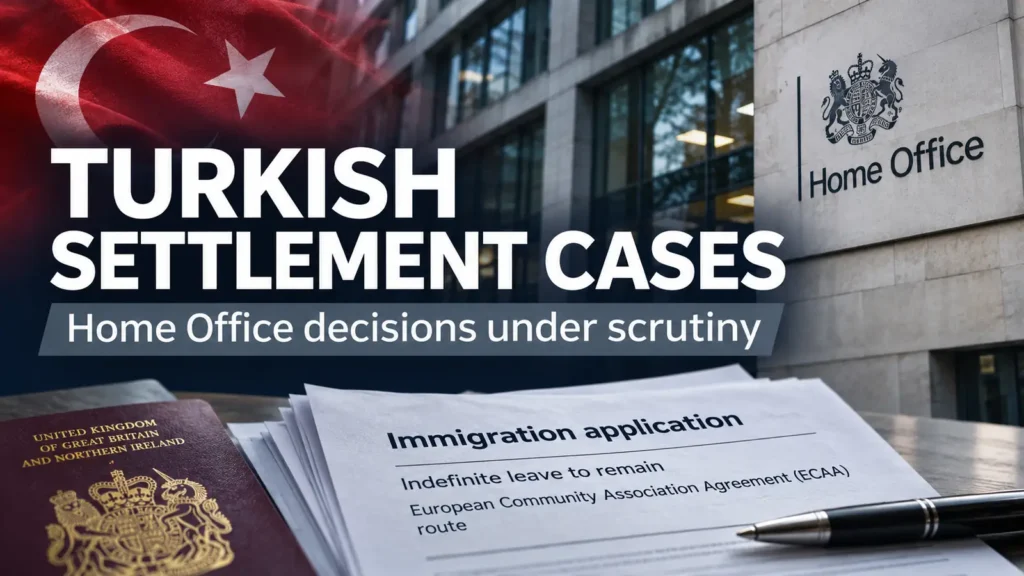
Turkish nationals seeking permanent settlement in Britain are challenging Home Office decisions after a sharp fall in approvals, reports of mistakes in refusal letters and warnings from Labour MP David Lammy about the lessons of the Windrush scandal.
The dispute concerns the European Communities Association Agreement (ECAA) route, under which Turkish businesspeople, workers and eligible family members who already hold qualifying permission can apply for indefinite leave to remain. A refusal can leave families facing profound uncertainty, but the cases reported so far do not establish that a new policy has been secretly introduced or that everyone refused has been removed from Britain.
Settlement grants down 78%, but what does that figure prove?
According to Home Office figures reported by the Guardian on 8 November, 745 ECAA applicants were granted settlement between January and June 2026, compared with 3,378 in the same six months of 2025. That is a fall of 2,633 approvals, approximately 78%. The figures are drawn from the department’s published immigration statistics, with the ECAA route identifiable in detailed settlement table Se_D02.
The drop is substantial, but a fall in the number of grants is not the same as a measured 78% rise in the refusal rate. To calculate a refusal rate reliably, the number and outcomes of decisions, the relevant applications and the period they relate to must be established. The Home Office told Parliament on 19 October that the published settlement table does not provide the requested breakdown of rejected or contested ECAA cases or their processing times. The underlying figures can be found through the Home Office settlement data tables.
An additional freedom of information response cited by the Guardian shows the number of ECAA administrative reviews rising from 145 during the whole of 2025 to 395 from January to mid-August 2026. These figures concern challenges to decisions, and cover unequal time periods. They are not a count of successful appeals or proof that every refusal was wrong.
What errors have been reported?
The Guardian describes a refusal that was subsequently overturned after the department questioned a window-cleaning business for lacking a website or social media presence and said full bank statements had not been provided. The published ECAA rules require a genuinely operating and viable business, but do not impose a general requirement for every business to maintain a website or social media account. Evidence about a business can be examined, but the absence of an online profile is not itself a published settlement condition.
The newspaper also reports a case in which an applicant’s absences from the UK were incorrectly counted as exceeding the 180-day threshold, alongside contested decisions involving serious illness and family care. Those accounts raise questions about evidence handling and the application of discretion. They are reports about individual cases, not independent findings that the entire ECAA decision-making system is unlawful.
One woman who reportedly began cancer treatment in Turkey after a diagnosis during the pandemic was told in October that she and her three children should leave the UK, despite clinical advice cited in her case. Another applicant was reportedly refused after spending time caring for a father with terminal Alzheimer’s. The full files and legal outcomes of these cases are not publicly established, so the reported circumstances should not be treated as final judicial findings.
What the immigration rules actually say
The Home Office’s ECAA settlement guidance generally requires five years of qualifying continuous residence, language and Life in the UK requirements, suitability checks and, for business applicants, evidence of a genuine, viable business that they intend to continue operating. The rules differ in detail for workers and family members.
Under Appendix Continuous Residence, absences exceeding 180 days in a 12-month period can ordinarily break continuous residence. However, specified absences are disregarded, including some caused by pandemic travel disruption and compelling or compassionate personal circumstances such as a life-threatening illness affecting the applicant or a close family member. Whether those exceptions apply depends on the facts and evidence of each case.
The latest ECAA caseworker guidance located for this report was updated in November 2025 to reflect a replacement of the previous general refusal framework with Part Suitability. That documented guidance update is not, by itself, evidence of a new rule requiring social media accounts or an across-the-board withdrawal of compassionate exceptions.
What David Lammy and the Home Office have said
David Lammy, the Labour MP for Tottenham and a former foreign secretary, said constituents had contacted him after settlement decisions disrupted their families’ lives. He said their experiences brought the Windrush scandal to mind and called for the department to revisit the lessons learned from it. His comparison is a political warning about decision-making and fairness, not a finding that the current cases are legally identical to Windrush.
The Windrush Lessons Learned Review and subsequent monitoring criticised inconsistent evidence standards, a lack of compassion and failures to use discretion. Recommendations included clearer instructions on proof, greater contact with applicants and stronger safeguards for vulnerable people. These are pertinent standards by which to assess the new complaints, although an independent review of the Turkish ECAA cases has not established a repeat of the earlier scandal.
In its response to the Guardian, the Home Office said there had been no change in how ECAA settlement applications were considered. It maintained that every case continued to be decided according to its individual circumstances and the published rules and guidance.
The department had previously acknowledged in June a higher-than-forecast number of ECAA applications, many containing complex evidence, and said additional resources had been assigned to reduce delays. The service standard was six months. In its 19 October parliamentary reply, it said decisions were running well above average weekly intake and the outstanding caseload had fallen considerably.
Has the policy changed?
The government has consulted on a broader system of ‘earned settlement’, including possible changes to qualifying periods. However, a parliamentary answer in February 2026 explicitly stated that the ECAA extension and settlement rules would continue to apply while consultation responses were assessed. A proposal about future settlement eligibility is not proof that the Home Office lawfully applied different requirements to the cases described here.
Lawyers interviewed by the Guardian say that applications lodged from September 2025 were treated more harshly, especially where compassionate circumstances were involved. That is a claim about casework practice. The department denies changing its approach, and the available published figures cannot on their own establish whether the fall in grants reflects more refusals, a backlog, changes in applicant volumes or a combination of factors.
What remains unanswered
The most important outstanding questions are how many ECAA settlement applications have been refused since September 2025, what proportion of those decisions have been overturned, whether any internal assessment criteria changed and whether the department has systematically reviewed the reported errors. The Home Office has not supplied that complete breakdown in the parliamentary answers examined for this article.
For applicants, the distinction matters. A disputed refusal is serious, but a reported mistake is not automatically an established systemic breach, and a refusal of indefinite leave does not by itself demonstrate that a person has already been deported. Scrutiny of the actual decisions, review outcomes and published rules is needed to determine the scale and cause of the problem.
Sources
- The Guardian, 8 November 2026: ECAA settlement refusals and reported case errors
- Home Office: Immigration system statistics, settlement detailed table Se_D02
- UK Parliament: ECAA decisions, disputed cases and processing, answered 19 October 2026
- UK Parliament: ECAA processing delays, answered 11 June 2026
- Home Office: ECAA caseworker guidance
- Immigration Rules: Appendix Continuous Residence
- UK Parliament: ECAA rules and proposed earned settlement
- Windrush Lessons Learned Review progress update