Mary Peltola remains ahead in Alaska’s unresolved US Senate election, with one set of figures placing her just below 50% and another displaying slightly more than 50%. The difference comes largely from how write-in votes are included in the calculation, not from two competing vote counts. A separate question about skipped rankings means neither percentage alone settles the result.
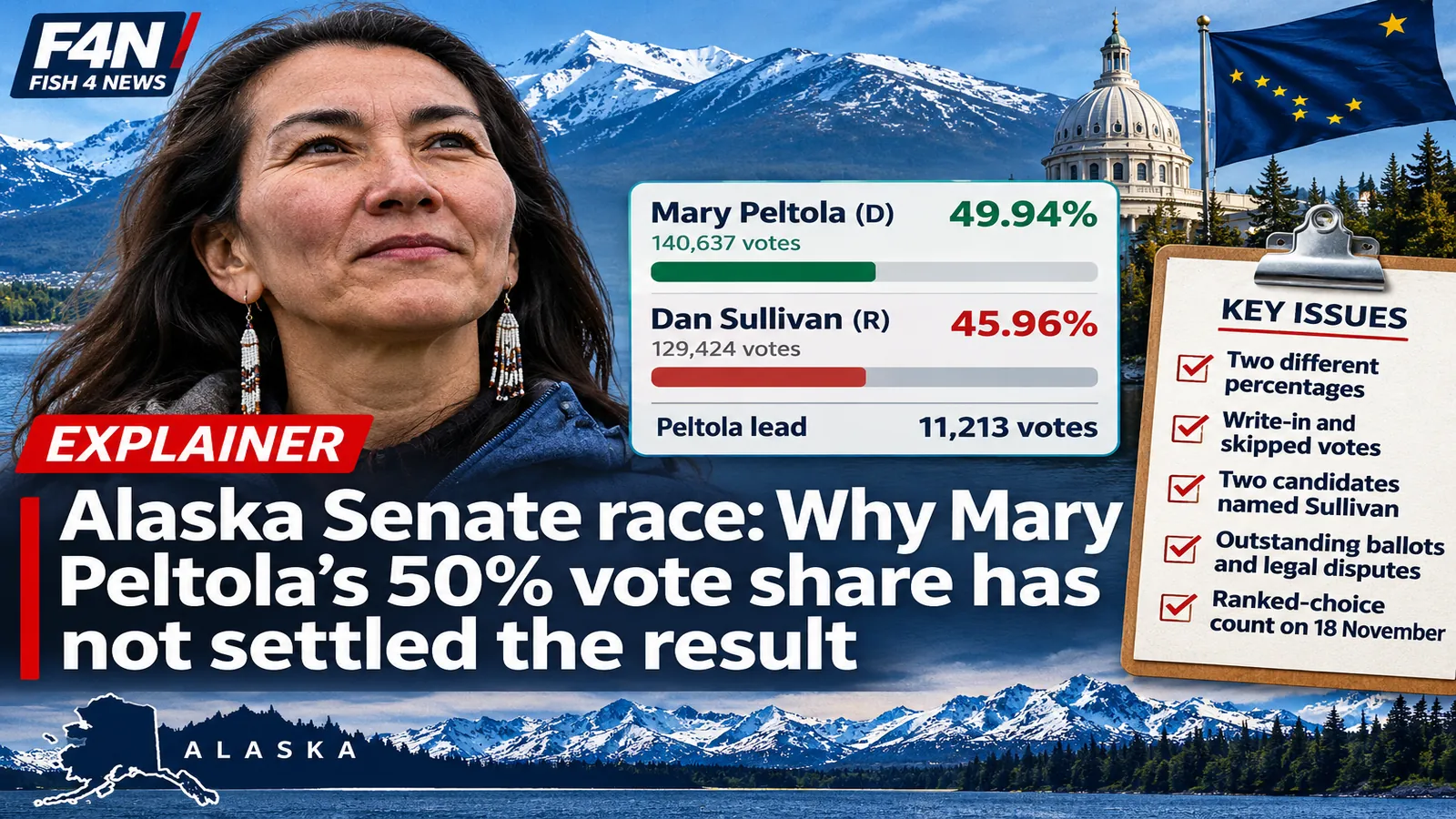
Count checked Monday 16 November 2026. Figures below are from the state’s 14 November unofficial first-choice update, not a completed ranked-choice tabulation or certified election result.
The Democrat is challenging Republican incumbent Dan S. Sullivan. With the state’s official results portal still marked unofficial, and ranked-choice tabulation scheduled for Wednesday 18 November if necessary, the unresolved majority calculation has prompted understandably different headlines. Here is what the figures do, and do not, show.
What is the latest Alaska Senate vote count?
| Candidate | First-choice votes | Share with write-ins |
|---|---|---|
| Mary Peltola (Democrat) | 140,637 | 49.94% |
| Dan S. Sullivan (Republican incumbent) | 129,424 | 45.96% |
| Gerald L. Heikes (Republican) | 6,002 | 2.13% |
| Daniel J. Sullivan Jr. (no party label) | 4,652 | 1.65% |
| Write-in votes | 872 | 0.31% |
| Total | 281,587 | 100% |
Peltola leads the incumbent by 11,213 first-choice votes. The reported percentages are rounded, so they may not add to exactly 100%. The totals include ballots counted at this stage and are subject to revision as more qualifying ballots are processed.
Why does one result show 49.94% and another show 50.1%?
The answer is the denominator, meaning which votes are included when working out each candidate’s share. The state’s complete first-choice summary includes 872 write-in votes among 281,587 votes. Divide Peltola’s 140,637 first choices by 281,587 and her share is 49.94%.
A separate results display excludes those 872 unresolved write-ins from its displayed candidate-percentage calculation. That leaves 280,715 votes in the denominator. Peltola’s 140,637 divided by 280,715 is approximately 50.1%. Her underlying vote count is unchanged.
Alaska’s election rules permit unresolved write-in rankings to be excluded from ranked-choice processing under specified conditions. But a percentage shown in an election-night-style display is not itself the legally final determination of whether a candidate has earned a first-round majority. The Division of Elections expressly distinguishes its summary of first choices from the formal ranked-choice tabulation.
The Division of Elections publishes explanations of how unresolved write-ins, continuing ballots and inactive ballots are handled. These technical definitions explain why a rounded headline percentage is not the same thing as an official declaration of victory.
How far short of the 50% mark is Peltola?
On the complete first-choice tally including write-ins, 140,794 votes would be required to exceed half of the 281,587 counted votes. Peltola has 140,637, so she is 157 votes short of that particular mathematical threshold. That is a snapshot using the summary-report denominator, not a ruling that exactly 157 more votes would make her the winner after all ballot adjustments.
There is a second complication. Some voters left their first ranking blank but selected a candidate further down the ballot. Under Alaska’s rules, a single skipped ranking can move the next valid ranking up, so a formal first-round calculation may recognise votes not displayed as first choices in the simple summary. Alaska News’ analysis of the state’s ballot-level file identified roughly 350 such ballots and estimated that accounting for them and write-ins left Peltola about 250 votes short under its interpretation. That is the outlet’s calculation, not an official tabulation.
The useful distinction is between a published first-choice summary, an election display’s percentage calculation and the formal count of active ballots required by Alaska law. Those should not be presented as interchangeable.
What about the two candidates called Sullivan?
The incumbent is Dan S. Sullivan, the Republican US senator. The other candidate is Daniel J. Sullivan Jr., a retired teacher who appeared on the general-election ballot without a party designation. They are different people and their votes were recorded separately.
Even adding their first-choice totals together does not put them ahead of Peltola. The incumbent’s 129,424 votes plus Daniel J. Sullivan Jr.’s 4,652 equal 134,076. That is 6,561 fewer than Peltola’s 140,637.
For an even more demanding hypothetical, add the 6,002 first-choice votes for fellow Republican Gerald Heikes to both Sullivans. The combined figure would be 140,078, still 559 below Peltola on the 14 November snapshot.
These additions are illustrations, not the ranked-choice result. Votes for another candidate do not automatically transfer to someone of the same surname or party. A ballot can rank Peltola next, rank the incumbent, rank someone else or contain no further valid preference. The allocation depends on what each voter actually marked.
Why was the second Sullivan’s candidacy disputed?
Alaska election officials initially sought to keep Daniel J. Sullivan Jr. off the ballot amid concerns about his reasons for standing. He challenged that exclusion successfully, and the state Supreme Court allowed him to remain on the ballot. Reporting by PolitiFact details the distinction between the senator and the namesake candidate.
President Donald Trump, Republican officials and others alleged that the second candidacy was intended to confuse voters and harm the incumbent. News reports have also described allegations that individuals connected to Democratic political groups encouraged him to run. Those allegations are disputed; they are not proof of criminal wrongdoing by Peltola or her campaign. Investigations announced by authorities are separate from an established finding of guilt.
The US Justice Department filed a federal lawsuit seeking restrictions on certification if allegedly confused votes could affect the outcome. US District Judge Sharon Gleason dismissed the case on 1 November, and the government appealed. Dismissal did not decide every allegation about the candidacy, but it denied the requested pre-election intervention. Read our report on the federal certification lawsuit. Alaska Public Media reported that the Justice Department’s appeal was not proceeding on an expedited timetable.
And what happened to Peltola’s separate absentee-ballot lawsuit?
Peltola’s campaign brought a different case seeking information on absentee ballots that election staff had provisionally marked for rejection. It argued that access could help ensure lawful ballots were counted. State officials said the requested working records included sensitive information and that producing a revised report during counting would disrupt administration.
On 11 November, Alaska Superior Court Judge Thomas A. Matthews granted summary judgment in favour of the Division of Elections. He ruled that the observer details report sought by the campaign was not a public record that had to be disclosed, and that the state was not required to create a new report from its voter-records system in the middle of the count. The court did not rule that the Senate election had been won by either candidate.
That means our earlier report on Peltola’s records lawsuit now has a substantive outcome. The legal case concerns access to provisional ballot data, not proof that particular ballots were wrongly rejected. It should not be conflated with the separate federal case about the two Sullivans.
Will Alaska need ranked-choice voting on 18 November?
If no candidate has a majority under the first-round rules when the eligible ballots have been processed, Alaska will conduct ranked-choice rounds. The candidate with the fewest votes is eliminated and ballots with a valid next preference for a continuing candidate are transferred. Rounds continue under the state’s procedure until two candidates remain, except where a candidate wins a majority in the first round.
A ballot that has no valid further ranking may become inactive or exhausted; it is not automatically awarded to the remaining candidate. That is why adding up candidates’ first-choice totals is not a substitute for processing the actual ranked ballots.
The FairVote ballot scenario tool models possible outcomes using available cast-vote records, but it is an independent illustration and not an official count or race call. The Division of Elections says its ranked-choice results will be released on 18 November for contests that require them.
Which votes are still outstanding?
Alaska continues to process eligible late-arriving and reviewed ballots. Voting in remote areas, absentee applications and ballots cast by people whose eligibility must be checked can require additional verification. The deadline for qualifying overseas ballots to arrive is 18 November.
As long as votes remain to be added, both the total number of valid ballots and the majority threshold can change. No responsibly sourced account should treat the 157-vote figure, or the independent estimated 250-vote gap, as a fixed target for the rest of the count.
What we know and what remains unknown
- Confirmed: Peltola had 140,637 first-choice votes to the incumbent’s 129,424 in the 14 November state update, a lead of 11,213.
- Confirmed: Including 872 write-in votes yields 49.94% for Peltola; excluding them from the displayed percentage yields about 50.1%.
- Confirmed: Peltola’s first-choice vote total exceeds the votes for both Sullivan candidates combined by 6,561 in that snapshot.
- Confirmed: The federal certification case was dismissed and appealed; the separate absentee-records case was decided against Peltola’s campaign on 11 November.
- Not yet established: Whether Peltola meets the first-round majority once all eligible ballots and valid rankings are processed.
- Not yet established: The final distribution of any ranked-choice transfers or the certified vote totals.
- Not established by these cases: That the presence of two Sullivans changed the eventual winner or that election officials improperly counted particular ballots.
What happens next?
- 16 November: Further unofficial results may be released as ballot counting continues.
- 18 November: Deadline for qualifying overseas ballots and scheduled ranked-choice tabulation if required.
- 25 November: Target date for state certification. The timetable can change if legal or administrative issues require it.
The latest authoritative checkpoint is the Alaska Division of Elections results page. A candidate’s victory statement, an unofficial lead, a news organisation’s race call and a certified result are different things. Fish 4 News will report the outcome separately once it is confirmed by an authoritative source.
Read the full Fish 4 News Alaska election coverage
- Peltola campaign’s lawsuit over rejected absentee-ballot records
- Federal court rejects bid to delay Alaska Senate certification
- US midterm election results: Senate, House and outstanding contests
Sources and primary documents
- Alaska Division of Elections: 2026 general election unofficial results, definitions and count schedule
- Alaska Division of Elections: ranked-choice voting procedures
- Alaska Superior Court: Alaskans for Mary v Dahlstrom, 11 November 2026 order (PDF)
- Alaska Public Media: Peltola’s count and the two Sullivan candidates
- Alaska News: analysis of differing majority calculations from ballot-level data
- PolitiFact: election litigation and the two Sullivan candidates
- FairVote: independent interactive ballot scenarios (not an official result)