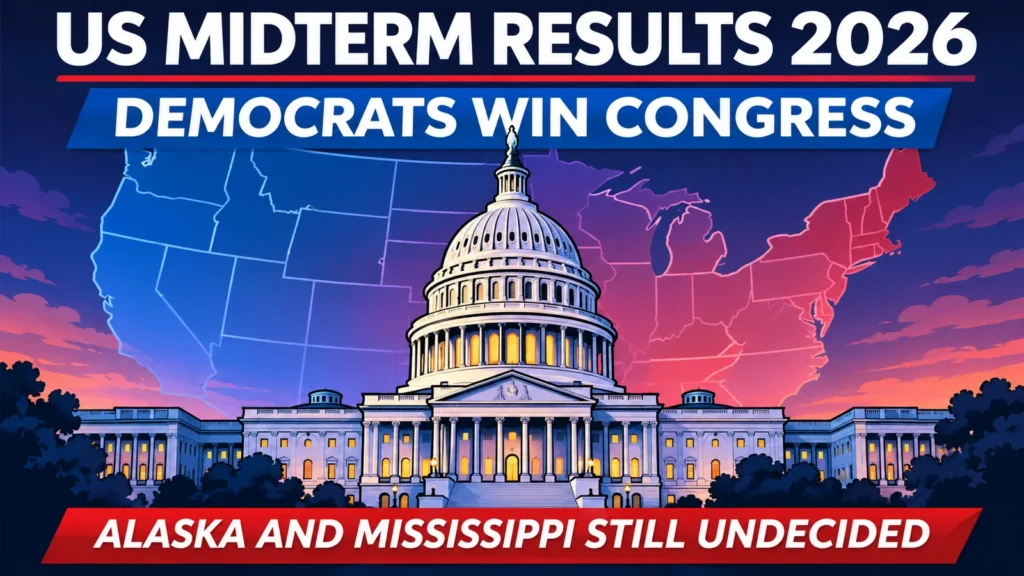
Democrats are set to control both the US Senate and House of Representatives after the 2026 midterm elections, giving President Donald Trump a newly elected opposition-led Congress. The outcome is clear, but tight contests in Alaska, Mississippi and several House districts mean the final numbers are still being determined.
Results update: Monday 9 November 2026, UK evening. Figures below are projected or unofficial unless explicitly stated otherwise. They will change as further votes are counted and states certify results.
The election on Tuesday 3 November saw Democrats gain seats in Republican strongholds, securing the 218 House seats necessary for a majority and at least 54 seats in the 100-member Senate, counting two independents who caucus with Democrats. Neither chamber’s newly elected membership takes office until January 2027. The Associated Press and Reuters have independently reported the change of control.
US midterm election results: who controls Congress?
| Institution | Democratic side | Republican side | Outstanding |
|---|---|---|---|
| Senate (100) | 54 seats projected, including two Democratic-caucusing independents | 44 seats projected | 2 seats: Alaska and Mississippi |
| House (435) | Democratic majority secured; more than 250 seats projected | Final total not yet settled | Numerous races uncalled; counts and network calls differ |
| Governors (50) | 28 projected Democratic governors | 20 projected Republican governors | Alaska and Kansas were still uncalled in the latest AP statehouse overview |
These figures describe the incoming elected institutions, not current officeholders. The Senate numbers include senators whose seats were not up for election. House calls can be revised and additions may be made between updates. AP’s House results and Senate results provide ongoing state-by-state comparisons.
Senate: Alaska and Mississippi still too close to call
The Democratic caucus already has enough seats to take control of the Senate, but the final margin will depend on two uncalled Republican-held states. A narrow first-choice lead is not a declared victory.
Mississippi: Democrat Scott Colom was leading Republican senator Cindy Hyde-Smith by 2,574 votes, 467,930 to 465,356, in the AP count reported on Monday. Colom had approximately 49.1% to Hyde-Smith’s 48.8%, with independent Ty Pinkins taking around 2.1%. Voters’ affidavit ballots still require eligibility checks, while certain postal ballots postmarked by election day can arrive until Tuesday 10 November. Counties are due to certify by Friday 13 November. Mississippi has no automatic recount procedure in this contest; a losing candidate seeking to challenge the result may have to go to court. Reuters reported the ballot dispute and the Washington Post reported the latest county deadlines.
Alaska: Democrat Mary Peltola held a very narrow first-preference lead over Republican incumbent Dan S. Sullivan. An AP-based tally displayed on Monday put Peltola on 102,962 votes and Sullivan on 102,325, a margin of 637, with an estimated 74% of votes counted. The totals do not represent a final ranked-choice result. If no candidate has a majority of first choices, preferences from eliminated candidates will be redistributed. Alaska plans its official ranked-choice tabulation for 18 November, after eligible later-arriving ballots have been processed. Reuters explains the process; Alaska’s Division of Elections publishes official counting material.
Alaska’s count has an additional legal dimension. The Trump administration sought to prevent certification in certain circumstances, alleging potential confusion between the incumbent Dan S. Sullivan and another candidate with a similar name, Daniel J. Sullivan. A federal judge dismissed the administration’s lawsuit and an appeal was filed. That dispute does not mean the result has been set aside. Fish 4 News previously reported the judgment and appeal.
House: Colorado projected for Democrats as other races remain unresolved
Democrats have already secured control of the 435-seat House, although the precise size of their majority is still changing. In the outstanding seats, some candidates are ahead without a formal race call, while two Louisiana contests are heading to runoffs.
Colorado’s 4th District is especially significant. Democrat Eileen Laubacher was ahead of Republican congresswoman Lauren Boebert by around 3,200 votes on Monday, approximately 49% to 48%, at a time when the race had not yet been projected by CNN. Laubacher attended orientation for new members of Congress but that does not establish that she has won. Boebert’s campaign has raised concerns about alleged unusual voting patterns without publicly providing specific evidence. Colorado election officials say ballots are being processed lawfully; the secretary of state’s office said it had not been contacted about the allegations. Counties have deadlines for ballot signature corrections on 12 November, the initial count on 13 November and canvass certification by 25 November. Axios reported Monday’s count; election officials’ response was reported by Democracy Docket.
Update, Monday 9 November 2026: CNN’s Decision Desk has projected that Democrat Eileen Laubacher will defeat Republican incumbent Lauren Boebert in Colorado’s 4th Congressional District. The preceding figures describe the count before that projection. Counting and certification are not yet complete, so this is a media projection rather than an officially certified result. Read Fish 4 News’ separate report on Boebert’s projected defeat and Laubacher’s lead.
Maine’s 2nd District also remains technically unresolved. Republican Paul LePage was ahead of Democrat Matt Dunlap by 5,418 first-preference votes. Dunlap conceded, but LePage did not pass 50% of initial ballots, so Maine began its ranked-choice tabulation on Monday 9 November. A concession is not the same as a completed state count. Maine Public explains the distinction.
Other uncalled House contests identified by CBS News include Alaska’s at-large district, parts of California, several Florida and North Carolina districts, Minnesota’s 1st District and Washington’s 5th District. In Louisiana, the 5th and 6th congressional districts are scheduled for 12 December runoffs.
Which governor and state legislature results matter?
Democrats have also made large state-level gains. A fresh AP call on Monday 9 November gave them the Georgia state House after more than two decades of Republican control. AP had called 91 seats for Democrats and 86 for Republicans, with three still unresolved. Republicans retained the state Senate, so Georgia will have divided legislative control despite Democrat Keisha Lance Bottoms winning the governor’s office.
Across the country, Democrats had gained control of at least 12 state legislative chambers, according to AP and the nonpartisan National Conference of State Legislatures. Gains were recorded in states including Arizona, Michigan, Minnesota, New Hampshire, North Carolina, Pennsylvania, Texas and Wisconsin. Results in Alaska’s legislature and North Carolina’s Senate remained unsettled.
The National Conference of State Legislatures reported Democrats projected to hold 28 governorships and Republicans 20, with Alaska and Kansas remaining uncalled at that checkpoint. Changing governorships and legislative majorities could affect policy on education, healthcare, taxation and elections. These outcomes are separate from control of the federal Congress.
What happens next for Donald Trump and the incoming Congress?
Democrats will be able to set committee agendas, scrutinise the administration, control legislation brought to votes in the House and exercise greater influence over Senate confirmation of presidential nominees. But Trump remains president, retains a veto over legislation and neither party has the two-thirds majority ordinarily needed to override a veto unilaterally.
Trump has criticised the results and questioned election integrity in public remarks; allegations of fraud are not proof that an election was improperly conducted. Republican and Democratic leaders are also debating how to respond to voter concerns over living costs, immigration and the administration’s policies. Reuters reported Republican reactions and AP reported the wider political consequences.
Democratic leaders have spoken about increased congressional oversight, while some incoming members have cautioned that investigations must be balanced with legislation addressing everyday costs. The newly elected Congress begins on 3 January 2027; until then, the outgoing Congress remains in office.
What dates should voters watch next?
- 10 November: Mississippi’s deadline for eligible late-arriving postal ballots and affidavit ballot processing.
- 12–13 November: Colorado ballot-cure deadline and initial counting target.
- 13 November: Mississippi’s county certification deadline.
- 18 November: Alaska’s planned official ranked-choice tabulation; Maine’s separate ranked-choice process began on 9 November.
- 25 November: Colorado counties’ canvass and certification deadline.
- 12 December: Louisiana House runoffs in districts 5 and 6.
- 3 January 2027: New US Congress convenes.
A projected winner is a news organisation’s judgment based on the available count. A candidate leading an incomplete count has not necessarily won. State certification is the legal process that makes the result official. These distinctions remain important even when national control has already been decided.
Related Fish 4 News coverage
- Democrats win control of the US Senate after major midterm gains
- US midterm election night guide and key races
- Alaska Senate certification lawsuit dismissed
- Keisha Lance Bottoms wins Georgia governor race
Sources
- Associated Press: 2026 US Senate results
- Associated Press: 2026 US House results
- Associated Press: Georgia state House result, 9 November
- Reuters: 2026 election results graphics and analysis
- Reuters: Alaska count and ranked-choice process
- Alaska Division of Elections: official results portal
- Mississippi Secretary of State
- Axios: Colorado 4th District update, 9 November
- CBS News: unresolved congressional races, 9 November
- National Conference of State Legislatures: chamber changes