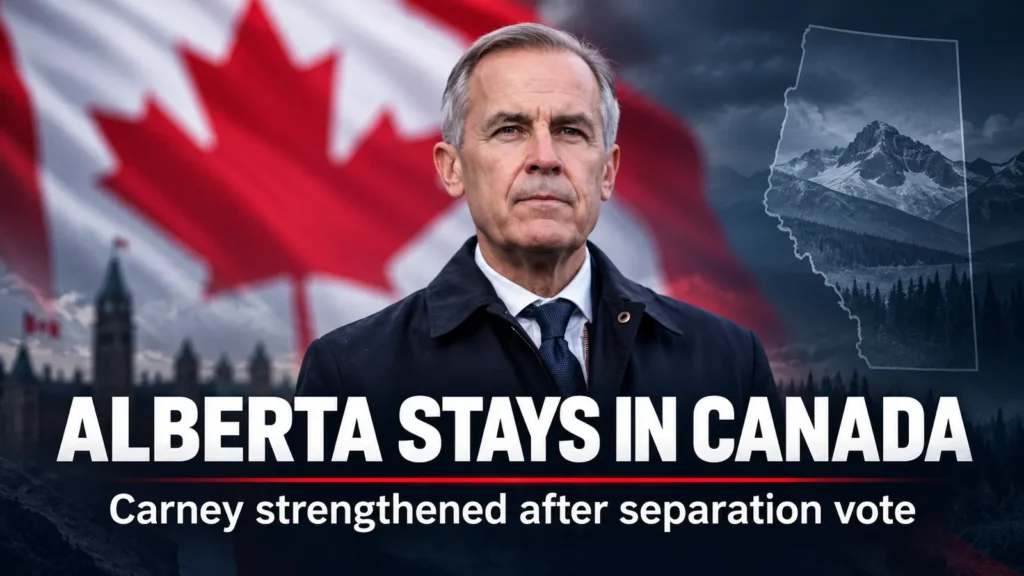
Alberta voters have decisively rejected moves towards independence, delivering a major boost to Canadian Prime Minister Mark Carney as his government confronts Donald Trump’s trade policies and threats to Canadian sovereignty.
Voters in Alberta have overwhelmingly backed remaining part of Canada in a historic referendum held on 19 October 2026, with approximately 75% rejecting a process that could have led towards independence. The result strengthens Prime Minister Mark Carney’s campaign for national unity as Canada faces continuing economic and political pressure from US President Donald Trump.
Alberta Delivers Decisive Rejection of Separation
Unofficial results from Elections Alberta indicate that roughly three-quarters of voters supported remaining in Canada, while around one-quarter favoured beginning the legal process towards a potential independence referendum.
The scale of the result represents a significant setback for Alberta’s separatist movement, which has argued that the energy-rich western province would prosper with greater independence from the federal government in Ottawa.
Crucially, voters were not being asked whether Alberta should immediately leave Canada.
Instead, the non-binding referendum asked whether the province should remain within the country or begin the constitutional process necessary to hold a future, binding referendum on separation.
The distinction matters. Even a victory for the separatist option would not have meant automatic independence.
Official results are expected on 29 October 2026.
Mark Carney: ‘Albertans Chose Canada’
Canadian Prime Minister Mark Carney welcomed the result as a powerful endorsement of national unity.
In an official statement issued on 20 October, Carney declared:
“Above all, Albertans chose Canada.”
He argued that the country could now move forward with renewed ambition, strengthening international trade relationships and developing major national infrastructure projects.
The result carries particular significance because Carney grew up in Alberta, a province historically associated with conservative politics and opposition to federal Liberal governments.
During a campaign rally in Calgary on 15 October, Carney urged voters to defend Canadian unity, warning that division could weaken the country at a time of growing international instability.
His message was clear: Alberta could achieve more as a powerful part of Canada than by pursuing a lengthy and uncertain separation process.
The referendum result provides political support for that argument, although it should not be interpreted as blanket approval for every policy pursued by his government.
What Does Donald Trump Have to Do With Alberta?
Although the referendum concerned Alberta’s constitutional future, it took place against the backdrop of deteriorating relations between Canada and the United States.
President Donald Trump’s tariffs and repeated suggestions that Canada could become America’s 51st state have strained relations between the two longstanding allies.
The comments have also contributed to a renewed debate about Canadian sovereignty and the country’s dependence on its southern neighbour.
For many Canadians, defending their country’s independence has become an increasingly prominent political issue.
Carney has sought to channel that sentiment into a strategy of national unity and economic diversification.
During his Calgary campaign speech, he warned that forces outside Canada’s borders could benefit from the country’s fragmentation.
“Some outside our borders are working to break us so they can own us,” he said.
The prime minister did not directly identify Trump in that particular remark, but the warning came amid repeated US rhetoric about Canada’s future and a continuing trade dispute.
There has also been a controversial American dimension to Alberta’s separatist movement.
Pro-independence campaigners have acknowledged approaching US officials to discuss possible economic relationships involving an independent Alberta.
However, those contacts do not establish that Trump directed the separatist campaign or that his administration formally supported Alberta leaving Canada.
The referendum was not a direct vote on Trump. Nevertheless, the result strengthens the political position of a Canadian prime minister determined to resist external pressure while keeping his country united.
Why Alberta Matters So Much to Canada
Alberta is central to Canada’s energy industry.
The province possesses the overwhelming majority of Canada’s proven oil reserves, alongside substantial natural gas resources and other mineral wealth.
That makes it economically important not only to Ottawa but also to America’s energy supply.
For decades, political disagreements over environmental regulations, energy infrastructure and federal economic policy have contributed to tensions between Alberta and the Canadian government.
Separatist campaigners argue that Alberta’s economic interests have repeatedly been disadvantaged by decisions made in Ottawa.
Their opponents maintain that independence would create considerable legal, financial and economic uncertainty.
Carney has attempted to address some of these grievances by supporting energy infrastructure and efforts to develop additional export routes.
Plans for improved access to Pacific markets are particularly significant because they could allow more Canadian energy exports to reach Asian customers rather than relying heavily on the United States.
The government is also seeking new international trading relationships as it attempts to reduce Canada’s exposure to American tariffs and shifting US trade policy.
A united Alberta is therefore important to Carney’s wider economic strategy.
But keeping the province within Canada is only the beginning. Ottawa must still persuade Albertans that federal policies can deliver tangible economic benefits.
Danielle Smith Rules Out Another Separation Vote
Alberta Premier Danielle Smith, who supported remaining in Canada, has accepted the referendum result and signalled that the separation debate should now end.
In a televised address on 20 October, Smith promised that there would be no further referendum on separation while she remains premier.
She also indicated that Alberta would continue pursuing its interests through political negotiations and the courts rather than using the threat of independence in disputes with Ottawa.
Her position is significant because she called the referendum after growing pressure from separatist campaigners.
Smith now faces the challenge of maintaining support among conservative voters who strongly oppose independence, while acknowledging the grievances of those who favour greater provincial autonomy.
The result may settle the immediate constitutional question, but it is unlikely to eliminate the political frustrations that helped bring the referendum about.
Alberta Has Not Given Ottawa a Blank Cheque
One of the most important details of the referendum is that separation was only one of ten questions put to voters.
The other nine addressed issues including immigration, eligibility for provincial services, voting requirements and proposed changes to constitutional arrangements.
Preliminary results indicate support for several proposals designed to increase Alberta’s control over provincial affairs.
However, the margins were considerably narrower on some constitutional questions, and the results were still being counted.
This creates a more complicated political picture than a simple victory for Canada’s federal government.
Albertans have decisively rejected taking the first formal step towards separation.
But significant numbers of voters also want changes to the relationship between the province and Ottawa.
Those demands will remain politically relevant regardless of the final referendum figures.
Several constitutional proposals would require cooperation beyond Alberta and could not be implemented simply because provincial voters supported them.
Indigenous Treaty Rights Are Also Central to the Debate
The proposed separation raised significant questions for First Nations communities.
Indigenous groups argued that their historical treaties with the Canadian Crown, some of which predate Alberta’s creation as a province, could not simply be disregarded by a unilateral decision to leave Canada.
Earlier legal challenges also raised concerns about consultation and the potential impact of separation on treaty rights.
These issues underline how complicated any actual independence process would have been.
A future constitutional negotiation would have involved far more than an agreement between Alberta’s provincial government and Ottawa.
The referendum result has removed the immediate prospect of such negotiations, but Indigenous rights remain an essential part of discussions about provincial and federal authority.
Has Alberta’s Independence Movement Been Defeated?
The referendum result represents an unmistakable political defeat for those advocating a formal separation process.
However, approximately one in four voters backed the alternative to remaining in Canada.
That is a substantial minority and suggests that dissatisfaction with the existing federal arrangement has not disappeared.
Some separatist campaigners have already indicated that they intend to continue promoting their cause.
The political challenge for Carney and Smith will be to distinguish between voters who genuinely want independence and those who supported the alternative as a protest against Ottawa.
The two groups are not necessarily the same.
A decisive victory for national unity does not automatically resolve disputes over energy policy, taxation, immigration or provincial autonomy.
What Happens Next?
Three developments will determine whether Alberta’s referendum becomes a lasting turning point in Canadian politics.
First, the official results scheduled for 29 October will establish the final voting figures and confirm the outcomes of all ten questions.
Second, attention will turn to how Carney and Smith cooperate over energy development, immigration, trade and federal-provincial relations.
Third, Canada’s continuing dispute with the Trump administration will test whether the political unity displayed during the referendum can translate into a stronger economic negotiating position.
The result gives Carney a significant political advantage.
He can now approach the challenge of managing relations with Washington without an immediate threat of a formal separation process in one of Canada’s most economically important provinces.
However, it does not give him unlimited authority, end Alberta’s disagreements with Ottawa or guarantee success in future trade negotiations.
Alberta has chosen to remain part of Canada. The next test is whether Canadian leaders can turn that unity into lasting economic and political strength.
Sources and further reading
- Elections Alberta: Official referendum information and ballot questions
- Elections Alberta: Unofficial results
- Prime Minister Mark Carney: Official statement, 20 October 2026
- Prime Minister Mark Carney: Calgary rally speech, 15 October 2026
- Reuters: Alberta votes by large majority to remain part of Canada
- Associated Press: Alberta voters reject move towards independence
- Global News: Danielle Smith responds to Alberta referendum