Google parent Alphabet lost roughly $500 billion in stock market value on Thursday, 29 October, after disappointing search advertising results and heavy AI spending raised questions about the economics of its core business.
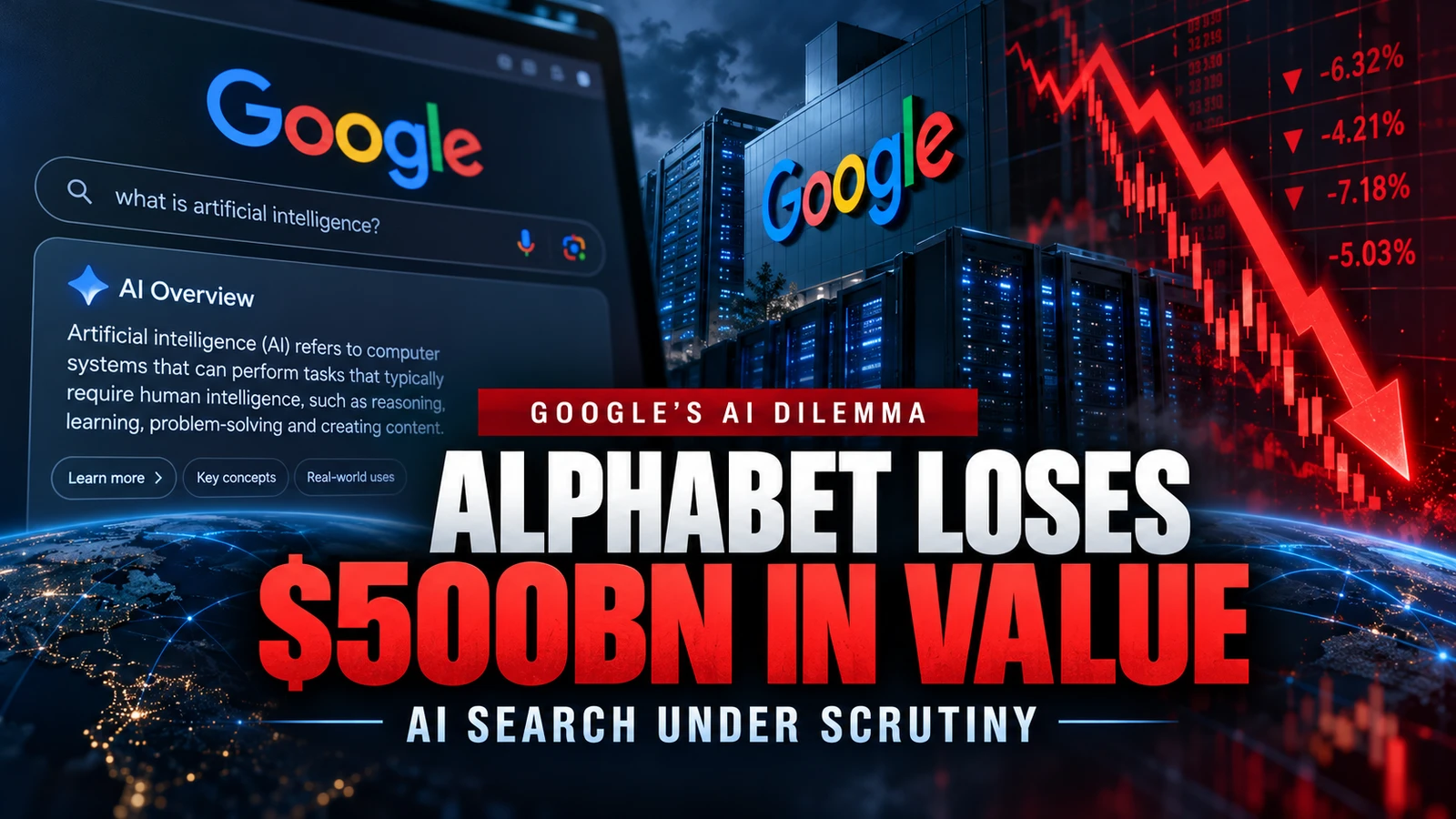
Alphabet’s Class A shares closed 12.6% lower at $283.82, in their steepest single-day decline since the company went public in 2004. The headline figure describes the fall in the market value of its shares. It does not mean Google spent or lost $500 billion in cash.
The share-price collapse also exposed a deeper question: can Google introduce more AI-generated answers to searches without undermining the advertising model that has helped finance its growth?
Why Alphabet shares fell
The sell-off followed Alphabet’s results for the three months to 30 September, released on Wednesday. Total revenue climbed 25% from a year earlier to $127.6 billion, but the company missed market expectations and reported a second consecutive quarter of negative free cash flow.
- Google Search and other revenue: $63.35 billion, up 12% year on year. Growth slowed from 17% in the preceding quarter.
- Google Cloud revenue: $30.71 billion, up 103% year on year.
- Capital expenditure: $51.36 billion in the quarter, against $42.29 billion generated from operating activities.
- Free cash flow: negative $9.07 billion, compared with negative $5.86 billion in the previous quarter.
These figures come from Alphabet’s official earnings release. Capital expenditure includes investment in property and equipment, much of it supporting the company’s AI and computing infrastructure.
Google Cloud’s rapid growth is an important counterweight to the pessimism. Alphabet is attracting significant demand for AI infrastructure and services. But strong demand does not settle how quickly the enormous cost of supplying it will produce returns for shareholders.
There is also an important qualification to the cash-flow figure. Alphabet said a $5.2 billion payment relating to a European Commission fine and a build-up of inventory for sales of its TPU systems reduced operating cash flow during the quarter. The negative free cash flow was therefore not solely the result of investment in AI infrastructure, although capital expenditure remains a central concern for investors.
The problem with answering searches directly
Google’s traditional search business has been built around people looking for information, services and products. Advertisers pay to appear in front of customers who may be ready to buy or make an enquiry.
AI Overviews and AI Mode change that experience. Instead of following several results to find an answer, users can increasingly receive a generated response on the search page itself.
Independent research suggests that this changes how people use results. In a Pew Research Center study of browsing behaviour among 900 US adults in March 2025, users clicked a conventional search result on 8% of visits involving an AI summary, compared with 15% of visits without one. Only 1% of visits involving an AI summary resulted in a click on a cited source within the summary.
That finding is significant for websites and publishers that depend on search referrals. However, it does not by itself establish that AI summaries caused Alphabet’s October revenue shortfall. The study measured browsing behaviour, not advertising revenue, and searches that trigger AI summaries may differ from those that do not.
Fewer website clicks do not automatically mean fewer advertising sales
There is a crucial distinction. Google does not ordinarily receive a payment when someone clicks an unpaid, organic search result. Its search advertising income comes from advertisers buying exposure and customer opportunities.
The commercial danger is therefore more indirect. If AI reduces visits to third-party sites, changes how customers discover businesses or leaves advertisers questioning the return on their campaigns, Google will need to demonstrate that its new search formats remain commercially valuable.
Google is already attempting to address this. Its advertising guidance explains that sponsored placements can appear within or alongside AI Overviews and AI Mode when searches have commercial relevance.
During Alphabet’s 28 October earnings call, chief business officer Philipp Schindler acknowledged that the rapid growth of AI Mode searches had contributed to slower Search revenue growth because advertising monetisation in AI Mode was lower. Schindler said foreign-exchange movements were the single largest reason Search revenue growth slowed compared with the previous quarter. He also cited changes in spending in particular advertising sectors, before identifying lower monetisation in AI Mode as another contributing factor. Alphabet did not disclose how much revenue the AI Mode effect represented. The acknowledgement, recorded in the earnings call transcript, is significant evidence that the commercial transition is already affecting its search business.
Alphabet also says its AI investment is supporting search query growth, including commercial searches. The company reported that year-on-year query growth was its highest in five years. Search revenue is still growing, even though the latest growth rate disappointed investors.
What the $500 billion fall really tells us
The market’s immediate concern was not simply that AI might keep people away from websites. Investors also confronted a business investing tens of billions of dollars every quarter in data centres, chips and related infrastructure while its most established earnings engine delivered weaker growth than expected.
Alphabet’s chief financial officer has signalled that capital expenditure will rise significantly again in 2027, according to Reuters reporting. That raises the stakes for Google’s ability to translate increased use of AI into sustainable profits.
The company faces competing pressures: it must improve AI search to keep users, develop advertising that works in an AI-led experience and spend heavily enough to compete in cloud and AI infrastructure.
What remains unknown
The results do not show that AI has destroyed Google’s advertising model, nor do they prove that fewer organic clicks caused the share-price plunge. Google continues to generate substantial revenue and operating profit.
The questions now are whether advertisers will achieve comparable results from AI-led search, whether publishers can sustain the production of content that search systems rely upon and whether Alphabet’s huge infrastructure investment will deliver adequate returns.
For now, the confirmed story is a historic collapse in Alphabet’s market valuation, against a background of slowing search revenue growth and accelerating AI costs. The longer-term effects on advertisers, publishers and the wider web remain uncertain.
The following day, selling spread across US technology shares. Fish 4 News has also examined the wider Wall Street sell-off and concerns about the cost of AI investment.
Sources
- Alphabet, third-quarter 2026 results (SEC filing, 28 October)
- Reuters, market report (29 October 2026)
- Pew Research Center, AI summaries and search clicks (22 July 2025)
- Google Ads Help, advertising in AI-powered search
- Reuters, Alphabet results and investor reaction (29 October)
- Alphabet earnings call transcript (28 October 2026)