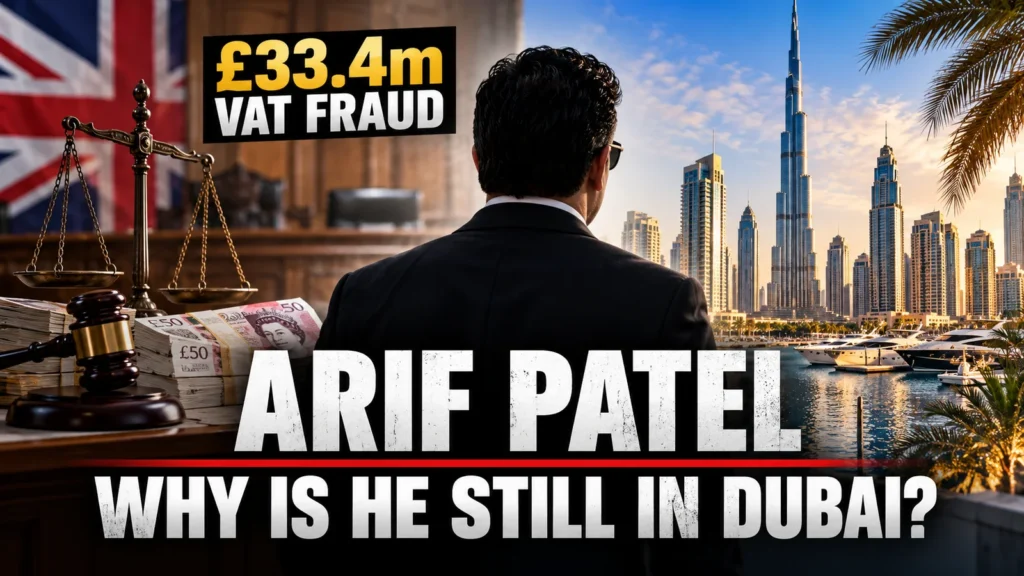
A fresh BBC investigation has traced a convicted British tax fraudster to Dubai, years after he left the UK on bail. The bigger question is not simply where Arif Patel is, but why he has not been brought back to serve a 20-year prison sentence.
Arif Patel, a former Preston businessman convicted over a £33.4 million tax fraud, is still living in Dubai and has not served a day of his 20-year sentence, according to a BBC File on 4 Investigates report published on 24 October 2026. Britain already has an extradition treaty with the United Arab Emirates. So why has he not been returned?
The BBC’s investigation by Ben Robinson and Alys Harte adds new reporting about Patel’s apparent social life in Dubai, websites promoting the name Arif Patel, and questions about his attempts to evade justice. Fish 4 News has separately examined the extradition treaty and official prosecution records to explain what authorities could do next.
What did Arif Patel do?
According to the Crown Prosecution Service (CPS), Patel led an organised criminal operation involving false VAT repayment claims linked to supposed exports of textiles and mobile phones. The gang stole £33.4 million from the government and also traded in counterfeit clothing valued at more than £19 million.
Investigators said the wider VAT fraud had targeted up to about £90 million in public funds. That is an attempted fraud figure, not the amount proven to have been stolen. The gang’s false paperwork and chains of companies were designed to make transactions appear legitimate.
A number of associates were prosecuted. The BBC reports that 24 people involved in the network were convicted, receiving a combined total of more than 116 years in prison.
How was he allowed to leave Britain?
The BBC reports that when Patel appeared at Bolton Crown Court in 2011, he was granted permission by a judge to travel to Dubai while on bail. He left and did not return.
The decision raises an obvious question about whether the original bail conditions adequately accounted for the risk of flight. But the full reasons for the judge’s decision and all the information before the court at the time have not been established in the current reporting. Hindsight alone cannot establish that the decision was unlawful.
Efforts to extradite him subsequently failed, the BBC reports. He was ultimately tried in his absence and sentenced to 20 years in prison in 2023. His imprisonment has still not begun.
Why has Arif Patel not been extradited from Dubai?
There is no publicly confirmed answer to that question. The BBC says earlier efforts to extradite Patel were unsuccessful, but the current status of any formal request, the reasons for any refusal and whether further proceedings are under way have not been publicly established. The UAE authorities did not answer the BBC’s questions.
What can be checked independently is the law. The UK and UAE have had an extradition treaty in force since 2 April 2008. It provides a legal framework for each country to seek the return of suspects and convicted offenders. Dubai is therefore not simply a country without an extradition arrangement.
But a treaty does not mean British police can arrest someone in another sovereign country. The requesting authorities must satisfy the treaty’s requirements, and the UAE must handle any request through its own legal procedures.
Could his trial in his absence be part of the problem?
This is one particularly relevant legal complication, although there is no evidence it has caused a refusal in Patel’s case. Article 4(1)(f) of the UK–UAE extradition treaty says a person convicted in their absence cannot be extradited unless the requesting country assures them of a retrial or an appeal amounting to a retrial.
Patel was convicted while abroad, making that provision potentially important. Whether the UK can offer an assurance that satisfies the treaty in his specific circumstances is a legal question. Neither the existence nor the absence of any such assurance has been publicly confirmed.
The CPS’s general extradition guidance itself warns that convictions in absence can complicate extradition because England and Wales do not provide an automatic right to a fresh trial or appeal in every case. That does not establish what happened in Patel’s extradition proceedings.
What could the UK do to bring him back?
The available routes depend on the status of the case, which is not public. In principle, there are several steps the relevant authorities could pursue or clarify:
- Confirm the status of any extradition request. Ministers and prosecutors could explain, insofar as legal confidentiality permits, whether a live request exists and what obstacle has prevented surrender.
- Use the existing bilateral treaty. A supported request can be made through diplomatic channels, with the required evidence, conviction and sentencing documents.
- Address the in-absentia safeguard. UK lawyers would need to determine what retrial or equivalent appeal guarantee can lawfully be provided and whether it meets the UAE’s requirements.
- Seek arrest or international police assistance where lawful. The treaty permits urgent provisional arrest requests, including through Interpol channels. An Interpol notice is not itself an international arrest warrant and does not override UAE law.
- Continue asset-recovery and diplomatic efforts. Recovering criminal proceeds and returning a convicted person are separate legal tasks. Progress on one does not guarantee progress on the other.
None of those steps can be described as a current or promised action against Patel without confirmation from the responsible authorities. The crucial missing information is what has already been tried and why it has not succeeded.
What happened to the £90.5 million repayment order?
On 28 August 2025, Chester Crown Court made a confiscation order against Patel for £90,503,211, according to the CPS. This sum reflects a confiscation proceeding and should not be confused with the £33.4 million taken through the VAT fraud.
The BBC reports that Patel has challenged the order through the Court of Appeal and that no money has yet been recovered under that order while the appeal remains unresolved. The BBC also reports that HMRC had seized more than £78 million of assets associated with the wider gang. Those figures refer to different stages and categories of enforcement and should not be added together as if they were cash already returned to taxpayers.
What did the BBC find about his life in Dubai?
BBC journalists traced a series of online articles and promotional websites portraying a Dubai-based Arif Patel as a businessman and philanthropist. Some used unrelated or stock photographs. An apparently genuine recent image then helped the BBC locate photographs of Patel at high-profile social occasions in Dubai.
The BBC identified links between some sites and a Dubai-based online reputation-management company. It did not establish that Patel commissioned the material or controlled the websites. The apparent attempt to polish an online image is therefore a matter for scrutiny, not a proven new offence by Patel.
The BBC also spoke to former HMRC investigator Graham Honey, who said he was approached in 2020 by someone representing Patel about a possible settlement. Honey’s account was that Patel was willing to discuss paying money but not to return to face imprisonment. That is a witness’s reported account, not an established record of formal negotiations or an agreed offer.
Dame Margaret Hodge, the prime minister’s anti-corruption champion, told the BBC that Patel should not be beyond the reach of British justice and said she would ask questions about the status of extradition efforts.
Arif Patel case: a timeline
- 2003–2008: The period covered by offences later recorded by the CPS.
- 2011: Patel is allowed to travel to Dubai on bail and does not return.
- 2023: He is convicted and receives a 20-year prison sentence in his absence.
- 28 August 2025: Chester Crown Court makes a £90.5 million confiscation order.
- 24 October 2026: BBC File on 4 Investigates publishes new reporting on his continued life in Dubai and efforts to recover money.
The questions that still need answering
The facts of Patel’s conviction are established. So is the existence of the treaty that could provide for his return. What remains unknown to the public is who, if anyone, is currently pursuing his extradition, what legal obstacle stands in the way and when the UK may recover money under the confiscation order.
The BBC says the Dubai government, Patel’s Manchester-based solicitor and his brothers did not respond to its approaches. Their silence does not prove the reason for his continued freedom.
Until those questions are answered, the troubling contrast remains: a 20-year sentence imposed by a British court, and a convicted fraudster who, according to the BBC’s latest investigation, has yet to serve any of it.
Watch: BBC News investigation into Arif Patel
The following BBC News video features reporter Ben Robinson discussing the File on 4 investigation. Reporting credit: BBC News, File on 4 Investigates, Ben Robinson and Alys Harte.
Sources: BBC File on 4 Investigates, 24 October 2026; BBC News video report; Crown Prosecution Service, confiscation order, 29 August 2025; UK–UAE extradition treaty (official government record); CPS extradition guidance.