Private renters in England could gain legal deadlines for landlords to investigate serious housing hazards and make homes safe, under government proposals open for public comment until 18 December 2026.
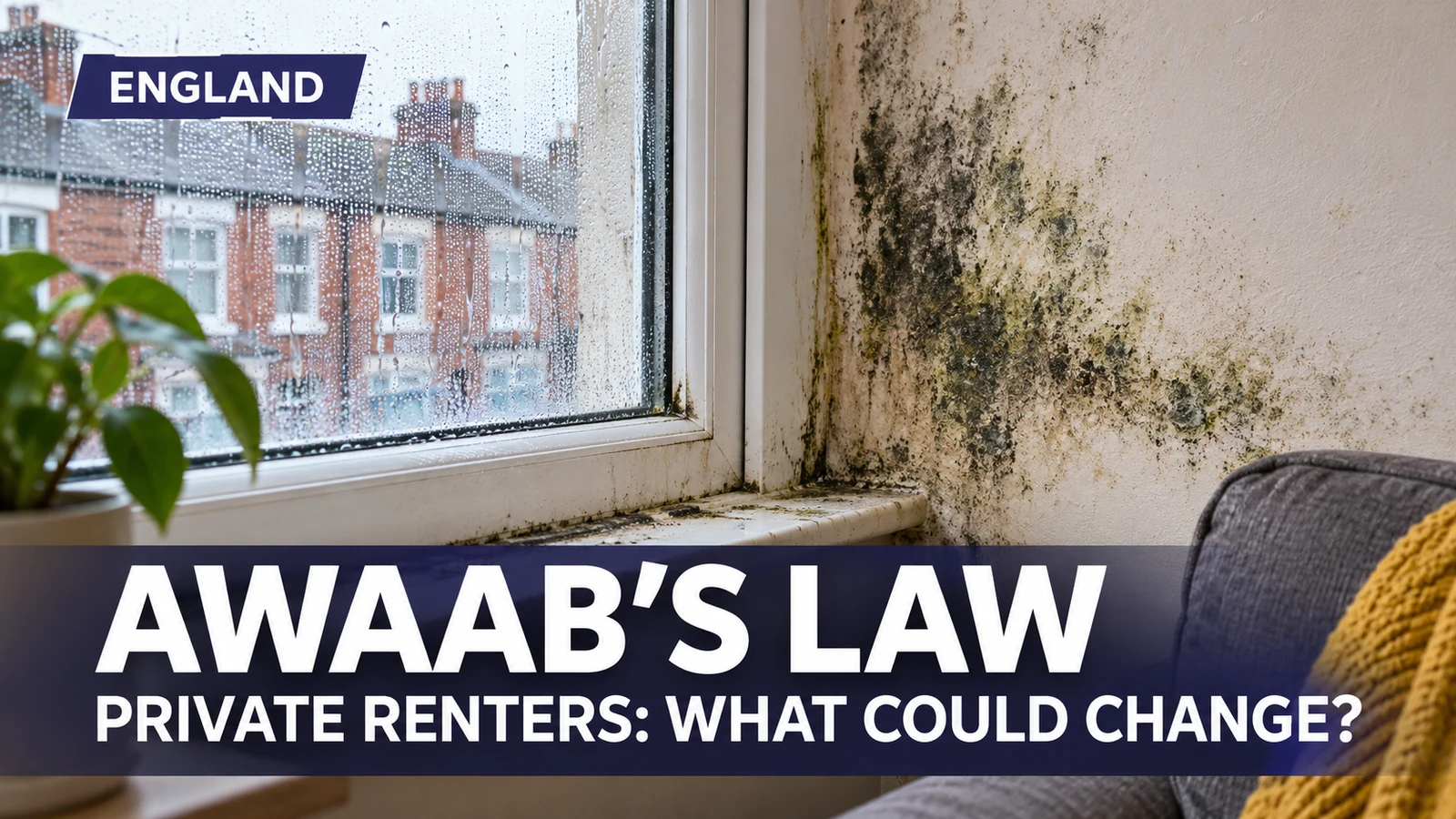
The changes would extend Awaab’s Law beyond social housing, potentially giving tenants clearer grounds to challenge delays over dangerous damp, mould and other serious risks. But the new deadlines have not yet taken effect for private tenants, and the government is still deciding what they should be.
The consultation, launched on 9 October, asks tenants, landlords and housing organisations how the rules should operate, including whether private landlords should face the same repair timescales as social landlords.
What is Awaab’s Law?
The law is named after two-year-old Awaab Ishak, who died in 2020 following prolonged exposure to mould in his family’s social housing home in Rochdale. His death brought renewed attention to the health consequences of unsafe housing and failures to respond to complaints.
In social housing in England, the first phase took effect on 27 October 2025. Under existing government guidance, social landlords must investigate potential significant damp and mould hazards within 10 working days and make the home safe within five working days after completing the investigation. Emergency hazards must be investigated and made safe within 24 hours.
Where required safety work cannot be completed in time, social landlords must arrange suitable alternative accommodation at their expense. Longer-term preventative works may take more time, but are subject to further requirements.
A second phase, due on 30 November 2026, will broaden the significant hazards covered in social housing to include excess cold and heat, electrical dangers, fire risks and structural hazards. That November date does not introduce Awaab’s Law deadlines for private renters.
What could change for private tenants?
The Renters’ Rights Act 2025 created powers to extend the framework, but further regulations are needed before the private-rented-sector requirements operate. The government is seeking views on several decisions:
- Which hazards should trigger the law. One proposal covers the Housing Health and Safety Rating System hazards, apart from overcrowding.
- How serious a problem must be before the new deadlines apply, and whether the vulnerability of someone living in the home should affect that assessment.
- Whether landlords should investigate significant hazards within 10 working days, as social landlords currently must, or a different period.
- How quickly landlords should make serious hazards safe, including a possible five-working-day requirement following an investigation.
- Whether emergency hazards should be made safe within 24 hours or a different period, and whether landlords must provide written findings and temporary accommodation.
These are consultation options, not a list of obligations already imposed on private landlords. Ordinary maintenance issues would not automatically qualify as emergency or significant hazards under the proposed framework.
What rights do private renters have now?
Private tenants are not without protection while the consultation is under way. Landlords already have duties to maintain key parts of the property, including the structure, exterior, heating and hot water systems. The Homes (Fitness for Human Habitation) Act guidance explains that rented homes must be fit to live in, and serious problems can give tenants grounds to seek a court order requiring work and, where appropriate, compensation.
For most repairs, the current legal expectation is that a landlord acts within a reasonable time after becoming aware of the problem. What counts as reasonable depends on its severity and circumstances. The specific Awaab’s Law deadlines applicable to social housing should not be quoted as if they already apply to private tenancies.
A council’s private-rented-housing or environmental-health team can investigate dangerous housing conditions and may use legal powers to require action. Shelter explains how to ask a council for help if a landlord ignores problems or fails to deal with them in reasonable time.
What should tenants do if they find damp or mould?
- Report it promptly in writing. Describe the location, extent and any immediate safety concerns to the landlord or letting agent.
- Keep evidence. Date photographs, retain messages and note when the problem first appeared, whether it has worsened and how the landlord responded.
- Explain relevant risks. Tell the landlord if a child or someone with a health vulnerability is affected. Share only information necessary to explain the urgency.
- Allow reasonable access for inspection and repairs, while keeping a record of arrangements and missed appointments.
- Escalate if nothing happens. Contact the local council’s private rented housing or environmental health service and seek independent advice from Shelter or Citizens Advice.
Tenants considering court action or withholding rent should seek independent housing advice first. The consultation itself is not a way to resolve an individual repair complaint.
Why does the proposal matter?
The government’s English Housing Survey for 2024–25 found that 22% of private renters lived in homes classed as non-decent, while 11% lived in properties with recorded damp problems. Ten per cent of private-rented households lived in homes with at least one Category 1 health and safety hazard.
Awaab’s Law could bring more predictable deadlines and a clearer route to holding landlords to account. The government also acknowledges practical difficulties: smaller landlords may depend on individual contractors rather than maintenance teams, while alternative accommodation can be harder to arrange.
Could the rules cover temporary accommodation?
Yes, but the position is still being considered. The consultation asks whether Awaab’s Law should also apply to certain accommodation occupied under a licence rather than a tenancy, including supported housing, temporary accommodation for homeless households and care leaver accommodation.
The final scope, including any exemptions and enforcement arrangements, remains undecided.
When would the new rules start?
There is no confirmed start date for private rentals. The government says 2027 is the earliest feasible year, because regulations must follow the consultation. It is also weighing whether to introduce the rules in phases, beginning with damp, mould and emergency hazards, or bring them in together.
The consultation notes that a new private-rented-sector landlord ombudsman is expected from 2028. That planned service is separate from the already-existing rights of private tenants to report hazards to their council or take qualifying legal action.
How to respond before 18 December
The government’s consultation page is open until 11.59pm on Friday 18 December 2026. People can answer only the sections relevant to them; they do not have to complete every question.
Responses can also be emailed to awaabslawconsultation@communities.gov.uk. The proposals apply to England, not Scotland, Wales or Northern Ireland.
For renters dealing with dangerous damp or mould now, the practical message is straightforward: report it, keep evidence and use existing legal and council routes rather than waiting for the consultation to finish.
Sources
- Ministry of Housing, Communities and Local Government: consultation on extending Awaab’s Law
- GOV.UK: Awaab’s Law in the social rented sector
- English Housing Survey 2024–25: housing quality findings
- GOV.UK: guidance on the Homes (Fitness for Human Habitation) Act
- Shelter: environmental health complaints about private rented housing