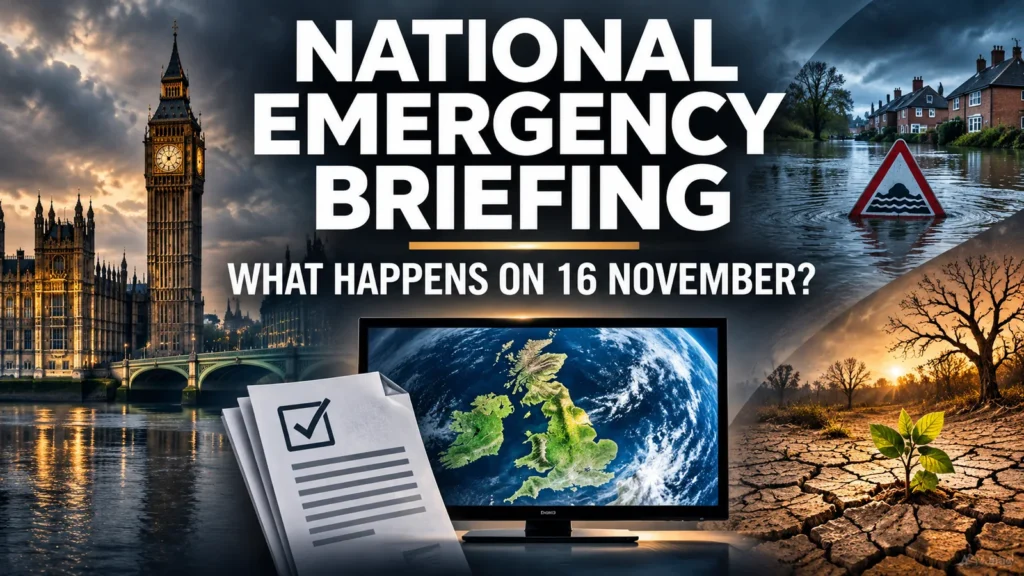
The National Emergency Briefing scheduled for 16 November is a parliamentary debate about climate and nature risks, not an official warning that a national emergency is about to happen.
The name sounds dramatic. Coupled with councils showing an emergency-themed film and the Government encouraging households to prepare for disruption, it is easy to see how separate events could be mistaken for one coordinated announcement. But official parliamentary records make clear what MPs are actually due to discuss.
What is happening on 16 November?
MPs will debate e-petition 767687, ‘Hold a UK-wide briefing on climate and nature risks’, in Westminster Hall on Monday 16 November 2026 at 4.30pm. The debate is due to be led by Dr Roz Savage, Liberal Democrat MP for South Cotswolds, according to Parliament’s published timetable.
The petition, created by broadcaster and environmental campaigner Chris Packham, has gathered more than 134,000 signatures. It asks the Government to arrange a nationwide emergency briefing on climate change and the loss of nature, introduced by the Prime Minister and delivered by independent experts. The organisers want it broadcast widely so the public can understand the risks and consider possible responses.
The debate itself is not the requested televised briefing. It is an opportunity for MPs to discuss the proposal, challenge the Government and hear a ministerial response. Westminster Hall petition debates do not ordinarily end with a vote to implement the petition or automatically change government policy.
Why is it called the National Emergency Briefing?
The name comes from an independent campaign, not from the Cabinet Office or the UK’s emergency alert system. Its central argument is that the consequences of climate change and declining ecosystems, including extreme weather, food insecurity, health pressures and economic disruption, deserve a more direct national conversation.
On 27 November 2025, campaign organisers held an expert briefing in Westminster. According to the organisers, ten specialists addressed more than 1,200 invited people drawn from politics, science, business and civil society. Subjects included climate change, nature, food systems, public health, national security and the economy.
That was a real event, but it was organised by the campaign rather than convened as a government emergency announcement. The material has since been developed into a roughly 50-minute film, The People’s Emergency Briefing, which community groups have been screening around the country.
Why are councils involved?
Some councils have backed the campaign, publicised screenings or asked MPs to support its call for a national broadcast. That is different from councils being ordered to activate emergency plans.
For example, Portsmouth City Council voted on 13 October 2026 to support the initiative and help facilitate screenings at council-operated venues where possible. Its published motion also calls for MPs to support a nationally televised briefing.
On 5 October, Lewes District Council unanimously endorsed the campaign. Its motion asked for more communication about climate risks and local resilience planning, as well as further engagement with county councillors and other public bodies.
These are council political decisions and community-engagement activities. They are not evidence that an imminent incident has been identified or that the Government has instructed councils to prepare for a particular emergency on 16 November.
What has the Government actually said?
The Government’s formal response on 15 June 2026, issued through the Department for Environment, Food and Rural Affairs, recognised that climate change and nature loss pose risks to health, the economy, national security and essential services.
It pointed to existing climate adaptation work, public information and planning for weather-related risks. It also welcomed the campaign’s effort to highlight the issues. However, the response did not commit the Government to the specific prime-time broadcast requested. That is one of the points MPs can press ministers about on 16 November.
Is this connected to the Government’s emergency-preparedness campaign?
Not as an organised part of the same initiative, on the evidence available. On 22 October 2026, the Cabinet Office launched the first stage of a three-year campaign encouraging people to prepare for temporary interruptions to power, water, phones and internet services. The Be Ready advice includes practical steps for households.
That government programme addresses resilience to different types of disruption. The National Emergency Briefing campaign is specifically asking for a public presentation of climate and nature risks. Their concerns can overlap, particularly around severe weather, but their organisers, objectives and processes are separate.
What we know, and what we don’t
- Confirmed: a Westminster Hall petition debate is scheduled for 4.30pm on Monday 16 November.
- Confirmed: the petition calls for a government-backed televised climate and nature briefing, not an immediate emergency declaration.
- Confirmed: some councils have formally supported the campaign and facilitated local screenings.
- Not confirmed: any government commitment to the specific national broadcast requested by the petition.
- No evidence identified: that this parliamentary debate is announcing an imminent disaster, a lockdown or the activation of national emergency powers.
None of this means that the underlying risks from flooding, extreme heat or biodiversity decline should be dismissed. They are the subject of established scientific research and government risk planning. It does mean readers should check who is organising an event and what the official documents actually say before sharing alarming claims about it.
How to follow the debate
The sitting is scheduled to start at 4.30pm on 16 November, subject to parliamentary business. It can be followed through Parliamentlive.tv. The official record will subsequently appear in Hansard. The petition remains open for signatures until 20 November.
Here is the campaign’s own trailer for The People’s Emergency Briefing. It shows the subject of the campaign but should not be confused with an announcement from the UK Government.
Sources and further reading
- UK Parliament: debate timetable
- Official petition and Government response
- National Emergency Briefing: original 2025 event
- Portsmouth City Council: October motion and minutes
- Lewes District Council: October motion and minutes
- Parliament: how petition debates work
- Cabinet Office: 22 October 2026 household advice