Harry Kane’s ankle surgery leaves Bayern Munich with a problem that goes well beyond finding someone to play centre-forward. Vincent Kompany must replace the England captain’s finishing, passing and movement while several alternatives are injured and Bayern face a tightening Bundesliga title race.
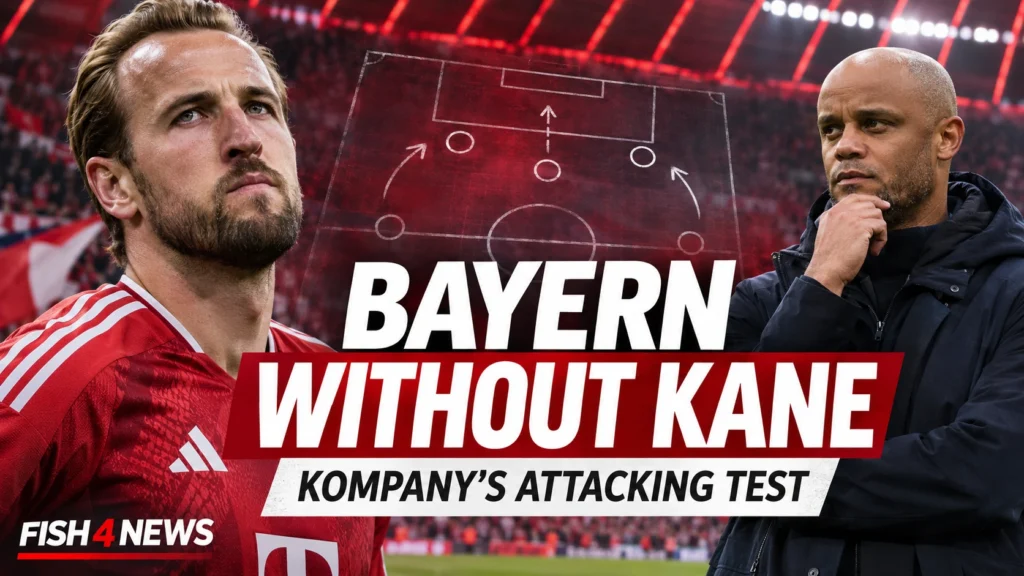
Kane, 33, underwent surgery after tearing a left ankle ligament in Bayern’s 1-1 draw with Cologne on Friday, 20 November 2026. The club confirmed the operation on Saturday and said rehabilitation had begun, but it gave no definite date for his return. For the details of the injury itself, see our separate Harry Kane injury and recovery report.
The immediate challenge is clear. Bayern have four remaining Champions League league-phase matches, travel to Hamburg in their next Bundesliga fixture and sit two points behind Borussia Dortmund. The longer-term question is whether the team has been built to function without a player whose value is much greater than his goals total.
Why is Harry Kane so important to Bayern Munich?
Bayern’s official review of Kane’s first three years, published with his contract extension on 5 November, credited him with 156 goals and 40 assists in 161 competitive appearances since joining in August 2023. That is 196 recorded goal involvements in 161 games. Bayern subsequently played again, so those figures are a dated milestone, not a current career total.
In 2026/27, the club’s first-team figures show 10 goals and 11 assists in 16 competitive appearances, including the German Super Cup, up to his substitution on 20 November. The Bundesliga officially credits him with four goals and seven assists in ten league appearances. Opta records eight league assists, illustrating that assist definitions can differ between providers. We use the Bundesliga’s seven for league-only comparisons.
| 2026/27 measure to 20 November | Kane’s figures | Scope / interpretation |
|---|---|---|
| Appearances | 16 | All competitive Bayern matches |
| Goals | 10 | Four Bundesliga, four Champions League, two DFB Cup |
| Assists | 11 | Club all-competition figure |
| Bundesliga goals / assists | 4 / 7 | Official Bundesliga figures |
| Bundesliga scoring rate | 0.49 goals per 90 | Four goals in 734 league minutes (Opta) |
| Penalty goals | 4 of 10 goals | One Bundesliga, two Champions League, one German Cup (Opta) |
| Non-penalty goals | 6 of 10 goals | All competitions; penalty goals excluded |
Sources: FC Bayern’s first-team page, Bundesliga player statistics and Opta Analyst. The 0.49 goals-per-90 measure is for the Bundesliga only. Counts and minutes have been labelled to prevent mixing competitions or providers.
More than a goalscorer
The Bundesliga numbers are revealing: Kane has been directly credited with 11 of Bayern’s 30 league goals through scoring or assisting, equivalent to about 37%. That is not a claim he created exactly 37% of their attacking threat. It excludes build-up passes, movement that pulls defenders out of position and other contributions that rarely appear in an ordinary scoring table.
Bayern’s own tactical analysis of their March 2026 victory at Dortmund noted that Kane’s average position was near the centre circle, at times behind Serge Gnabry. By dropping away from opposing centre-backs, Kane can link midfield to attack, draw a marker forward and release wide runners into the space behind. His positioning turns him into a creator as well as the player expected to finish moves.
This movement also affects pressing and the defensive transition. Kane can help organise the first wave of pressure and provide an outlet when Bayern win the ball back. When he is absent, a replacement has to decide when to press, when to run beyond and when to offer a short pass. The result may be faster attacks in some moments but less control in others.
Who can replace Harry Kane at Bayern Munich?
The Bundesliga’s current squad assessment makes the central difficulty obvious: several players with experience or suitability up front are unavailable. Bayern have not appointed one permanent replacement. The following figures cover all official Bayern first-team competitions in 2026/27 up to 20 November, using the club’s published squad records; the youth players are discussed separately because their reserve statistics are not directly comparable.
| Candidate | Appearances | Goals | Assists | Immediate suitability |
|---|---|---|---|---|
| Lennart Karl | 15 | 3 | 2 | Available; plausible false nine |
| Luis Díaz | 11 | 5 | 1 | Central running threat once recovered from injury |
| Serge Gnabry | 7 | 1 | 0 | Experienced centrally; hamstring injury |
| Ismael Saibari | 14 | 3 | 3 | Can play centrally; ankle injury |
| Jamal Musiala | 5 | 2 | 1 | Creative central option; returning to fitness |
| Michael Olise | 16 | 12 | 6 | Main creator/finisher, not natural No. 9 |
Source: FC Bayern first-team player records. These appearance, goal and assist totals are not league-only figures. Injury availability is drawn from Bayern’s Cologne match preview and the Bundesliga’s current squad assessment; it may change ahead of Lille.
Lennart Karl: the immediate false-nine candidate
Karl, 18, moved into the central attacking position when Kane went off against Cologne. He is comfortable receiving between midfield and defence, turning into space and combining in tight areas. A false nine is a central attacker who drops away from the defensive line rather than staying between the centre-backs. Our animated false-nine explanation shows how following that movement can open space for runners, while holding position may leave the forward free to receive. Karl has the movement for the role, but not Kane’s height, aerial presence or established finishing record.
His inclusion could help Bayern combine around compact defenders. The danger is that crosses and second balls might reach a penalty area without a conventional striker occupying it. That forces Olise, the opposite winger and a midfielder to make more runs towards goal.
Luis Díaz: a faster, more direct attack
Díaz has played through the middle before and brings speed, pressing energy and dribbling. In the days before the Cologne match, Kompany said he expected the Colombian to return from his muscle injury within roughly a week, but that was a forecast, not confirmation he will start against Lille. See Bayern’s pre-Cologne injury update.
A Díaz-led attack could stretch a high defensive line. Yet moving him centrally also removes some of Bayern’s natural width on the left. There is a trade-off: more runs behind opposing defenders, but potentially fewer left-sided one-on-one situations and less of Kane’s long-range distribution.
Gnabry and Saibari: more traditional options, but not yet fit
Gnabry has extensive experience across the forward line, including centrally, and would arguably involve the least structural change. But his hamstring injury is expected to keep him out into 2027. Summer arrival Ismael Saibari has played as a striker, including for Morocco, but has his own serious ankle ligament injury and is also unavailable for the immediate schedule.
Musiala, Olise and the academy: distribute the work
Musiala made a comeback from injury against Cologne and can offer a different route through the centre. The issue is how quickly he can return to regular minutes, rather than treating him as an automatic 90-minute striker. Olise, with 12 goals and six assists in 16 club appearances, has already shown that another Bayern attacker can produce decisive numbers. But Bayern reported a bruised foot after he was withdrawn against Cologne, so his readiness must be watched.
Young striker Noah Codjo-Evora came on late against Cologne. Fellow prospect Bastian Assomo is another development option. Their youth and reserve-team records should not be presented as proof either can reproduce Kane’s output against Champions League-level opposition. The more plausible short-term answer is to share centre-forward duties between established attackers, with opportunities for youngsters when circumstances allow.
Could Vincent Kompany change Bayern’s system?
Kompany generally builds around a four-player defensive line with two deeper midfielders and a fluid group of attacking midfielders and wingers. Bayern press aggressively high up the field and often leave their defenders exposed to large spaces when attacks break down. Kane’s ability to take and return a short pass helps Bayern organise the next wave of pressure after losing possession.
A false nine would not necessarily mean a completely new formation. Karl or Musiala could drop towards Joshua Kimmich and Aleksandar Pavlović while wide attackers run inside the centre-backs. The nominal shape might still look like 4-2-3-1, but the movement would be different. Against teams who defend deep, Bayern would need extra runners into the box; against teams who push up, a quicker central forward might offer more threat behind the defensive line.
There is a risk to every approach. Keeping a conventional striker would preserve a target for crosses but may reduce link-up quality. Using Karl or Musiala in a roaming central role could improve short combinations but reduce presence at the far post. Díaz centrally may increase speed but disrupt the left flank. The crucial tactical test is not whether Bayern can reproduce Kane’s exact movements, but whether they can collectively replace their purpose.
How have Bayern performed without Kane?
The evidence does not justify a sweeping claim that Bayern cannot win without their striker. On 1 November 2025, Bayern beat Bayer Leverkusen 3-0 despite Kane starting on the bench. Nicolas Jackson, then available as a striker, started and scored; Kane entered after 59 minutes, when Bayern were already three goals ahead. That is evidence Bayern could win without starting Kane, but it does not identify a present-day replacement because Jackson is no longer in this squad.
The 20 November Cologne match offers a more immediate, less reassuring snapshot. Kane left after about 20 minutes; Bayern finished 1-1, producing 17 attempts but only one on target. Sporting Life’s match figures put Bayern’s expected goals at 1.07 against Cologne’s 1.99. Expected goals, or xG, estimates the quality of shots, not the goals a team deserved by right.
Those figures support the observation that Bayern had possession without creating many high-quality opportunities. They do not establish that Kane’s injury caused the problem. Cologne were disciplined, Bayern trailed early and Olise also left at half-time. This is one match, not a controlled experiment. A credible with-and-without comparison would need a larger sample adjusted for opposition strength, changes to the starting XI and match state.
Could the injury affect the Bundesliga title race?
As of Sunday 22 November, after Saturday’s Bundesliga results, Dortmund lead with 24 points from ten games. Bayern are second on 22, level with Freiburg but ahead on goal difference. Leipzig have 21 points. Bayern are unbeaten in ten matches, with six wins and four draws, and have scored 30 league goals. Their attacking power remains considerable; the four draws explain why even small reductions in finishing efficiency could matter.
The confirmed domestic schedule includes Hamburg away on 28 November, Paderborn at home on 4 December, Hoffenheim away on 13 December and Werder Bremen at home on 18 December. Beyond the winter break, Leverkusen at home on 13 January and Stuttgart away on 23 January are among the fixtures that could be demanding. The club’s fixture list is the source; none of those matches should be described as a confirmed absence before a medical timetable exists.
The title race could tighten if Bayern continue to dominate territory while failing to convert chances. Equally, Karl, Díaz, Olise and returning teammates might sustain the scoring rate by changing how chances are created. Bayern’s current league position supports uncertainty, not an assertion that Dortmund are certain to benefit.
Which Champions League games might Kane miss?
Bayern have eight points from four Champions League league-phase games: victories against Bodø/Glimt and Atlético Madrid and draws against Viking and Arsenal. Their remaining UEFA-confirmed fixtures are:
- 25 November: Lille away
- 8 December: Slavia Prague at home
- 20 January: Manchester United away
- 27 January: Real Betis at home
Bayern will be without Kane at Lille. He is also expected to miss further games while rehabilitating, but the club has not confirmed exactly how many. Reports suggesting approximately three months out would place all four fixtures within the possible absence window. Those are projections, not individual medical clearances or formal withdrawals.
European opponents are more likely to punish mistakes in transition and disrupt Bayern’s build-up. Losing Kane may reduce the team’s ability to hold up a difficult pass and regain its attacking shape. Conversely, a quicker central runner could create different opportunities against a high line. Bayern’s route into the knockout rounds is not yet decided, and qualification scenarios should not be mistaken for fixtures.
Does Bayern have a longer-term Harry Kane problem?
Kane’s age and the depth behind him are legitimate planning questions. Yet his injury is not evidence of permanent decline. Bayern extended his contract on 5 November 2026 through 30 June 2029, describing him as central to their future. Read the official contract announcement and F4N’s report on his 2026 Ballon d’Or win for the context behind his standing at the club.
That makes the real squad-building issue resilience rather than succession at any cost. Bayern could give academy forwards selected opportunities, add more flexible depth in future windows or spread attacking responsibility around a younger core. No transfer decision has been announced and a single injury should not be used to invent a crisis about his long-term future.
England face a related but different challenge, with Thomas Tuchel considering how to replace Kane in international football. Read F4N’s analysis of England’s striker options without Kane for the contrast between club and country.
Harry Kane and Bayern: key questions answered
When will Harry Kane return?
Bayern have not confirmed a date. Reports have suggested an absence lasting roughly three months, which would put a possible return around late February 2027, but rehabilitation and readiness for competitive minutes cannot be predicted with certainty.
Who is Bayern’s backup striker?
There is no confirmed permanent deputy. Karl has already moved into the central position during a match; Díaz is another possible choice when fit, while Gnabry and Saibari remain sidelined.
Will Bayern change formation?
Not necessarily. Kompany can retain his broad structure while using a false nine and asking more midfielders and wide attackers to run beyond the ball.
Who will take Bayern’s penalties?
Bayern have not publicly confirmed a new designated taker for Kane’s absence. The first penalty awarded without him may clarify the short-term choice.
Could Bayern sign a striker in January?
A future signing is possible, but there is no verified decision to recruit one. Bayern must weigh short-term cover against the development of existing players and Kane’s contract through 2029.
Watch: Harry Kane explains his Bayern Munich role
In this BBC Football interview, recorded before his November injury and published on 2 September 2026, Kane explains why he drops deep, how his movement can create space for Bayern’s other attackers and why a centre-forward contributes more than goals alone. BBC football tactics correspondent Umir Irfan leads the discussion.
Video: Tiago Herani, How Bayern Munich Plays Under Vincent Kompany (2 May 2026). For the immediate injury and selection context, also see Bayern’s official Kompany press conference following Cologne.
What Bayern must solve now
The evidence points towards adjustment rather than a direct replacement. Kane supplies a combination of goals, assists, dropping movements and game management that no single available squad member obviously reproduces. Bayern can still win matches without him, as previous results show, but the Cologne draw demonstrates how quickly an attack can become blunt despite territorial dominance.
For Kompany, the task is to make Bayern’s midfield, wide attackers and stand-in centre-forward work together without depending on one player to provide both the final pass and the final touch. The next few matches will tell us more than any simple list of possible strikers.
Sources and further reading
- FC Bayern: confirmed surgery and rehabilitation, 21 November
- FC Bayern: 2026/27 first-team statistics
- Bundesliga: Kane’s league figures
- Opta Analyst: minutes, penalties and competition breakdown
- FC Bayern: Kane’s positional role and link-up play
- FC Bayern: Cologne match report
- Sporting Life: Cologne match and expected-goals data
- Bundesliga: 2026/27 league standings
- UEFA: Bayern’s remaining Champions League fixtures
- FC Bayern: Kane’s contract extension