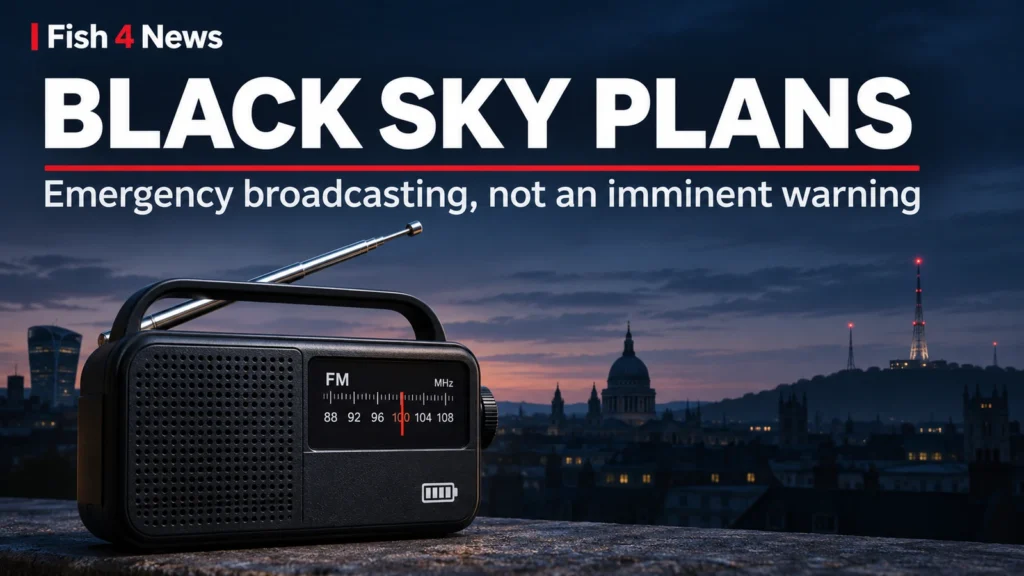
If a power failure cut off television, broadband and mobile networks across Great Britain, one of the most important ways to reach the public could be a battery-powered FM radio.
That is the thinking behind the BBC’s emergency broadcasting arrangements, described in a report on 7 November 2026. The plans are designed for a severe disruption sometimes called a ‘Black Sky’ event, when electricity failures cause other essential services to stop working. Their existence is not evidence that a nationwide blackout is about to happen.
The distinction matters. Preparing to communicate during an exceptionally serious emergency is part of keeping public services resilient, not a prediction that the emergency will occur.
How the BBC would stay on air
According to BBC correspondent David Sillito’s report, roughly 100 BBC staff would operate a special emergency radio studio. It would have secure communications that do not depend on the internet, along with enough fuel, food and water to work for at least three days without new supplies.
The report describes selected journalists sending information from emergency centres around the country using satellite-equipped vehicles. BBC teams would also have satellite phones and agreed fallback arrangements if those stopped working.
For listeners, FM radio would be central. Transmitter sites with backup diesel generation could continue carrying vital information while mains electricity was unavailable. This is a resilience plan, not a guarantee that every transmitter or household receiver would function uninterrupted in every conceivable emergency.
The principle is straightforward: a mobile phone network needs powered masts and interconnected digital systems. An FM broadcast can be received on a simple battery-powered, wind-up or car radio, even when the household has no electricity.
These are not arrangements invented this weekend. In a parliamentary answer on 29 December 2025, the Department for Culture, Media and Sport said the BBC had assessed backup power at key sites and transmitters, that its plans were intended to maintain key radio services nationally and that it regularly tested its systems.
What the emergency scripts actually say
The government has also published public-health scripts that could be read over radio during a national power outage. They deal with practical problems that could arise when electric pumps, refrigeration, heating and sewage systems are disrupted: safe water, sanitation, food and keeping warm or cool.
Crucially, these scripts were published on 16 December 2025. They are not newly issued emergency warnings from November 2026. The Department of Health and Social Care publication says they were prepared by the four UK Chief Medical Officers, as independent advisers, for a very unlikely scenario. They are public-health advice for possible use in an emergency, not government policy.
The accompanying water and sanitation guidance identifies BBC Radio 2 and Radio 4 as channels through which emergency advice could be shared. It explains why radio could remain useful if phone, internet and television services were interrupted.
Why plan for such a serious failure?
Electricity keeps much more running than the lights. Water pumps, electronic payments, petrol pumps, mobile phone infrastructure and parts of the transport network can all be affected when power is lost. A relatively local event showed how those problems can multiply: flooding in Lancaster on 5 December 2015 cut electricity to about 61,500 people, disrupting shops, transport, cash machines and some water services. FM radio and some traditional telephone lines continued to work.
The BBC’s report also points to the widespread outage that struck Spain and Portugal in April 2025 as a reminder of how dependent modern services are on the grid. Neither incident means Britain is now facing an equivalent national emergency. They illustrate why contingency plans are made before they are needed.
Is a nationwide blackout likely or imminent?
There is no verified evidence in these disclosures of an imminent national blackout. The BBC reported that the government had identified no specific threat to the grid. In an answer to Parliament on 4 August 2026, ministers said Great Britain had a highly resilient electricity system and assessed the likelihood of a large-scale power outage as low.
The government’s 2026 National Risk Register is intended to help organisations prepare for serious risks, including rare but high-impact scenarios. Its existence should not be confused with an alert that one of those scenarios is expected to unfold.
There is also a distinction between a local power cut, a regional outage and the failure of the entire national transmission system. They are not interchangeable events, and planning for the most extreme case does not tell us when, or whether, it will happen.
What should households do?
The sensible response is routine preparedness rather than panic buying. On its official Be Ready power cuts page, the government recommends keeping a torch, a battery or wind-up radio with spare batteries, a small amount of cash and at least three days’ worth of suitable water and food. The page specifies three litres of bottled water per person per day and advises writing down useful radio frequencies and the number 105 for reporting power cuts in Great Britain.
People who need extra help during electricity interruptions can check eligibility for the Priority Services Register. Anyone relying on powered medical or communications equipment should review the backup arrangements with the relevant provider.
A three-day supply of essentials is a practical buffer for many different disruptions, from flooding to local electricity failures. It does not mean the BBC or the government expects the country to lose power for 72 hours.
The more reassuring fact is that emergency broadcasting has been considered and tested in advance. The uncertainty in a rare, severe power failure is real, but the publication of a contingency plan is not itself a warning.
Sources
- BBC News, David Sillito, 7 November 2026: Black Sky emergency broadcasting report
- Department of Health and Social Care, 16 December 2025: public-health broadcast scripts
- UK Parliament, 29 December 2025: BBC emergency radio resilience
- UK Parliament, 4 August 2026: assessment of blackout likelihood
- Government Be Ready campaign: advice on power cuts
- Cabinet Office: National Risk Register 2026