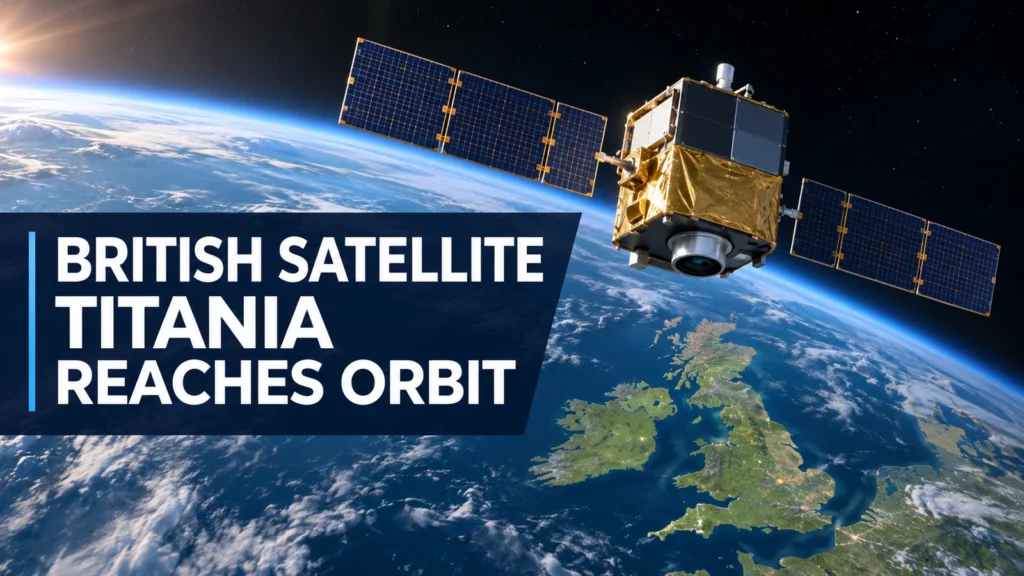
Britain’s Titania military satellite is now in orbit after launching from California in October, adding a second spacecraft to a planned UK military observation network.
The Ministry of Defence announced the milestone on 7 November 2026. Titania was developed in Hampshire by BAE Systems and the Defence Science and Technology Laboratory (Dstl) under a £9.5 million contract.
What does Titania do?
The satellite is intended to help British forces observe activity on Earth from space, supporting intelligence, surveillance and reconnaissance. Put simply, satellites can provide an overhead view that helps military planners understand developments across large areas without relying solely on aircraft or ground observers.
Titania weighs about 100kg, roughly the size of a washing machine. According to the MOD, it travels at around 27,000km/h and completes an orbit of Earth approximately every 90 minutes. The department has not publicly provided detailed specifications of its imaging instruments or claimed that the satellite is already delivering fully operational intelligence.
When and where did it launch?
The launch took place in October 2026 aboard a SpaceX rocket from California, according to contemporary reporting by ITV News and Sky News. The MOD’s 7 November statement confirms that the launch happened the previous month but does not specify the exact day. The announcement date should not be confused with the launch date.
Who built and operates it?
BAE Systems and Dstl developed Titania in Hampshire. UK Space Command will operate it as part of ISTARI, the Ministry of Defence programme for building a network of satellites and ground systems to gather and use information from space.
Titania follows Tyche, launched in 2024. Planned additions include Juno, involving Surrey Satellite Technology Ltd (SSTL), and Oberon, involving Airbus Defence and Space. These are elements of a developing military space capability rather than a single completed satellite system.
How does the £3 billion investment relate to Titania?
The government says it is committing more than £3 billion over four years to defence space capabilities, including satellites and protection of space-based systems. That is a wider programme allocation, not the cost of Titania. The MOD identifies Titania’s development contract separately at £9.5 million.
The wider spending is intended to strengthen the UK’s ability to monitor activity in space and protect services that depend on satellites, including navigation and communications.
What is Project Inaros?
Alongside Titania, the MOD announced trials of Project Inaros, a network of three ground-based sensors at sites in the UK, Australia and British facilities in Cyprus. Developed by British-Australian company Optera with the National Security Strategic Investment Fund, the sensors use neuromorphic technology, which responds to changes in light rather than processing every image in the conventional way.
The aim is to detect unusual movement or potential threats near satellites and give UK Space Command earlier warning. Inaros remains a trial: the MOD has not said the network is already a fully operational warning system.
Why does this matter?
Armed forces depend on satellites for communications, positioning and situational awareness. Having UK-controlled observation spacecraft can reduce reliance on information supplied by other countries, while monitoring the space around them can help identify risks to those assets.
The milestone confirms that Titania has reached orbit. How well its systems perform and when it becomes fully operational are separate questions that the MOD has not yet answered publicly.