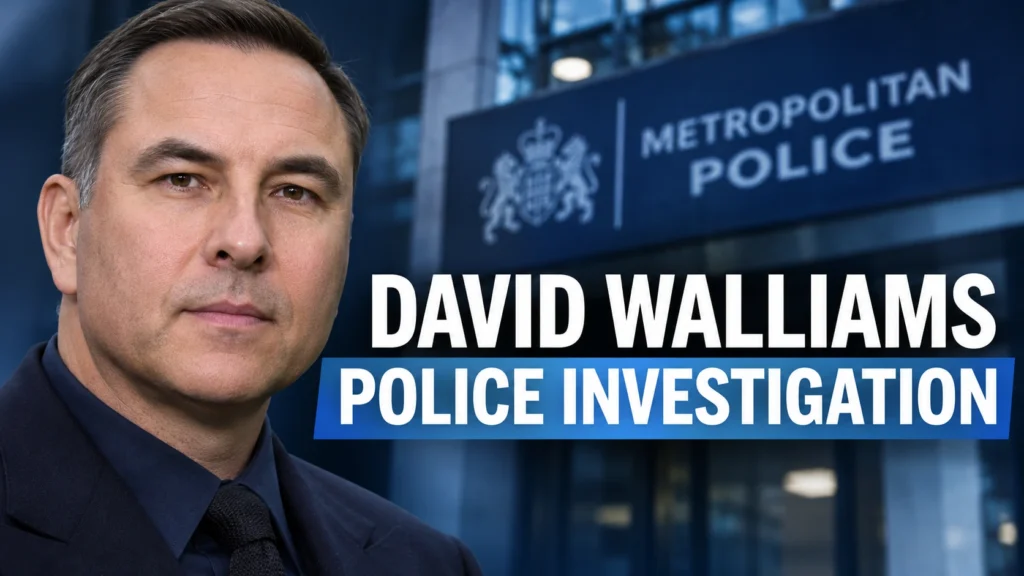
Metropolitan Police detectives have opened a criminal investigation into allegations of non-recent serious sexual offences involving David Walliams. The police say the new complaints are separate from those published by ITV News and The Guardian on 10 November. Walliams denies wrongdoing.
The announcement on Friday 13 November 2026 marks a new stage in the case. Detectives are also reviewing the original media investigation to assess whether it contains evidence of criminal offences. Police have not identified the number of complainants, the specific offences under investigation or any dates for interviews, charges or court proceedings. No arrest or charge has been publicly confirmed.
This is a follow-up to Fish 4 News’ 10 November report on the allegations and High Court ruling. That earlier article explains what was alleged and why the attempted injunction failed. This report focuses on the confirmed criminal investigation, the full chronology and what could happen next.
What the Metropolitan Police have confirmed
The Met said it had received a number of allegations of non-recent serious sexual offences involving a man now in his 50s. While the police statement did not name him, The Guardian and Reuters reported that it concerns Walliams, 55.
The police said the allegations received by detectives were separate from those published by ITN and The Guardian. Officers are nevertheless reviewing the journalists’ reporting to identify any evidence of offences. Those who have contacted police are receiving support from specialist officers.
Detective Superintendent Mike Cagney is leading the investigation. Police have encouraged anyone affected to come forward, regardless of when an alleged offence occurred.
An investigation is not a finding that an offence took place. It does not establish guilt, and it does not mean a charging decision has been made.
David Walliams investigation: full timeline
Dates below distinguish reported journalistic developments, confirmed court decisions and formal police actions. Some investigative steps took place privately and became public only in November 2026.
2003: Account involving an 18-year-old model
Model Lilly Creightmore later alleged that Walliams contacted and pursued her from when she was 18 in 2003. She said she considered his behaviour inappropriate and an abuse of celebrity power. Walliams denies the allegation. This is an allegation published in November 2026, not a police finding. The Guardian details the account.
January 2004: First meeting described by another complainant
A woman referred to by journalists as Alex alleged she met Walliams at a fan event at 15 and that subsequent communications developed into an exploitative relationship. She described later sexual contact when she was 17 and 18 as consensual but involving an imbalance of power. Walliams denies grooming or wrongdoing. Read the reported account and response.
August 2007: Allegation of assault involving a 15-year-old
A woman given the pseudonym Jade alleged that after contacting Walliams online at 15 she went to his home, where she says he sexually assaulted her. Walliams denies any sexual contact or criminal wrongdoing in relation to this allegation. The allegation was publicly reported in November 2026. The Guardian summarises the account.
2016: Allegations linked to Britain’s Got Talent
A woman identified as Sarah alleged that she met Walliams through a Britain’s Got Talent recording when she was 18, and later experienced unwanted advances at his home. Walliams denied manipulating her, getting her drunk to take advantage of her or having sexual contact. This remains an allegation, separate from any police-confirmed account. Read the Guardian’s summary.
Early 2022: Allegations are brought to a journalist
According to the court-based chronology reported by The Independent, a Guardian reporter received information about allegations involving Walliams. The paper approached him about inappropriate-conduct allegations in May 2022. They were denied, and no story was published at that time.
April 2023: Joint investigation begins
The Guardian and ITN agreed to work together on the allegations. Their eventual reporting drew on interviews and supporting material collected over a lengthy period.
December 2025: HarperCollins ends new publishing relationship
HarperCollins UK said it would no longer publish new titles by Walliams amid separate reported workplace misconduct concerns. Walliams strongly denied behaving inappropriately and said he had not been informed of the allegations. Fish 4 News covered the publisher’s decision at the time. This is not a police finding.
18 May 2026: Journalists seek Walliams’ response
The two news organisations sent questions to Walliams about the investigation. The subsequent injunction proceedings involved medical evidence and arguments about the serious potential health consequences of publication. The details are set out in ITV News’ account of the legal case.
16 October 2026: Preliminary High Court hearing
A preliminary hearing took place in London as the court considered a bid to stop publication of the reporting. The claimant was initially protected by anonymity.
27–28 October 2026: High Court hears the injunction case
The High Court considered competing rights and responsibilities, including the risks raised by Walliams’ lawyers and the public interest in reporting the allegations.
3 November 2026: Judge refuses the injunction
Mr Justice Nicklin dismissed the application for an injunction preventing publication. Permission to appeal was granted. The ruling dealt with whether the reporting could be published, not whether the allegations were true.
9 November 2026: Appeal deadline passes
Walliams did not appeal by the court’s deadline. The publishers were able to name him and report their investigation.
10 November 2026: ITV and The Guardian publish
The organisations released their joint investigation, containing allegations by multiple women about Walliams’ conduct towards teenagers and young women. The reporting included allegations of grooming and sexual assault, which he denies. Read the original investigation. Fish 4 News published its first article on the case the same day.
11 November 2026: Police encourage people to report allegations
The Metropolitan Police invited potential complainants to contact detectives, following the publication. At this stage the force had not publicly confirmed a formal criminal investigation. ITV News reported the police appeal.
13 November 2026: Criminal investigation announced
The Met confirmed that it had received new, separate allegations of non-recent serious sexual offences. Specialist officers were supporting those who had come forward, and detectives were reviewing the original media reporting as part of their work. Read the Met statement as reported by The Guardian.
What David Walliams has said
Walliams has denied allegations of grooming, sexual predation, exploiting his fame and other wrongdoing. In a letter to the journalists investigating the allegations, he acknowledged sometimes behaving thoughtlessly towards people with whom he had casual relationships, but denied abusing any power imbalance. He said he had not broken the law.
There is no publicly confirmed charge against Walliams as of 13 November. The new allegations and the earlier media reports must be treated as allegations unless and until proved in court.
What happens next?
There is no published police or court timetable. The following steps explain how an investigation of this kind may develop. They are possibilities, not confirmed actions scheduled in Walliams’ case.
1. Police assess and investigate complaints
Officers may take detailed witness accounts, examine messages and historical records, identify potential corroboration and assess whether alleged conduct could constitute an offence under the law in force at the relevant time. The CPS says that allegations dating to before 1 May 2004 must be assessed under earlier sexual-offences legislation. They may also seek information from media organisations. The Crown Prosecution Service describes how criminal investigations gather evidence.
2. Investigators may seek an account from the suspect
Police can consider interviewing a suspect under caution, whether voluntarily or following arrest where lawful and necessary. An interview or arrest is not inevitable. Neither would, by itself, prove guilt. As of this report, police have not publicly confirmed that Walliams has been interviewed or arrested.
3. Police may consult prosecutors
Investigators may request early investigative advice from the Crown Prosecution Service. For serious offences, a completed evidential file may be referred to prosecutors for a charging decision. The existence of a police investigation does not mean a file has already been sent to the CPS.
4. CPS assesses the evidence and public interest
The CPS generally applies a two-stage test: whether there is a realistic prospect of conviction on the available evidence and, if so, whether prosecution is in the public interest. Prosecutors may seek further enquiries, authorise charges or decide the test is not met. Read the CPS explanation for rape and serious sexual assault cases.
5. If charged, the case moves to court
If a charge is authorised and brought, the case would ordinarily begin in a magistrates’ court. Serious offences are then sent to the Crown Court, where any trial would involve testing the evidence and a verdict. Court dates would only be reportable once set. A defendant remains presumed innocent unless convicted.
6. The investigation could also close without charges
Police may conclude the evidence is insufficient to refer the matter, or prosecutors may decide not to charge. A decision not to prosecute is not itself proof that an allegation was fabricated. Complainants may have review rights in appropriate circumstances.
How long could the investigation take?
There is no reliable end date for the police inquiry. The CPS says investigations and charging decisions in serious sexual offence cases can take many months, depending on the evidence, complexity and enquiries required. It would be misleading to present an arrest date, charging date or trial as certain. The CPS provides more detail on the process and potential timescales.
What remains unknown
- How many separate allegations the Met has received and how many people have come forward.
- Which alleged offences and historical periods detectives are investigating.
- Whether any person has been interviewed under caution, arrested or placed on bail.
- Whether police have sought formal early advice from the CPS.
- Whether the investigation will lead to charges, no further action or additional public appeals.
How to contact the police
The Metropolitan Police have asked people with relevant information to call 101, quoting reference 4900/10NOV26, or contact the Complex Sexual Offences Unit on 020 7175 2738. Specialist support is available to people who come forward.
Follow this story
Fish 4 News will distinguish confirmed police action, allegations and any subsequent court developments. For the original allegations and injunction decision, read our 10 November report. Other background includes our earlier career timeline and the HarperCollins decision. See all David Walliams updates.
Sources
- The Guardian, 13 November 2026: Metropolitan Police investigation and quoted statement
- Reuters, 13 November 2026: Independent confirmation and response
- ITV News, 11 November 2026: Police appeal
- ITV News, 11 November 2026: High Court legal chronology
- The Independent, 10 November 2026: Detailed litigation timeline
- The Guardian and ITV News, 10 November 2026: Original allegations and response
- Crown Prosecution Service: How criminal cases work
- CPS: Serious sexual assault charging decisions