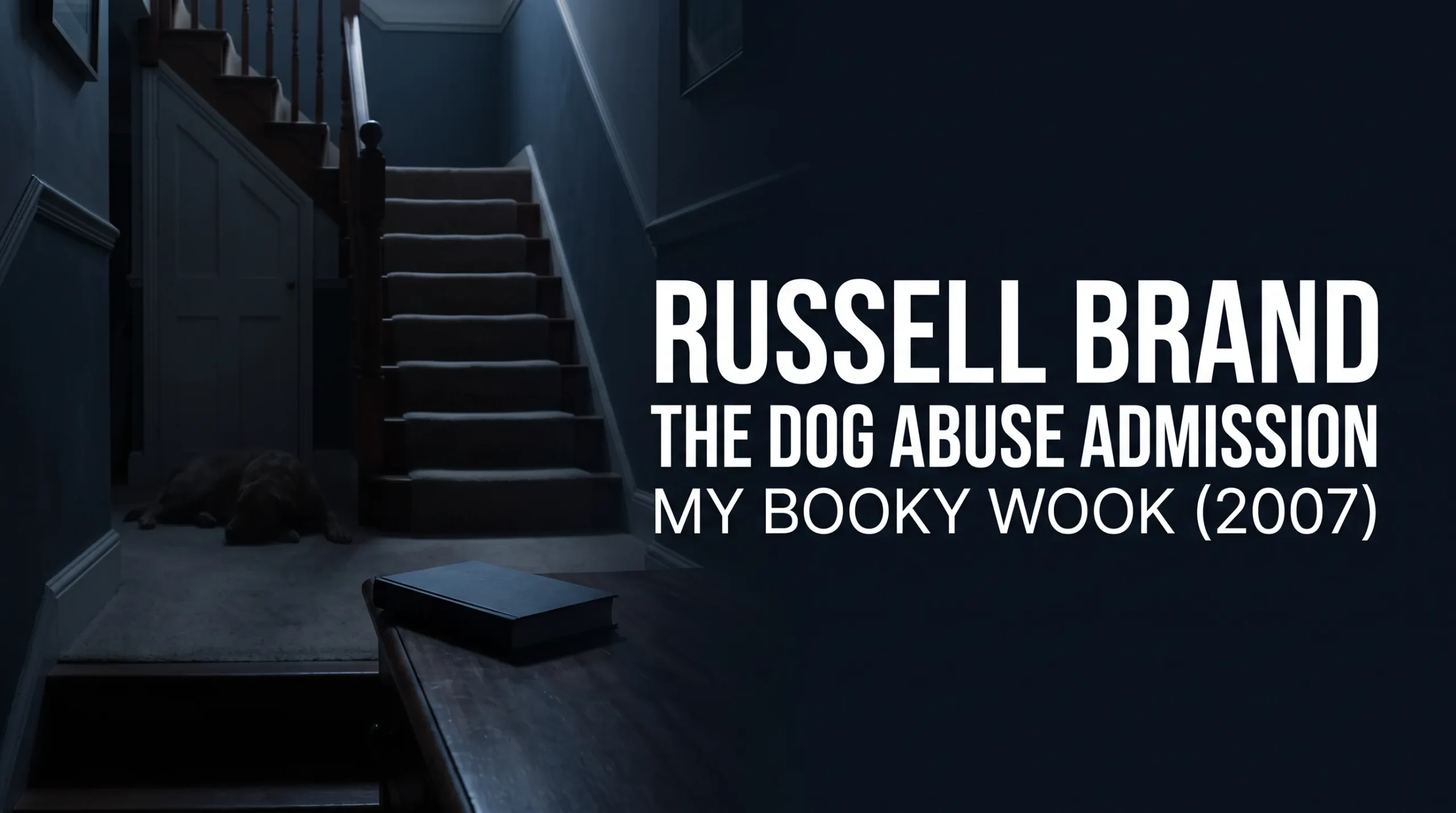
Russell Brand described deliberately kicking his childhood dog down the stairs, then pretending to comfort her, in his 2007 autobiography My Booky Wook.
The passage attracted renewed attention during Brand’s 2026 trial and after his rape and sexual assault convictions, raising questions about cruelty, apparent affection and the difference between remorse and changing behaviour.
The dog, named Topsy, had once been allowed to sleep upstairs. Brand wrote that his mother’s partner Colin later banned her from the upper floor. He said he responded by calling the dog upstairs, waiting for her to approach and kicking her back down. He then described going downstairs, offering a sympathetic cuddle and behaving as though someone else had caused her suffering.
What did Russell Brand write about his dog?
In the passage, Brand said he had felt anger about the household rule and would lure Topsy towards him at the top of the staircase. He described his change in behaviour as becoming “Mr. Hyde”, and said he kicked the dog back downstairs before acting concerned for her welfare.
Brand’s friend Matt Morgan, according to the memoir, compared it to the dog living with two different people: one who hurt her upstairs and another who comforted her below. The imagery is disturbing because the affection was part of the same incident as the cruelty, not evidence that Topsy had been kept safe.
The account is not a new confession made in 2026. It appeared in a commercially published memoir in 2007 and has been reported again as attention returns to Brand’s past. The published passage is evidence of what he chose to describe; it does not independently verify every event recounted from childhood.
Importantly, the memoir also contains an explicit statement of guilt. Brand wrote that he felt “very guilty” about his conduct and said he tried to make amends by treating animals respectfully. That later expression of remorse should not be omitted when reporting his account. Nor does it undo the cruelty he described. Sources include BuzzFeed’s reproduction of the passage and Quote Catalog’s contextual report.
Why does someone hurt another being and then show affection?
The combination of harm and apparent tenderness is recognised in descriptions of some abusive relationships. An incident of abuse may be followed by reassurance, apologies, gifts or affection. These responses can make it harder for someone experiencing abuse to understand what happened or to decide whether the behaviour has genuinely changed.
Women’s Aid explains that an abusive person may apologise or overcompensate with affection without taking meaningful responsibility. It distinguishes temporary kindness from sustained accountability and change. Similarly, the Kent and Medway Domestic Abuse Partnership describes how some situations move between abusive incidents, attempts at reconciliation and calmer periods.
These are general explanations of abusive dynamics, not a psychological assessment of Brand. His description of comforting Topsy was, on his own account, a performance of concern immediately after deliberate harm. His stated guilt was expressed separately in the memoir. We cannot determine from the book whether the childhood actions reflected a wider, enduring pattern or what motivated them.
It would also be wrong to diagnose Brand as a psychopath from this anecdote, or to claim that cruelty to an animal proves someone will later commit sexual offences. The memoir cannot establish a causal connection to his subsequent crimes.
Why has the passage resurfaced now?
On 5 November 2026, Brand was convicted at Southwark Crown Court of one rape and three sexual assaults against four women. On 9 November, he was sentenced to 10 years and six months in prison. The Crown Prosecution Service confirmed the sentence and the offences, which took place between 2004 and 2009. He was acquitted of two other rape charges and one count of attempted indecent assault.
The verdict has prompted renewed scrutiny of his public statements, media career and autobiographical writing. Some social-media commentators have interpreted the Topsy anecdote as a sign of his character. That is opinion, not a clinical diagnosis or a finding made by the jury.
The dog incident was not part of the criminal convictions and must not be confused with the evidence on which the jury found Brand guilty. Fish 4 News previously reported the guilty verdicts, the sentence and the evidence behind the verdicts.
What can and cannot be concluded
Brand’s own account describes deliberate cruelty towards a defenceless animal, followed by a calculated display of sympathy. He also wrote that he regretted his behaviour. Both elements belong in a fair account of the book.
The wider lesson is not that affection after harm always proves manipulation, nor that an apology is meaningless. It is that apologies and comforting gestures are not substitutes for safety, accountability and lasting changes in conduct. Beyond what Brand wrote, any claim about his childhood psychology or its relationship to later crimes remains speculative.
Sources
- BuzzFeed: the published My Booky Wook passage
- Quote Catalog: memoir account and expression of guilt
- Women’s Aid: apologies, affection and accountability
- Kent and Medway Domestic Abuse Partnership: abusive patterns
- Crown Prosecution Service: sentencing statement, 9 November 2026
Follow this story: Russell Brand coverage on Fish 4 News.