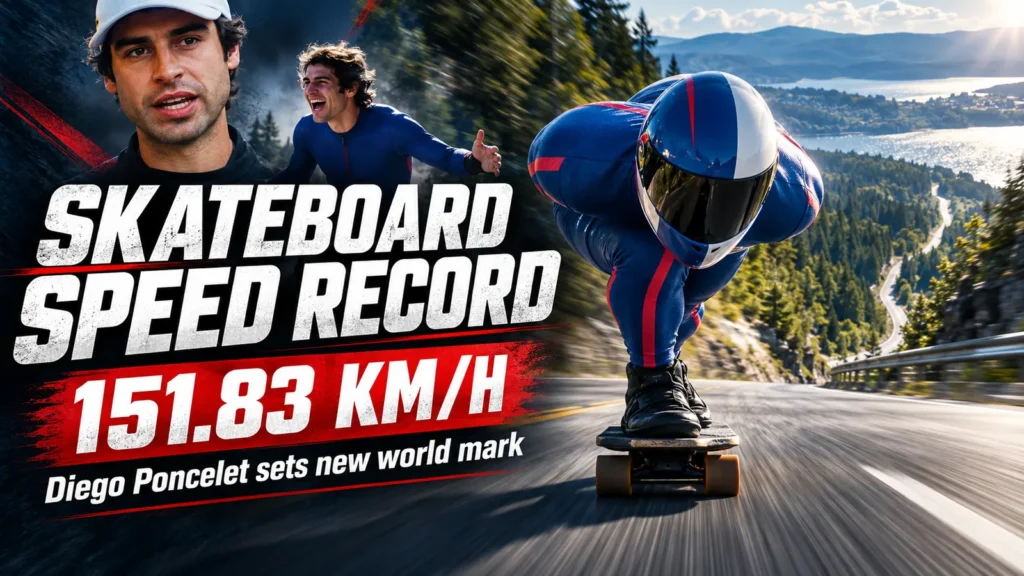
Spanish skateboarder Diego Poncelet has set a new Guinness World Record after reaching 151.83km/h (94.34mph) on a skateboard in Quebec, Canada. The 27-year-old, a two-time downhill skateboarding world champion, achieved the remarkable speed on 22 September 2026, breaking a record held by British skateboarder Pete Connolly since 2017. The achievement was officially announced on 15 October.
A Skateboard Travelling at Almost 95mph
The record-breaking attempt took place on a closed section of Route des Éboulements, a steep mountain road in Quebec’s Charlevoix region.
Poncelet reached 151.83km/h, travelling more than 42 metres every second, while balancing on a skateboard powered entirely by gravity.
The speed surpassed the previous Guinness World Record of 146.73km/h (91.17mph), established by British skateboarder Pete Connolly on the same road on 16 September 2017.
According to Guinness World Records, the achievement was independently witnessed and officially certified in the category of fastest skateboard speed downhill (standing).
For Poncelet, however, breaking the existing record was only part of his ambition.
He wanted to become the first person to exceed 150km/h in the category, a speed long considered beyond the practical limits of downhill skateboarding.
Speaking to Reuters, Poncelet explained:
“If I’m honest with myself, my real objective was 150 kph. That was the dream.”
Finding the Perfect Road Took Years
Poncelet’s pursuit of the record began approximately four years earlier.
He examined roads around the world, searching for a combination of gradient, length, surface conditions and suitable terrain.
One promising location was in the Austrian mountains, where he tested a road with an exceptionally steep 23% gradient.
Despite reaching speeds of around 129km/h during those tests, he concluded that the Austrian route was unsuitable for achieving his ultimate target.
His search eventually brought him back to Canada, where Connolly had established the previous record.
The Canadian road offered an unusual combination of characteristics:
- Approximately 2.2 kilometres in length.
- A maximum gradient of 18%.
- A 600-metre steep straight section suitable for building speed.
- A demanding descent involving corners, cracks and uneven surfaces.
However, the road had deteriorated considerably since Connolly’s attempt nine years earlier.
Large cracks, bumps and damaged asphalt created additional dangers. Poncelet had to identify and memorise the best line through the descent while maintaining control at extraordinary speeds.
At one point, he would already be travelling at around 110km/h before reaching a crest where the road appeared to disappear beneath him.
The challenge was not simply reaching maximum speed. He also had to remain stable through the remainder of the descent.
The Engineering Behind 94mph on a Skateboard
Achieving such speeds required more than exceptional skateboarding ability.
Poncelet worked with engineers and equipment specialists to develop a highly aerodynamic setup, drawing on techniques more commonly associated with motorsport.
Wind-tunnel testing in Geneva helped refine his body position, helmet, racing suit and skateboard.
The objective was to minimise aerodynamic drag while preserving enough stability to navigate the road.
His equipment included a specially developed aerodynamic suit by Jonathan & Fletcher, designed with textured fabric and a rear spoiler arrangement to manage airflow around his body.
A custom helmet and skateboard fairing developed by Siegrist and Skippings helped direct airflow more efficiently, including around his feet and board.
He rode a 9.81 skateboard fitted with prototype wheels supplied by Seismic Skate Systems.
According to Seismic Skate Systems, the setup included 90mm Megawatt wheels using an experimental high-rebound urethane compound, alongside specialist ceramic bearings, bushings and grip tape.
Prada Linea Rossa also contributed specially designed footwear and gloves intended to improve aerodynamics, stability and vibration control.
Poncelet’s physical preparation was equally important. He trained to hold an extremely compact aerodynamic position and maintain precise control despite the forces acting on his body and board.
The project received support from Red Bull, Porsche, Prada and Meta.
Waiting for the Right Wind
Even with the equipment prepared and the road selected, weather conditions remained critical.
Poncelet had already exceeded the old record during preliminary testing, reaching 146.88km/h, but was determined to go further.
He waited five days for suitable conditions before returning for the officially witnessed attempts on 22 September.
Guinness World Records confirmed that he completed seven runs that day.
On his fourth run, he reached 148.27km/h, enough to claim the world record.
But Poncelet was still short of his personal target of 150km/h.
After a break, the team returned when the wind became more favourable.
During his final record-breaking descent, a tailwind of approximately 10–14km/h helped create the conditions required for maximum speed.
The wind was not without risk. Earlier crosswinds had threatened his stability, demonstrating how even modest changes in direction could become dangerous at these speeds.
Poncelet committed to his aerodynamic tuck and accelerated down the mountain road.
The speed trap recorded 151.83km/h.
He had exceeded his 150km/h target and improved the previous world record by 5.10km/h.
The result prompted celebrations from Poncelet, his family and the team who had spent years developing the attempt.
Why the Descent Was So Dangerous
Unlike a bicycle or motorbike, Poncelet’s skateboard had no conventional braking system.
Downhill skateboarders normally reduce speed through techniques including controlled slides, often using protective pucks attached to their gloves.
However, Poncelet explained that attempting to brake at the speeds involved in the record run could have caused him to lose control.
The smallest mistake in body position could create aerodynamic instability, while cracks and bumps in the road threatened the skateboard’s balance.
Maintaining the aerodynamic tuck also restricted his forward visibility, forcing him to rely heavily on his knowledge of the course.
The attempt was conducted on a closed road with organised support and safety arrangements, rather than in ordinary public traffic.
Guinness World Records adjudicator Andrew Glass, who witnessed the attempts, described the achievement as one of the most impressive feats he had seen.
A Tribute to British Record Holder Pete Connolly
Behind Poncelet’s achievement is a personal connection to the man whose record he surpassed.
British skateboarder Peter “Pete” Connolly set the previous record of 146.73km/h in Quebec in September 2017.
Connolly was recognised internationally as one of downhill skateboarding’s leading speed specialists.
He had encouraged the pursuit of speeds beyond 150km/h, believing the milestone was achievable.
Connolly subsequently died, and Poncelet’s record attempt became a tribute to his late friend.
Returning to the same Canadian hill carried particular significance.
It was the location where Connolly had established a benchmark that stood for nine years and where Poncelet finally realised the ambition they had shared.
The achievement therefore represented not just a new sporting record but a continuation of Connolly’s legacy within downhill skateboarding.
Who Is Diego Poncelet?
Born in Mexico and raised in Spain and Switzerland, Poncelet is a Spanish downhill skateboarder who has become one of the sport’s leading international competitors.
He won the World Downhill Skateboarding Championship in 2022 and successfully defended his title in 2023.
His interest in speed began during childhood, and he initially dreamed of becoming a Formula One driver.
That fascination eventually developed into a career in downhill skateboarding, where he combined competitive success with an interest in engineering, aerodynamics and technical innovation.
At 27, he has now added an officially recognised Guinness World Record to his two world championship titles.
A New Benchmark for Downhill Skateboarding
Poncelet’s achievement demonstrates how far downhill skateboarding has developed through a combination of athletic skill, engineering and specialist equipment.
The jump from Connolly’s 146.73km/h record to 151.83km/h may appear relatively small numerically, but maintaining stability beyond 150km/h introduces exceptional technical and physical challenges.
His success has established a new target for athletes attempting to push the limits of gravity-powered skateboarding.
Whether another rider can exceed 151.83km/h remains to be seen.
For now, Diego Poncelet holds the Guinness World Records title for the fastest downhill skateboard speed achieved in a standing position.
Watch: Diego Poncelet’s Record-Breaking Skateboard Run
Red Bull documented Poncelet’s journey, from the search for a suitable mountain road and wind-tunnel engineering to the successful record attempt in Canada.
The film includes footage of his earlier unsuccessful runs, technical development and the moment his team confirms the new world record.