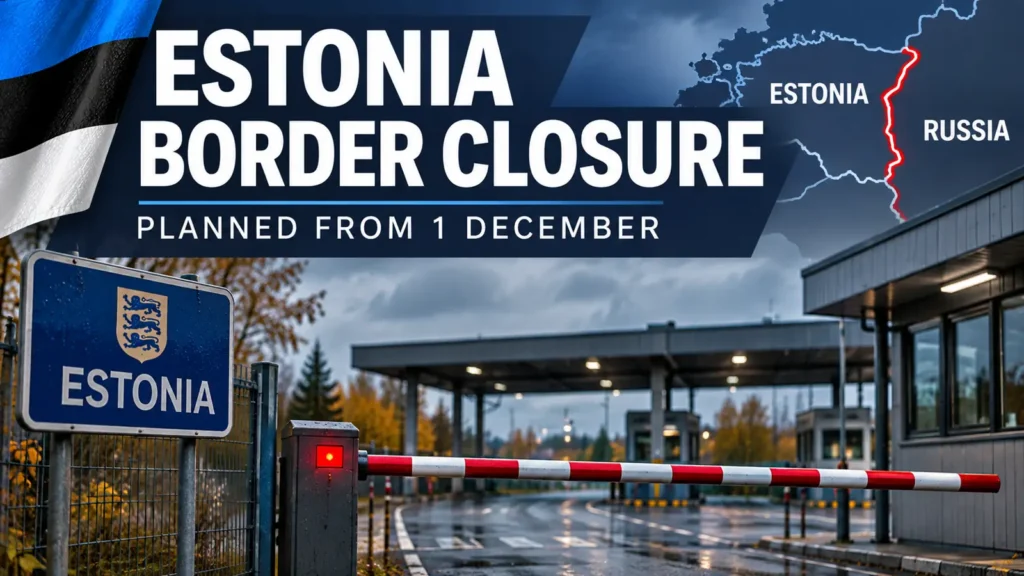
Estonia plans to close its three remaining road border crossings with Russia from 1 December 2026 after an attempted arson attack against drone manufacturer Threod Systems that Estonian security officials attribute to Russian military intelligence.
Foreign Minister Margus Tsahkna announced the proposed closure on Sunday 15 November, following the detention of eight Latvian nationals in connection with the attempted attack near Tallinn. Estonia is a member of NATO and the European Union, and has been a prominent supporter of Ukraine.
Which Estonia–Russia border crossings would close?
The proposal covers the three road crossing points at Narva, Luhamaa and Koidula. The crossing points still handle pedestrians and freight under restricted operating hours. Interior Minister Igor Taro said the planned measure would apply to both pedestrians and vehicles.
The Estonian Foreign Ministry said the government plans to begin the closures on 1 December 2026. The final decision, practical arrangements and duration have not yet been confirmed. It would therefore be premature to describe the entire border, including all forms of transport, as already closed.
Tsahkna said the move was intended to reduce opportunities for hostile activity and sanctions evasion. He had consulted counterparts in Latvia, Lithuania and Finland, and planned to raise further measures against Russia at a meeting of EU foreign ministers in Brussels on Monday.
What happened at Threod Systems?
According to Estonia’s Prosecutor’s Office and Internal Security Service (KAPO), suspects attempted to break into Threod Systems’ premises in Viimsi, north of Tallinn, at around 3.06am on Saturday 14 November. Investigators say the intention was to break windows, introduce flammable liquid and cause a fire or explosion.
The company makes long-range reconnaissance and attack drones. Its security team intervened and the plot was stopped before significant damage occurred. Estonia’s government said nobody was injured and the company’s production and deliveries were unaffected.
Estonian police and security authorities detained eight suspects, all Latvian nationals. Prosecutors sought court orders to remand five of them in custody. The investigation must still establish the individual roles of the suspects and whether others were involved.
What has Latvia confirmed?
Latvia’s State Security Service (VDD) said it shared information about a potential sabotage plot with its Estonian counterparts on 13 and 14 November and helped coordinate the response.
In a statement issued on 15 November, VDD confirmed that it searched nine locations in Latvia linked to the suspects. It said officers seized explosive devices, pyrotechnics, ammunition, mobile phones and data-storage equipment. Authorities have not publicly established how each seized item relates to the attempted attack.
What is the evidence of Russian involvement?
KAPO says its counterintelligence investigation assesses that the sabotage attempt was ordered and coordinated by Russia’s military intelligence service, the GRU. Prime Minister Kristen Michal and Foreign Minister Tsahkna have publicly endorsed that assessment.
That is a serious allegation by Estonia’s security authorities, not a finding yet tested in a public criminal trial. No detailed evidential case establishing the GRU’s involvement has been published. Russia has denied involvement in sabotage operations; its foreign ministry has criticised Estonia’s border closure plans.
Is this part of a wider pattern?
Estonia says a separate arson attack on defence contractor Milrem Robotics in August 2026 was also commissioned by Russian intelligence. The government made that attribution public in September.
Estonian officials argue that attacks against defence manufacturers aim to disrupt support for Ukraine and intimidate European governments and businesses. Latvia’s security service has separately warned that Russian services increasingly seek to recruit nationals of other countries to carry out sabotage, complicating efforts to trace responsibility.
Those assessments are important context, but they do not by themselves establish who directed every individual incident.
What happens next?
- Estonia’s government is expected to settle the formal closure decision and clarify whether it will be temporary or indefinite.
- People and freight operators using Narva, Luhamaa and Koidula will need to monitor official border guidance before travelling on or after 1 December.
- Estonian prosecutors and Latvian investigators will continue examining the suspected plot, the detainees’ roles and possible accomplices.
- Michal has called a government security cabinet meeting for Friday 20 November to review the sabotage threat and discuss further steps.
Watch: DW News on Estonia’s border plans
DW News reports on Estonia’s decision and the alleged Russian sabotage operation. The video is a news report, not footage of the attempted attack.
Sources
- Estonian Foreign Ministry: proposed border closure, 15 November 2026
- Office of the Estonian Prime Minister: Threod Systems attack, 15 November 2026
- Latvian State Security Service: joint investigation and searches, 15 November 2026
- ERR News: security service and prosecutor statements
- Reuters: international response and border crossing details