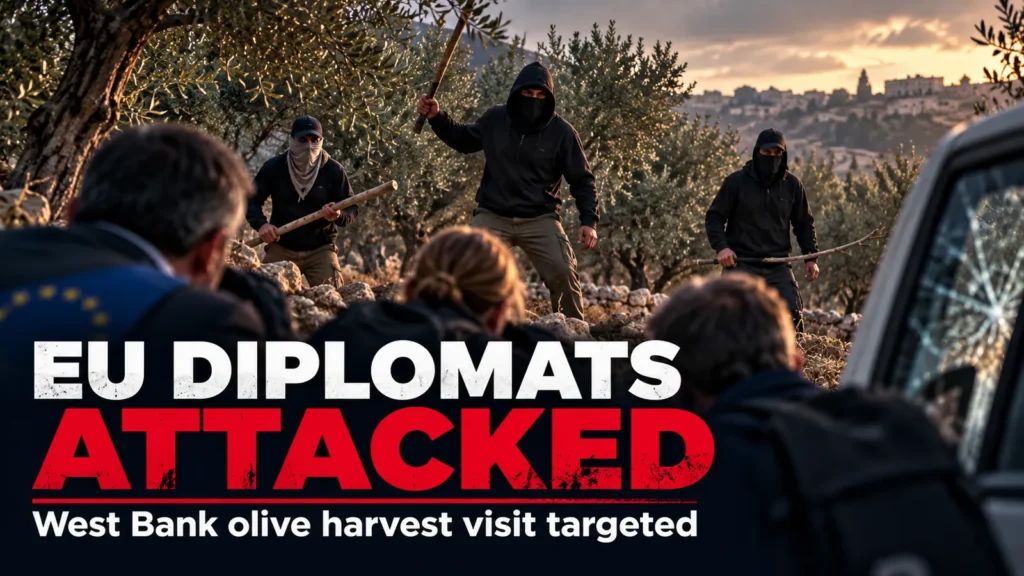
Masked Israeli settlers attacked Palestinian olive harvesters and a visiting European delegation near Taybeh in the occupied West Bank on Saturday, 17 October 2026. Among those caught in the violence were diplomats from France, Belgium and Poland, a French mayor and Catholic representatives. The incident has renewed demands for accountability amid mounting evidence of widespread violence against Palestinian communities.
What happened in Taybeh?
The delegation had travelled to Taybeh, a Palestinian Christian village northeast of Jerusalem, to accompany local residents during the annual olive harvest.
The visitors included Belgium’s consul general to the Palestinians, French and Polish diplomats, Bernard Baudoux, the mayor of Aulnoye-Aymeries in northern France, and Archbishop Vincent Dollmann of Cambrai.
According to eyewitnesses and journalists present, masked Israeli settlers carrying sticks approached the group as its members prepared to leave.
Baudoux, who was wearing his official French mayoral sash, was pushed to the ground. Attackers also struck a diplomatic vehicle, smashing one of its windows.
Three people were reported injured during the confrontation.
Unlike many incidents involving isolated Palestinian farming communities, this attack was witnessed by European diplomatic representatives and journalists.
A Guardian journalist at the scene filmed the approaching attackers and documented the immediate aftermath.
That evidence adds considerable weight to the accounts provided by the delegation.
Ten arrests announced – but who will face charges?
On Monday, 19 October, Israeli police announced the arrest of ten suspects during an operation responding to recent settler violence.
The operation followed the Taybeh attack and a separate assault on American photojournalist Heidi Levine, who was seriously injured while covering Palestinian olive harvesters near Abu Falah on Friday, 16 October.
Levine reportedly suffered broken ribs and vertebrae, wounds requiring stitches and a severe finger injury that required surgery.
Israeli police said the investigation involved the country’s internal security agency, Shin Bet, alongside Border Police and the military.
However, Associated Press reported that authorities had not identified the ten suspects or clarified their individual involvement in the attacks. The operation also covered suspected violations of military orders and illegal construction offences.
The arrests therefore represent an investigative development, not confirmation that the specific attackers in Taybeh have been charged or convicted.
By 21 October, the Guardian reported that several of those detained had subsequently been released. In an interview published that day, Levine described the severe injuries she suffered and credited Palestinian bystanders with helping protect her during the assault. No conviction in either attack was reported in the sources reviewed for this update.
More than 2,060 attacks in 2026
The incident is part of a much wider pattern.
According to a United Nations Office for the Coordination of Humanitarian Affairs report published on 15 October, more than 2,060 settler attacks resulting in Palestinian casualties, property damage or both had been recorded since the start of 2026 across around 300 Palestinian communities.
That represented an average of around seven recorded attacks every day, compared with five per day in 2025. In the reporting period covered by the UN’s 15 October update, 244 incidents were recorded across 113 communities, an average of 17 per day.
The consequences extend beyond physical injuries.
Settler attacks, intimidation and restrictions on access to agricultural land have disrupted Palestinian livelihoods, damaged crops and infrastructure and contributed to the displacement of thousands of residents.
The olive harvest is particularly important because many Palestinian families depend on olive trees for income, food and their connection to land cultivated across generations.
Preventing families from reaching their groves can therefore have consequences long after the attackers have left.
Another confrontation at an olive harvest on 21 October
On Wednesday, 21 October, Israeli forces detained dozens of Israeli and international volunteers accompanying Palestinian farmers near Nahalin in a separate West Bank olive harvest incident. Among those detained was Brad Lander, a Democratic candidate for the US House of Representatives, who was later released.
Israeli authorities said the harvest had not been coordinated in advance and cited security concerns. Participants and human rights organisations criticised the detentions. The Nahalin incident is separate from the attacks at Taybeh and Abu Falah and the subsequent criminal investigation.
Why do so few attacks lead to prosecutions?
One of the most troubling aspects is the historic record of law enforcement.
Israeli human rights organisation Yesh Din has monitored Israeli police investigations into ideologically motivated offences committed by Israelis against Palestinians in the West Bank.
Its figures covering 2005 to 2025 found that 93.6% of the investigation files it monitored ended without an indictment.
The organisation also concluded that police investigative failures accounted for 82% of the cases it examined.
Those findings do not establish guilt in individual cases. They do, however, raise serious questions about whether Palestinians can consistently obtain effective protection and legal redress.
The Taybeh attack now provides an unusually visible test of that system.
If assaults witnessed by foreign diplomats, recorded on camera and condemned internationally do not result in effective prosecution, what prospects do Palestinian families have when similar incidents happen without international observers?
Europe condemns the violence – but will anything change?
Belgian Foreign Minister Maxime Prévot condemned the attacks and called for those responsible to face justice.
France issued an official statement on 18 October, demanding that Israeli authorities arrest and prosecute the perpetrators.
The European Union also condemned the attacks, calling for accountability and effective measures to prevent further violence against Palestinians, journalists and diplomatic representatives.
These statements are significant, but European governments have already introduced sanctions targeting violent settlers and organisations supporting them.
In June 2025, the UK and several international partners imposed personal sanctions on Israeli ministers Itamar Ben-Gvir and Bezalel Smotrich over their incitement of violence against Palestinians.
In May 2026, the EU adopted additional restrictions against extremist settlers and supporting organisations.
The following month, Britain coordinated further sanctions with international partners, specifically targeting networks financing and enabling attacks.
Despite these measures, the UN’s figures demonstrate that settler violence remained widespread throughout 2026.
Broader economic pressure has proved more difficult.
In April, efforts by Spain, Ireland and Slovenia to suspend the EU–Israel Association Agreement failed to obtain sufficient support among EU governments.
Germany and Italy were among those opposing an immediate suspension.
European governments have therefore demonstrated a willingness to sanction specific individuals while remaining divided over stronger measures affecting their wider relationship with Israel.
What about the United States?
American policy has also been inconsistent.
In January 2025, President Donald Trump revoked an executive order introduced by the Biden administration that had authorised sanctions against people undermining peace and security in the West Bank.
The US Treasury confirmed that the associated sanctions programme was terminated and the designated individuals removed from its sanctions list.
Following the October 2026 attacks, however, senior American officials condemned the violence.
US Ambassador to Israel Mike Huckabee strongly criticised the assault on Heidi Levine, while Secretary of State Marco Rubio urged Israeli authorities to act against settler violence.
The difference between those public statements and the administration’s earlier removal of sanctions raises a legitimate question about how Washington intends to use its influence.
How has Israel responded?
Israeli Foreign Minister Gideon Sa’ar condemned the Taybeh attack, describing those responsible as rioters. He also suggested that the visiting diplomats could have improved their safety by coordinating their movements with the Israeli military.
Prime Minister Benjamin Netanyahu’s office questioned whether the available footage established individual responsibility and warned against making accusations against settlers collectively.
Israeli President Isaac Herzog, meanwhile, condemned the violence against Levine.
There has also been criticism from within Israel.
Former senior Israeli diplomats demonstrated outside the country’s foreign ministry on Sunday, demanding stronger action against violent settlers.
These competing responses underline the divisions within Israeli politics and society over settlement activity, policing and accountability.
What does international law say?
In a July 2024 advisory opinion, the International Court of Justice concluded that Israel’s continued presence in the occupied Palestinian territory was unlawful.
The court stated that Israel must cease new settlement activity and bring its unlawful presence to an end as rapidly as possible.
It also identified obligations on other states not to recognise or assist in maintaining the unlawful situation.
Israel has rejected the court’s conclusions, arguing that the dispute should be resolved through direct negotiations.
The advisory opinion is not itself an enforceable criminal judgment against any individual settler. Nevertheless, it establishes an important international legal framework for assessing state responsibilities and settlement policy.
The question now is accountability
The latest arrests are an important development, but they are only the beginning of a legal process.
The key questions are whether investigators identify the people directly responsible for the attacks, whether prosecutors bring substantiated charges and whether Palestinian communities receive meaningful protection during future harvests.
European governments must also decide whether their existing sanctions and diplomatic pressure are achieving their stated objectives.
The attack on European diplomats attracted international attention because foreign representatives were directly affected.
Yet Palestinian residents have been reporting threats, attacks and interference with their land for years.
The fundamental question is not simply what happens to those accused of attacking European visitors. It is whether the same standards of protection and accountability will apply when the victims are Palestinians and there are no diplomats or cameras watching.
Fish 4 News will follow the investigation, judicial proceedings and international diplomatic response. Arrest and investigation details were last checked on 21 October 2026.
Sources
- The Guardian – journalist’s eyewitness account of Taybeh attack
- Associated Press – arrests and attacks on diplomats and journalist
- UN OCHA – updated West Bank settler violence figures, 15 October 2026
- Yesh Din – law enforcement data 2005–2025
- French Foreign Ministry – response to Taybeh attack
- UK government – sanctions on settler-violence networks
- US Treasury – West Bank sanctions programme termination
- International Court of Justice – July 2024 advisory opinion
- Israel Police – 19 October operation and 10 arrests
- The Guardian – Heidi Levine’s account and arrest update, 21 October
- Reuters – Brad Lander and olive harvest detentions, 21 October