The FBI is investigating a suspected cyber intrusion involving the National Crime Information Center (NCIC), the database used by police across the United States to check wanted people, missing persons and stolen property, according to reports published on Friday 20 November 2026.
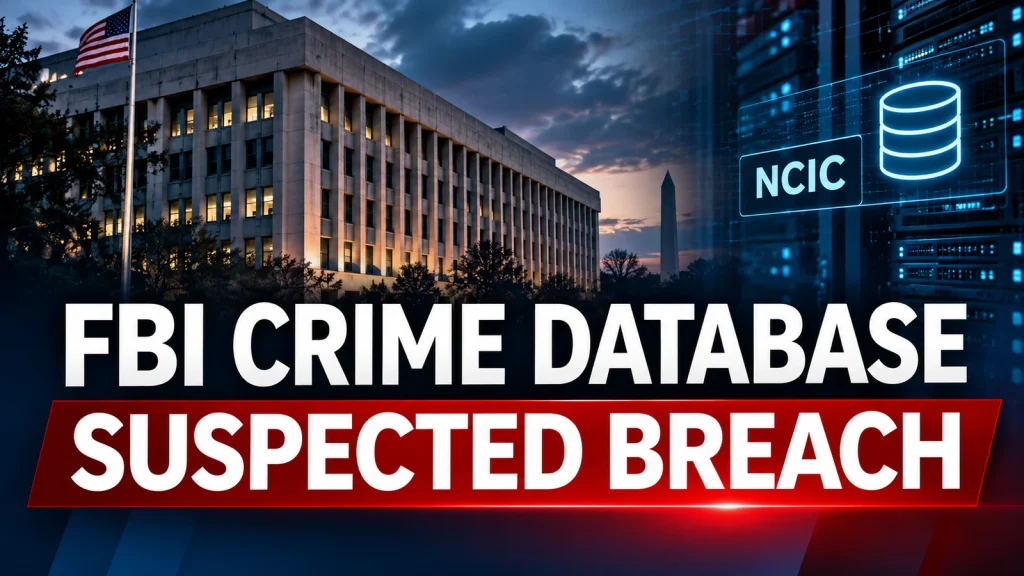
The investigation was first reported by CNN, citing two people briefed on the matter. NBC News subsequently reported the apparent breach, also citing two people briefed on the incident. Reuters reported that the FBI had not responded to its request for comment.
There has been no public determination of who was responsible, whether unauthorised access was successful or whether records were stolen or altered. The reports concern a suspected intrusion under investigation, not a fully established data breach.
What is the FBI’s NCIC crime database?
NCIC stands for National Crime Information Center. It is not the FBI’s public crime-statistics website. It is an operational information system that allows authorised federal, state, local and other criminal justice agencies to share and check records around the clock.
According to the FBI’s own explanation of NCIC, the database includes information that can help officers identify wanted people, locate missing persons, recover stolen vehicles and property and assess potential safety risks during encounters.
The FBI launched NCIC in 1967. Its published overview states that, as of 2023, the system contained more than 18 million active records across 22 files and served more than 100,000 law-enforcement and criminal-justice partners. Those are historical FBI figures, not a count of records exposed by the reported incident.
Why would a hack of NCIC matter?
Police officers can consult NCIC during routine traffic stops and investigations, including to establish whether a person is wanted or a vehicle has been reported stolen. Access to this information is important for both public safety and the decisions officers make in the field.
A confirmed intrusion could raise two different concerns: the confidentiality of information held in the system and the integrity of records used by police. It would be especially serious if records had been changed without authorisation, although there is no public evidence that such changes occurred in this case.
The FBI’s guidance already requires agencies to confirm an NCIC match before taking official action. The bureau also describes encryption, authenticated access and record-validation requirements as safeguards for the system.
What do we know about the suspected FBI cyberattack?
- On Friday 20 November 2026, CNN reported that the FBI was investigating an apparent NCIC intrusion, citing two people briefed on the case.
- NBC News reported the same investigation later on Friday and said the FBI had no comment as of that evening.
- Reuters reported the story on 20 November in the United States, with publication carried into 21 November in other time zones; it said the FBI did not respond to its request for comment.
- The FBI has not publicly named a suspected attacker or published an assessment of what information, if any, was accessed.
What has not been confirmed?
The method of entry, exact timing, number of affected records, possibility of data theft and any disruption to police operations remain unknown. It is also not established whether the suspected activity affected the NCIC system itself, access infrastructure or a connected service.
No individual or group should be blamed for the latest suspected incident without evidence. Nor is there evidence that other recent technology outages in the United States are connected to it.
Did the FBI suffer another cyber incident in September?
On 23 September 2026, the FBI issued a public statement saying a cybercriminal group had claimed to compromise its recruitment portal, fbijobs.gov, and potentially affect FBI employee personal information.
The bureau said it was investigating and that the point of compromise had not been established, including whether it involved a third-party supplier or its own systems. Reporting has linked the earlier claims to a group known as ShinyHunters, but the September recruitment-portal matter and the November NCIC investigation are separate incidents; no link between them has been established.
What happens next?
The key questions are whether investigators confirm unauthorised access, establish the scope of any exposure and determine whether the information used by police remained reliable. Until those findings are made public, describing the entire NCIC database as conclusively hacked would go beyond what is confirmed.
Fish 4 News will update this report if the FBI releases an official statement or further verified details emerge.
Sources
- CNN: FBI investigation into apparent NCIC intrusion, 20 November 2026
- NBC News: apparent breach investigation, 20 November 2026
- Reuters: FBI criminal information database report, 21 November 2026
- FBI: National Crime Information Center official overview
- FBI: statement concerning fbijobs.gov, 23 September 2026