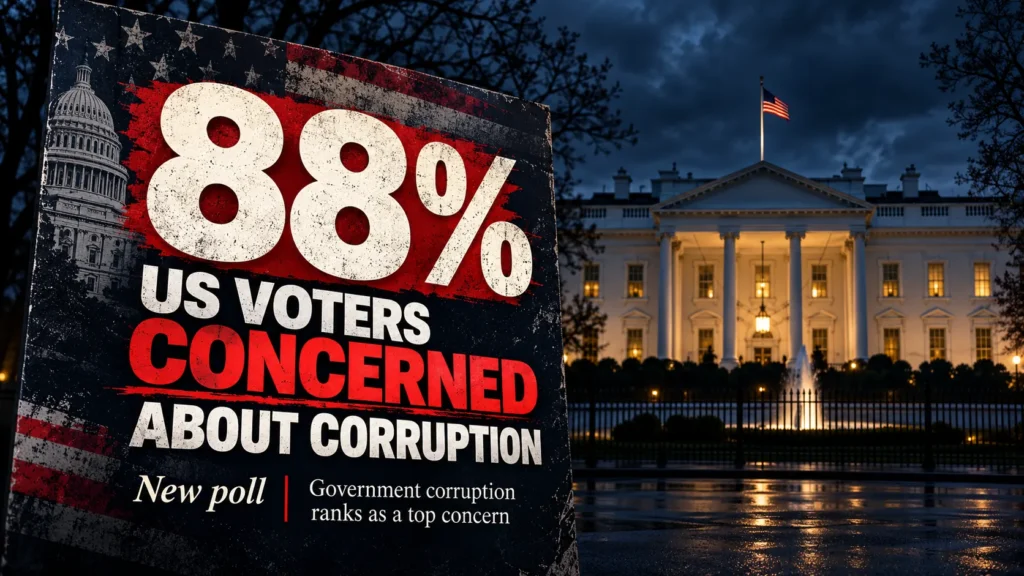
Government corruption has become the most widely shared major concern among American voters in a Fox News poll ahead of the 3 November 2026 midterm elections. The survey found that 88% of registered voters were extremely or very concerned about corruption in government, while President Donald Trump’s job approval fell to 36%, the lowest recorded by Fox News during either of his presidencies.
Corruption overtakes inflation in voter concerns
The Fox News survey, conducted between 9 and 12 October, questioned 1,202 registered voters across the United States.
Government corruption attracted the highest level of concern among the issues tested, although rising living costs remained close behind.
| Issue | Extremely or very concerned |
|---|---|
| Government corruption | 88% |
| Inflation and high prices | 85% |
| Gas prices | 83% |
| Healthcare | 80% |
When considering only those who described themselves as extremely concerned, government corruption again ranked first at 60%, compared with 58% for inflation, 50% for gas prices and 48% for healthcare.
The poll had a margin of sampling error of 2.5 percentage points.
There is an important qualification. Respondents were asked how concerned they were about individual issues, rather than being required to choose a single election priority.
The findings therefore demonstrate widespread concern about corruption, but do not establish that 88% of Americans regard it as their most important voting issue.
Nevertheless, the results suggest that political integrity is becoming a prominent part of the national discussion at a time when many American households remain under financial pressure.
Trump’s approval falls as voters question political leadership
The same survey placed Trump’s job approval at 36%, with dissatisfaction extending beyond corruption to his handling of the economy and inflation.
Democrats also held a 10-percentage-point advantage over Republicans when voters were asked which party they trusted more to handle government corruption.
In the poll’s national congressional voting question, 54% supported a Democratic candidate and 45% a Republican candidate.
Those figures represent voter intentions at the time of the survey, not an election result.
The findings present a complicated picture for both political parties.
While Democrats enjoyed an advantage on corruption and several economic issues, only 35% of voters believed the Democratic Party had a clear plan for addressing the country’s problems. The equivalent figure for Republicans was 33%.
Congress itself received an approval rating of just 15%.
These figures indicate that distrust extends beyond the White House to the wider political establishment.
Is corruption becoming an economic issue?
The connection between corruption and household finances was a central theme of a 17 October discussion hosted by former Republican National Committee chairman Michael Steele on MS NOW.
Steele was joined by Democratic strategist Chuck Rocha, an adviser to Texas Senate candidate James Talarico, and Rob Flaherty, a former senior official in Democratic presidential campaigns.
Their argument was that corruption allegations become more politically significant when voters associate the influence of wealthy individuals with economic decisions affecting ordinary households.
Rather than discussing political misconduct solely as an ethical problem, Democratic campaigns have increasingly attempted to connect it to the cost of food, fuel, housing and other essentials.
This represents a campaign argument rather than an established finding that particular financial difficulties have been caused by corruption.
However, separate research suggests that many Americans already associate government corruption with wider failures of public policy.
A Brennan Center for Justice survey, published in June, found that 88% of respondents believed corruption contributed to major national problems going unresolved.
The survey also found that 94% considered prioritising billionaires and large corporations over the public to be a form of corruption.
Such concerns provide an important backdrop to the enormous sums entering American election campaigns.
Elon Musk’s election spending raises questions about political influence
Billionaire businessman Elon Musk has become one of the most significant financial backers of Republican candidates during the 2026 election cycle.
According to Reuters reporting published on 12 October, Musk had committed approximately $366 million to political spending during the cycle beginning in January 2025.
Around $276 million of that total had been contributed since July 2026.
The spending included $158 million to the Senate Leadership Fund, a Republican-aligned political action committee, and $76 million to Musk’s own America PAC.
A further $10 million went to Lone Star Liberty PAC, an organisation supporting Republican Senate candidate Ken Paxton in Texas.
An investigation by The Texas Tribune traced two major Musk contributions to the Senate Leadership Fund, $75 million and $83 million, which were followed by equivalent transfers into Texas PAC, a separate group supporting Paxton.
These transactions illustrate how large donors can finance extensive political advertising through organisations operating independently of candidates’ official campaigns.
Under US election law, super PACs may accept unlimited contributions but must operate independently of the campaigns they support.
Such donations are not inherently unlawful, and the amount of money spent does not by itself demonstrate corruption or an improper agreement.
However, critics argue that the scale of political funding available to billionaires raises legitimate questions about access, influence and whether wealthy donors receive disproportionate attention from elected officials.
Musk’s political involvement has also attracted scrutiny because of his business interests, including SpaceX’s government contracts.
There is no established evidence that his reported election contributions were exchanged for specific government decisions.
Ken Paxton’s finances attract further scrutiny
The Texas Senate contest offers another example of how financial transparency has become part of the political debate.
Paxton, the state’s Republican attorney general, is standing against Democrat James Talarico.
During Steele’s broadcast, Rocha drew attention to Paxton’s property holdings and questioned how his wealth had grown during his time in public office.
An investigation by ProPublica and The Texas Tribune, published on 4 September, examined apparent omissions and discrepancies in Paxton’s federal financial declarations.
The news organisations identified 15 properties owned or co-owned by Paxton, with an estimated combined market value of approximately $11 million.
Their reporting found potential failures to declare rental income and certain mortgage liabilities, raising questions about whether his disclosures complied with federal ethics requirements.
Paxton’s declared net worth ranged from $1 million to $27 million, reflecting the broad valuation ranges permitted on financial disclosure forms.
Those figures should not be confused with a verified personal fortune or the value of his property portfolio.
Paxton’s campaign rejected the allegations, arguing that he had enjoyed a successful career outside public service and describing the criticism as politically motivated.
Paxton was previously impeached by the Republican-controlled Texas House of Representatives in 2023 over separate allegations but was subsequently acquitted by the Texas Senate.
The more recent financial reporting raises questions requiring scrutiny. It does not amount to a court finding that Paxton has committed an offence.
Americans condemn corruption, but political loyalty changes their judgement
One of the more revealing findings about American attitudes comes from research published by the Brookings Institution on 8 October.
The study examined whether voters judged identical hypothetical presidential misconduct differently depending on which political party the president represented.
Participants were presented with a scenario in which a president directed federal agencies to investigate prominent political opponents.
Among Republican respondents, 22% considered the conduct highly corrupt when attributed to a Republican president, compared with 64% when attributed to a Democratic president.
Democratic respondents also displayed a partisan difference. Forty-eight percent considered the behaviour highly corrupt when attributed to a Democratic president, rising to 78% when attributed to a Republican.
Both groups therefore judged the opposing party more harshly, although the measured difference was larger among Republicans.
The findings suggest that Americans may recognise the same behaviour as potentially corrupt while applying different standards according to political allegiance.
Nevertheless, support for accountability was widespread.
The study found that 81% supported a criminal or ethics investigation when a president used federal agencies against political opponents, including substantial majorities across party lines.
That distinction matters. Partisan loyalties may influence who voters blame, but they do not necessarily eliminate support for investigating abuses of power.
Does concern about corruption translate into votes?
There is another reason to be cautious about declaring corruption the issue that will decide the midterms.
In a separate Fox News survey conducted in September, only 4% of voters spontaneously identified corruption as the country’s most important issue when asked an open-ended question.
The October result of 88% came from a prompted question measuring the strength of concern about a specific subject.
These are different measures and cannot be directly compared as evidence of a sudden surge in electoral importance.
What they establish is that Americans recognise corruption as a serious problem when asked about it.
Whether voters place that concern ahead of economic pressures, immigration, foreign policy or other considerations when casting a ballot remains uncertain.
Campaign strategists may try to make the connection between political integrity and everyday living standards more prominent, but polling alone cannot show that such messages will determine the election.
A test of political accountability
The US midterm elections on 3 November will determine control of Congress and help shape the degree of scrutiny facing the Trump administration during the remainder of his presidency.
Government corruption is clearly a significant public concern, and the amounts being spent on political campaigns have brought questions about money and influence into sharper focus.
Yet corruption is not a single, easily defined allegation.
It can involve criminal conduct, conflicts of interest, improper use of public authority, failures of transparency or behaviour that is lawful but nevertheless considered ethically unacceptable.
Each specific allegation requires evidence, appropriate investigation and fair consideration of the response from those involved.
The larger question is whether voters will demand consistent standards of accountability regardless of which party holds power.
The Fox News poll demonstrates that concern about corruption is widespread.
Whether that concern leads to political consequences, institutional reform or renewed public trust is still an open question.
Watch: Corruption catches up with Trump as voters make it a top election issue
Michael Steele discusses the Fox News poll, campaign financing and the political arguments surrounding corruption with Chuck Rocha and Rob Flaherty in a broadcast published on 17 October 2026.