With Ohio’s governor election days away, Donald Trump and JD Vance are defending Vivek Ramaswamy’s controversial advert featuring his opponent’s estranged mother. Other leading Republicans have condemned it, while historical court records support key elements of Dr Amy Acton’s childhood account. Election analysts are reassessing the race, although polling has yet to show what effect, if any, the advertisement has had on voters.
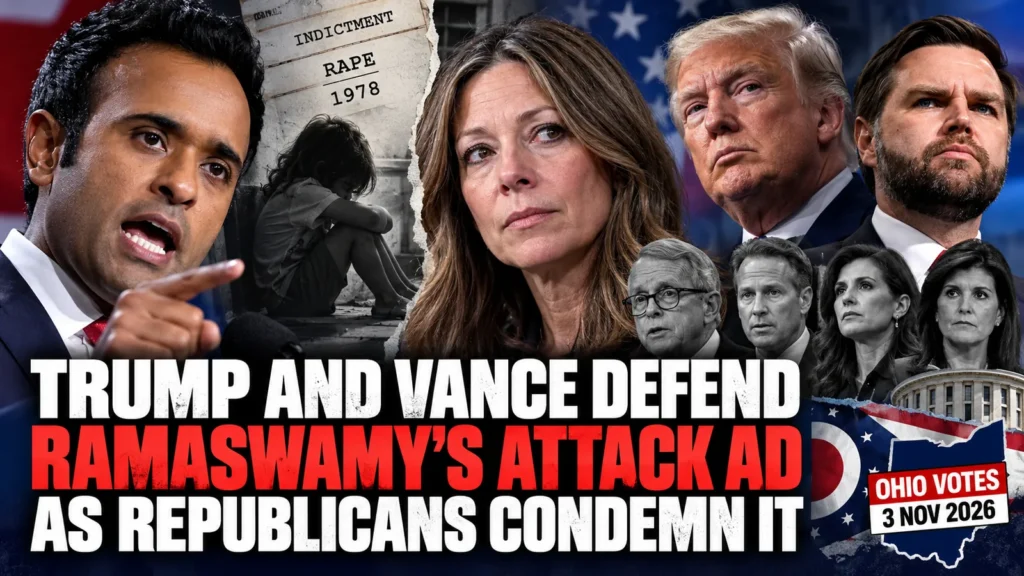
Republican Ohio governor candidate Vivek Ramaswamy is refusing to withdraw a controversial attack advertisement against Democratic opponent Dr Amy Acton, despite historical court records supporting significant parts of her account of childhood abuse. President Donald Trump and Vice President JD Vance have defended the campaign, while prominent Republicans, including Ohio Governor Mike DeWine, Senator Jon Husted and Congresswoman Nancy Mace, have criticised the advert. Ohio chooses its next governor on 3 November 2026.
An attack advert involving a nearly 50-year family estrangement
The controversy erupted on 19 October when a 60-second advertisement appeared online featuring Donna Arthur, the biological mother of Democratic Ohio governor candidate Dr Amy Acton.
In the recording, Arthur accused her daughter of dishonesty, challenged her descriptions of childhood homelessness and urged voters not to support her. She also questioned whether her daughter was capable of helping other people.
But the advertisement did not explain why mother and daughter had reportedly not spoken since 1978.
Acton has previously described experiencing homelessness, neglect and sexual abuse during her childhood. She says she was removed from her mother’s care at the age of 12, after her stepfather was accused of raping her.
Ramaswamy subsequently confirmed that his campaign produced the advert. His team announced plans to spend $4 million promoting it during the closing stages of the election. The figure refers to the advertising buy, not the production cost.
His campaign has maintained that the commercial concerns Acton’s honesty and suitability for public office. Its reliance on testimony from a mother estranged from her daughter for almost five decades has nevertheless generated criticism across party lines.
What the historical court records establish
The dispute prompted renewed examination of criminal records dating back to 1978. On 22 October, Mahoning County Clerk of Courts Michael P. Ciccone released redacted documents relating to the criminal case against Acton’s stepfather, Cledith Arthur.
The documents independently corroborated important elements of material previously supplied by Acton’s campaign. They establish that Arthur was arrested and charged in July 1978 with raping his 12-year-old stepdaughter. A grand jury indicted him that September.
Arthur pleaded not guilty but failed to attend a subsequent court hearing. Authorities issued an arrest warrant after he disappeared, and attempts to locate him continued for years. He died in 2004 without standing trial.
The distinction matters: the records confirm the criminal proceedings and indictment, but not a conviction. The sexual assault allegations were never determined by a jury.
Even with that limitation, the historical records provide independent documentary support for significant aspects of Acton’s account of her childhood and family separation.
Evidence relating to childhood homelessness
Acton has also spoken publicly about living in a tent at a campground outside Youngstown. Historical paperwork identifies Terrace Lake Park as an address associated with Cledith Arthur. A later police report also refers to him having camped there.
These records support the family’s connection with the campground but do not independently establish every detail of Acton’s description of living in a tent. FactCheck.org has examined the available records and reported that documents and other accounts corroborated key elements of her history.
Acton’s brother publicly challenges their mother
The dispute has drawn a response from Acton’s younger brother, Philip Stearns, who has supported his sister’s account and criticised Ramaswamy’s decision to use their estranged mother in political advertising.
Stearns says the children were removed from their mother’s custody following the allegations against their stepfather. He has also said their mother remained married to Cledith Arthur until his death.
In a response video released on 20 October, Stearns described repeated abuse during their childhood and said his sister tried to protect him. His testimony conflicts directly with the suggestion that Acton’s childhood experiences were fabricated.
Acton’s descriptions of her upbringing are not new political claims. She discussed childhood hardship in a 2019 profile in the Youngstown Vindicator, years before launching her gubernatorial campaign.
Ramaswamy stands by the advertisement
During an exchange recorded at a childcare centre on 22 October and circulated on social media, Ramaswamy described politics as a tough sport in which candidates highlight perceived flaws in their opponents.
Shortened versions of the recording suggested that he directly described Acton as flawed because she survived childhood sexual abuse. The longer recording requires a more precise interpretation.
Ramaswamy was accusing Acton of dishonesty and presenting that alleged dishonesty as a political flaw. He did not explicitly say that surviving abuse made her flawed.
That distinction does not resolve the controversy over using a family member estranged from Acton since childhood to challenge parts of an upbringing supported by historical records.
On Friday 23 October, Ramaswamy again insisted that the issue was honesty, not childhood abuse. He accused critics of misrepresenting the advertisement and attempting to distract from Acton’s political record.
Donald Trump and JD Vance defend Ramaswamy
President Donald Trump publicly backed Ramaswamy’s decision to keep broadcasting the advertisement. At an Iowa campaign rally on 22 October, Trump said Ramaswamy had contacted him for advice and, according to the Associated Press, encouraged him to continue using the commercial.
Trump also promoted the advertisement on Truth Social and criticised Ohio Governor Mike DeWine for calling for it to be withdrawn.
Vice President JD Vance adopted a similar position. Appearing alongside Ramaswamy in Ohio on 21 October, Vance criticised Republicans who had objected to the commercial, arguing that they were concentrating on intra-party criticism instead of opposition to Democratic policies and candidates.
Vance defended the advert’s central allegation that Acton had been dishonest. Donald Trump Jr. also helped amplify the video online.
Their positions have put the president, vice president and members of Trump’s political circle at odds with other high-profile Republican figures.
Republican criticism extends beyond Governor DeWine
Update, 24 October 2026: According to the Associated Press, by Friday all five living full-term Ohio governors had criticised the advert, including three Republicans and two Democrats. Former Republican governor Bob Taft joined current governor Mike DeWine in calling for it to stop. Taft said it went beyond the bounds of human decency. The development increases the breadth of opposition within Ramaswamy’s own party, although DeWine has retained his endorsement.
Mike DeWine, Ohio governor
DeWine, who previously appointed Acton as Ohio’s health director, described the advertisement as deeply troubling and called for it to be withdrawn. He said family members should generally remain outside personal campaign attacks.
DeWine has not withdrawn his endorsement of Ramaswamy. His objection is to the advertising tactic, not an announced change in candidate support.
Jon Husted, US senator
Ohio Republican Senator Jon Husted said he would not have run the advertisement. Husted is also campaigning in a closely watched Senate contest and has appeared with Ramaswamy and Vance. His criticism did not amount to withdrawing political support.
Frank LaRose, Ohio secretary of state
LaRose distanced himself from the strategy, indicating that it was not the type of commercial he would have chosen.
Nikki Haley, former presidential candidate
Former Republican presidential candidate Nikki Haley, who clashed with Ramaswamy during the 2024 primaries, criticised his character and described him as “a bad guy” in reaction to the controversy.
Nancy Mace, Republican congresswoman
South Carolina Congresswoman Nancy Mace strongly condemned the advertisement in a CNN appearance on 21 October, describing it as the most offensive campaign advert of the election season and challenging Vice President Vance’s defence.
Lydia Mihalik, Ohio development director
Lydia Mihalik, a Republican member of DeWine’s cabinet, criticised the use of Acton’s childhood experiences in political advertising and said the advert crossed a boundary campaigns should respect.
These Republican responses are not identical. Some demanded withdrawal while others expressed disapproval but continued to support Ramaswamy. They nevertheless demonstrate that criticism does not come only from Democrats.
Other campaign advertisements have faced scrutiny
Nursing home allegation challenged by records
In August, Ramaswamy’s campaign aired an advert featuring a woman who blamed Acton’s handling of the COVID-19 pandemic for the isolation and death of her mother in a nursing home.
Subsequent reporting established that the deceased woman had lived in Kentucky, outside Acton’s jurisdiction, and died after Acton resigned as Ohio’s health director. Those circumstances undermined the attempt to attribute her death to Acton’s actions.
Convicted child sex offender appeared in another advert
A separate controversy emerged in October when Vernon Edwards appeared in footage used in a Ramaswamy campaign advert about property taxes.
According to local broadcaster WKRC, Edwards had previously been convicted of sexual offences involving children under 13. Ramaswamy’s campaign said it was unaware of his criminal record and removed his appearance from the advertisement.
There is no established evidence that Ramaswamy personally knew of Edwards’ conviction before the footage was used. The incident nevertheless raised questions about campaign vetting.
What do the Ohio election polls actually show?
Ohio voters choose their next governor on Tuesday 3 November 2026. Several polls carried out before the advertisement surfaced showed a competitive contest, although reported margins varied.
The figures below provide a snapshot of published polling available by 23 October, with fieldwork dates rather than publication dates shown.
| Pollster | Fieldwork | Amy Acton | Vivek Ramaswamy |
|---|---|---|---|
| Bowling Green / YouGov | 29 Sep–9 Oct | 50% | 44% |
| On Point Polling | 16–17 Oct | 47.9% | 43.1% |
| Marist University | 15–18 Oct | 50% | 43% |
| Fox News | 15–19 Oct | 50% | 48% |
| VoteHub / Verasight | 1–20 Oct | 46% | 45% |
Figures use each pollster’s published likely-voter results. Some surveys include undecided voters and minor-party candidates, so totals need not add to 100%.
Crucially, these figures cannot reliably measure the effect of the controversial advertisement. The commercial first surfaced on 19 October. Marist and On Point completed fieldwork before then. Fox News finished on the day it emerged, and the VoteHub survey interviewed respondents over a much longer period, overwhelmingly before the controversy.
Publication after 19 October does not mean voters were surveyed after that date. As of 23 October, no independent poll identified in the reporting had been conducted wholly after the dispute began in a way that permitted a reliable before-and-after comparison.
Why the comparison matters
A comparable new poll, particularly from the same organisation with similar methodology, could show whether voting intentions have shifted. Even that would not prove the advertisement caused the movement: debates, national events, competing adverts, turnout and economic concerns can also affect opinions.
Early voting in Ohio began on 6 October, meaning many residents had already voted before the advertisement emerged.
Election analysts change their assessments
On 22 October, the University of Virginia’s Sabato’s Crystal Ball changed its assessment of the Ohio governor’s race from Toss-up to Lean Democratic. On 23 October, the Cook Political Report also moved its rating from Toss-up to Lean Democrat.
Cook discussed the advertisement controversy and its political implications. However, both ratings are the judgements of analysts assessing multiple factors, not surveys measuring voter intentions or evidence that any particular share of the electorate changed its mind.
Could the controversy affect other Republicans?
The disagreement also matters beyond the governor’s election. Ohio is holding a US Senate contest between Republican Jon Husted and Democrat Sherrod Brown on 3 November.
Husted has distanced himself from the commercial while remaining aligned with the wider Republican campaign in Ohio.
Commentators have raised questions about whether the dispute might affect Republican enthusiasm or independent voters. Others argue that many people have already decided how to vote and any late effect could be limited. The actual electoral impact remains unknown.
Ohio votes on 3 November
Ramaswamy maintains that the advertisement raises legitimate questions about his opponent’s credibility. Acton and her supporters say the campaign is exploiting childhood trauma through the claims of a mother estranged from her daughter for nearly 50 years.
Historical documents support significant elements of Acton’s childhood account, while the campaign continues to defend its decision to air the advert. Trump and Vance support Ramaswamy’s approach, but DeWine, Husted, Haley, Mace and others have voiced objections.
The immediate questions concern the reliability of the advertisement and the judgement involved in producing it. The next useful evidence about voters’ response will be comparable surveys conducted after the controversy became public.
The political reaction is visible, but the advertisement’s effect on voting intentions has not yet been established.
Sources and further reading
- Associated Press: Republican reactions, governors and campaign tour
- FactCheck.org: court records and Acton’s childhood account
- Ohio Capital Journal: historical records and family background
- Mahoning County court-document collection
- Mediaite: full context for Ramaswamy’s remarks
- Reuters: Vance’s response and Republican criticism
- Axios: reaction to the advert
- CNN transcript: Nancy Mace
- WKRC: Vernon Edwards and campaign advertising
- On Point Polling: original 16–17 October survey
- Marist: Ohio October polling
- VoteHub / Verasight: polling report and fieldwork
- Cook Political Report: 23 October assessment
Watch the campaign footage and responses
Ramaswamy discusses the Acton advert
Watch the video directly on YouTube.
Original campaign advert featuring Donna Arthur
Watch the video directly on YouTube.
Amy Acton’s brother Philip Stearns responds
Watch the video directly on YouTube.