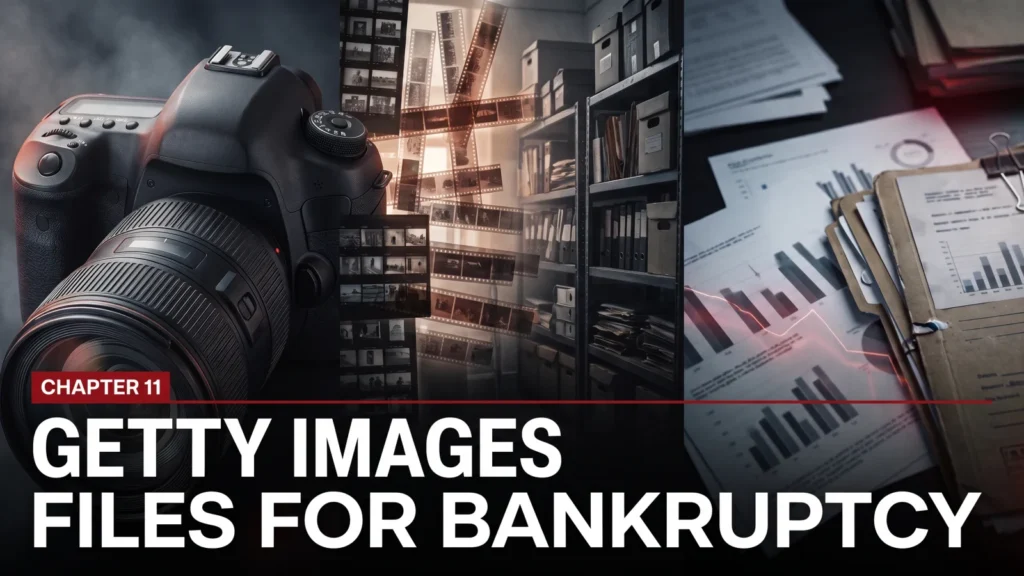
Getty Images has filed for Chapter 11 bankruptcy protection in the United States as part of a planned financial restructuring, following mounting debt pressures, costly investor litigation and the collapse of its proposed merger with Shutterstock.
The photographic agency filed its petition in the US Bankruptcy Court for the District of Delaware on 21 October 2026. It says it intends to continue supplying photographs and video, paying employees and contributors, and serving customers while it reorganises its finances. The company has not announced that it is closing down.
The restructuring could take Getty Images private under the ownership of affiliates of the Getty family and Koch Equity Development. Existing shareholders are expected to lose their shares without a payment under the proposed plan. The reorganisation remains subject to court and other necessary approvals. Getty’s 21 October filing with the US Securities and Exchange Commission confirms the proceedings.
Why has Getty Images filed for bankruptcy?
The financial problems go well beyond the rise of artificial intelligence. In its own restructuring disclosure, Getty identifies more than $200 million in judgments and interest related to litigation brought by holders of share warrants. It also cites the failed Shutterstock merger and approximately $239 million in annual debt-servicing costs on a financing structure originally intended to bridge the business towards that merger.
The disputes over warrants concern investors’ contractual rights to buy Getty shares. They are separate from the company’s copyright disputes involving AI businesses. Getty had already paid a substantial judgment and faced further legal exposure, adding pressure to available cash.
The company’s formal restructuring disclosure sets out these pressures in detail. The fact that Getty entered Chapter 11 does not, on its own, establish that its underlying photography business has ceased to be viable.
What happened to the Shutterstock merger?
Getty had planned to merge with Shutterstock in a deal valued at approximately $3.7 billion. The transaction was abandoned in July 2026 after a lengthy competition investigation in Britain.
The UK’s Competition and Markets Authority had concluded that the merger could proceed only if Shutterstock’s editorial photography operation was sold to an approved buyer. The regulator was concerned that bringing together major suppliers of news, sport and entertainment imagery would reduce choice for UK media organisations and could increase prices. Getty and Shutterstock decided not to proceed.
Crucially, the CMA drew a distinction between stock content and editorial content. It considered generative AI an increasingly important competitive force in the market for commercial stock imagery, but remained concerned about competition in authentic editorial photography. The CMA’s 7 July announcement explains its decision.
Is artificial intelligence responsible?
AI-generated images are changing the economics of stock photography. Advertisers and other commercial customers can now generate some illustrations and generic imagery rather than licensing existing pictures. That creates competitive pressure for companies including Getty and Shutterstock, but it would be misleading to describe AI as the sole proven cause of this bankruptcy.
Getty has not ignored AI. It has developed generative AI services built around licensed content. More importantly, its financial figures show different trends across its businesses.
In the second quarter of 2026, Getty reported editorial revenue of $96.5 million, up 9.2% from a year earlier, while creative revenue of $127.4 million fell 2.6%. Overall quarterly revenue declined 2.5% to $229.1 million, and the company reported a net loss of $85.8 million. These figures come from Getty’s published second-quarter results.
The editorial increase is not proof that news photography is immune to AI or broader financial pressure. Getty also attributed editorial demand to major sports coverage, including the 2026 Winter Olympics and FIFA World Cup, in its second-quarter SEC report. Nevertheless, the contrast challenges the simple claim that AI has destroyed the entire photography market.
What happens next?
Under the proposed plan, Getty family interests and Koch Equity Development would support a recapitalisation described as an equity commitment of up to $533 million. That headline figure includes financing and the conversion of existing debt, so it should not be read as $533 million of new cash arriving immediately.
A new SEC filing dated 26 October confirms that Getty borrowed $85 million on 23 October under an interim debtor-in-possession facility. The overall facility provides for financing of up to $143 million, subject to its terms and approvals. This is intended to help the company trade during the court-supervised process.
Getty expects to complete the restructuring by the end of 2026, although the timetable and final outcome are not guaranteed. Customers and contributors should therefore distinguish the company’s bankruptcy protection filing from a business shutdown.
Why it matters for journalism
Getty’s financial crisis raises wider questions about the future of licensed images. AI can create a convincing picture of a scene that never happened; newsrooms also need photographs and video that document real events, with reliable provenance and editorial accountability.
The evidence currently points to a complicated financial restructuring driven by litigation, borrowing costs, a failed merger and changing markets. AI competition forms part of that wider picture, but the most important distinction is between the pressure on generic stock imagery and the continuing commercial demand for verified news photography.
Primary sources
- Getty Images: SEC filing confirming Chapter 11 proceedings, 21 October 2026
- Getty Images: restructuring disclosure and plan
- Getty Images: financing filing, 26 October 2026
- Competition and Markets Authority: Shutterstock merger abandoned, 7 July 2026
- Getty Images: second-quarter financial results, 10 August 2026