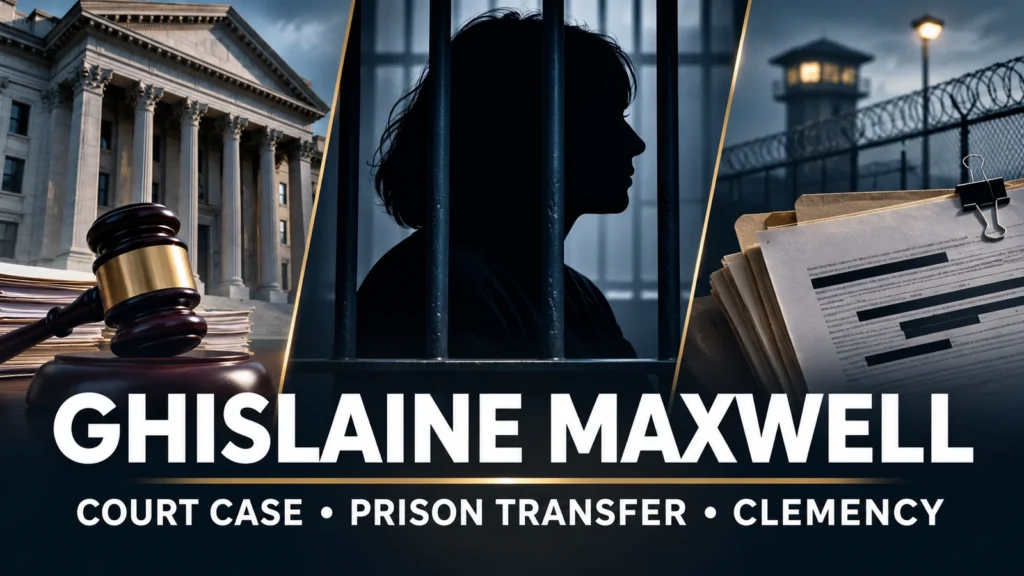
Ghislaine Maxwell remains in a Texas federal prison serving a 20-year sentence, but the court case surrounding Jeffrey Epstein’s former associate has not entirely fallen silent.
A US judge rejected Maxwell’s latest major challenge to her conviction in August 2026. Papers made public in October show she continued to seek reconsideration, while members of Congress are still demanding answers about her move to a less restrictive prison and the possibility of presidential clemency.
The different proceedings can be easy to confuse. Her conviction stands. The new documents contain claims made by Maxwell, not findings that her trial was unfair, and questions about her treatment in prison do not establish that a political deal was made.
Where is Ghislaine Maxwell now?
Maxwell, 64, is held at Federal Prison Camp Bryan in Texas, a minimum-security institution. She was convicted in December 2021 of offences linked to recruiting and grooming underage girls for Epstein, and received a 20-year sentence in June 2022. Her reported projected release date is July 2037, although federal release calculations can change.
The US Department of Justice case record provides the background to her prosecution. Epstein died in federal custody in August 2019 while awaiting trial; his death was ruled a suicide.
What happened to her attempt to overturn the conviction?
On 25 August 2026, US District Judge Paul Engelmayer denied Maxwell’s petition under Section 2255, a procedure used to challenge the legality of a federal conviction or sentence. In his 67-page written decision, he said the evidence at her trial established her guilt and rejected claims that prosecutors had concealed decisive evidence or that new material warranted relief.
The judge found that many arguments had already been rejected on appeal or could have been raised earlier. He also concluded that documents made public through the Epstein Files Transparency Act did not exonerate Maxwell and, where relevant, often reinforced the trial findings.
This followed another setback in October 2025, when the US Supreme Court declined to take up her earlier appeal, which centred in part on the scope of Epstein’s Florida non-prosecution agreement. The August judgment denied her a certificate of appealability at district-court level; that did not automatically erase every possible future procedural route, but it left the conviction in force.
What was filed on 21 October 2026?
The most recent substantial public court material identified in this review appeared on 21 October. The US Attorney’s Office filed a cover letter and five redacted attachments under docket entry 874 in United States v Maxwell. Together they amount to 435 pages.
The packet includes a memorandum written by Maxwell herself asking for a judgment to be altered or amended under Rule 59(e), with arguments concerning evidence disclosure, Epstein’s Florida agreement, witness testimony and matters raised by later document releases. The memorandum is dated 22 September; 21 October is the date the redacted material was publicly docketed.
It would be misleading to describe all 435 pages as newly discovered evidence. The attachments contain older records, extracts, argument, repeated pages and an unsigned proposed order. An unsigned proposal is not a ruling. The publicly available docket checked for this article did not show an order overturning Maxwell’s conviction or granting a new trial.
The filings can be followed through the public docket index. The arguments have not been independently accepted by the court, and allegations about other people mentioned in the records should not be treated as proof of misconduct.
Why was she transferred to a minimum-security prison?
On 1 August 2025, Maxwell was moved from the low-security Federal Correctional Institution Tallahassee in Florida to the minimum-security camp at Bryan, Texas. The transfer came roughly a week after she was interviewed on 24 and 25 July by Todd Blanche, then the Deputy Attorney General.
The timing prompted questions from lawmakers, particularly because prison placement rules generally restrict people with a sex-offender public-safety designation from minimum-security camps without a waiver. Reporting by The Marshall Project in September 2026 identified Rick Stover, a special assistant to the Bureau of Prisons director, as the approving official, which the bureau confirmed to the publication.
On 9 October 2026, Senator Cory Booker demanded further records from Bureau of Prisons director William Marshall III. Booker sought the waiver paperwork, an explanation of who authorised the move and details of the roles played by prison officials and Blanche. He asked for a response by 19 October.
The Bureau of Prisons has said the transfer was based on security considerations and denied that preference, special treatment or political influence determined it. Blanche has also denied discussing a prison transfer or pardon in the interview. Lawmakers dispute whether the explanation and supporting records are adequate.
A prison policy change in May 2026 has added to the controversy, but that change occurred months after Maxwell’s August 2025 move. Its existence does not establish why the earlier transfer was authorised. No public evidence reviewed here proves an exchange of favourable prison treatment for testimony.
What did Maxwell tell the Justice Department?
The Justice Department published redacted transcripts and audio of Blanche’s two-day July 2025 interview with Maxwell. She discussed Epstein’s associates, properties and activities, and disputed various accusations. Those answers represent her account, not independently verified findings.
Her remarks about prominent individuals have attracted scrutiny. It is especially important to distinguish her claimed recollections from documents, sworn testimony and investigative findings, because Maxwell is a convicted participant in Epstein’s abuse and has an evident personal interest in securing legal relief.
Why did she refuse to answer Congress?
On 9 February 2026, Maxwell appeared remotely before the House Oversight Committee and invoked her Fifth Amendment right against self-incrimination, refusing to answer substantive questions. Committee chairman James Comer said lawmakers wanted answers about the crimes committed by Epstein and Maxwell and about possible associates, according to Reuters’ account of the deposition.
Her lawyer said she would cooperate if President Donald Trump granted clemency. That was a conditional offer advanced by her representative, not confirmation that clemency had been agreed. A person’s appearance in Epstein-related documents, on a contact list or in a witness account does not by itself demonstrate criminal wrongdoing.
Could Donald Trump pardon her?
The US president has constitutional power to issue pardons and commutations for federal offences. On 29 July 2026, the Senate agreed by unanimous consent to S.Res. 608, a resolution opposing a pardon or other clemency for Maxwell. The measure expresses the Senate’s view and is not legally binding on the president.
As of 9 November 2026, this review found no confirmed presidential pardon or commutation for Maxwell. Speculation about such an outcome remains speculation unless an official decision is announced.
What is confirmed, and what remains unanswered?
- Confirmed: Maxwell’s 2021 conviction and 20-year sentence remain in force following the August 2026 ruling.
- Confirmed: her September reconsideration papers and supporting materials were publicly filed in redacted form on 21 October.
- Confirmed: she was moved to a minimum-security Texas camp in August 2025, and lawmakers have requested more information about the decision.
- Not established: that the October filings prove suppressed evidence, that the prison transfer was a reward for cooperation or that a clemency arrangement exists.
- Still to watch: any substantive ruling on the latest motion, documentary answers from prison officials and any formal White House action.
The broader Epstein document disclosure process continues separately from Maxwell’s challenge to her conviction. The Justice Department said on 30 January 2026 that it had released nearly 3.5 million pages under the Epstein Files Transparency Act. Publication makes material available for scrutiny; it does not make every allegation in those documents true.
For background, see Fish 4 News’ earlier report, Trump, Epstein and 23,000 Files: How We Got Here.
Sources and further reading
- US District Court: 25 August 2026 opinion and order
- US Attorney’s Office: 21 October 2026 filing letter (docket 874)
- Maxwell’s September 2026 memorandum, publicly filed in October (docket 874-1)
- Senator Cory Booker: 9 October request for transfer records
- Senator Sheldon Whitehouse: June 2026 transfer inquiry and BOP response
- US Justice Department: July 2025 Maxwell interview transcripts and audio
- US Senate: adoption of resolution S.Res. 608
- Reuters: 25 August 2026 decision and reported release timetable