A Mexican federal judge arrested in Colombia is facing nine US criminal charges after prosecutors accused him of accepting a $2 million bribe to release an alleged senior member of a Canadian-led drug trafficking organisation. Mexican authorities have separately confirmed four pre-existing investigations into his judicial conduct.
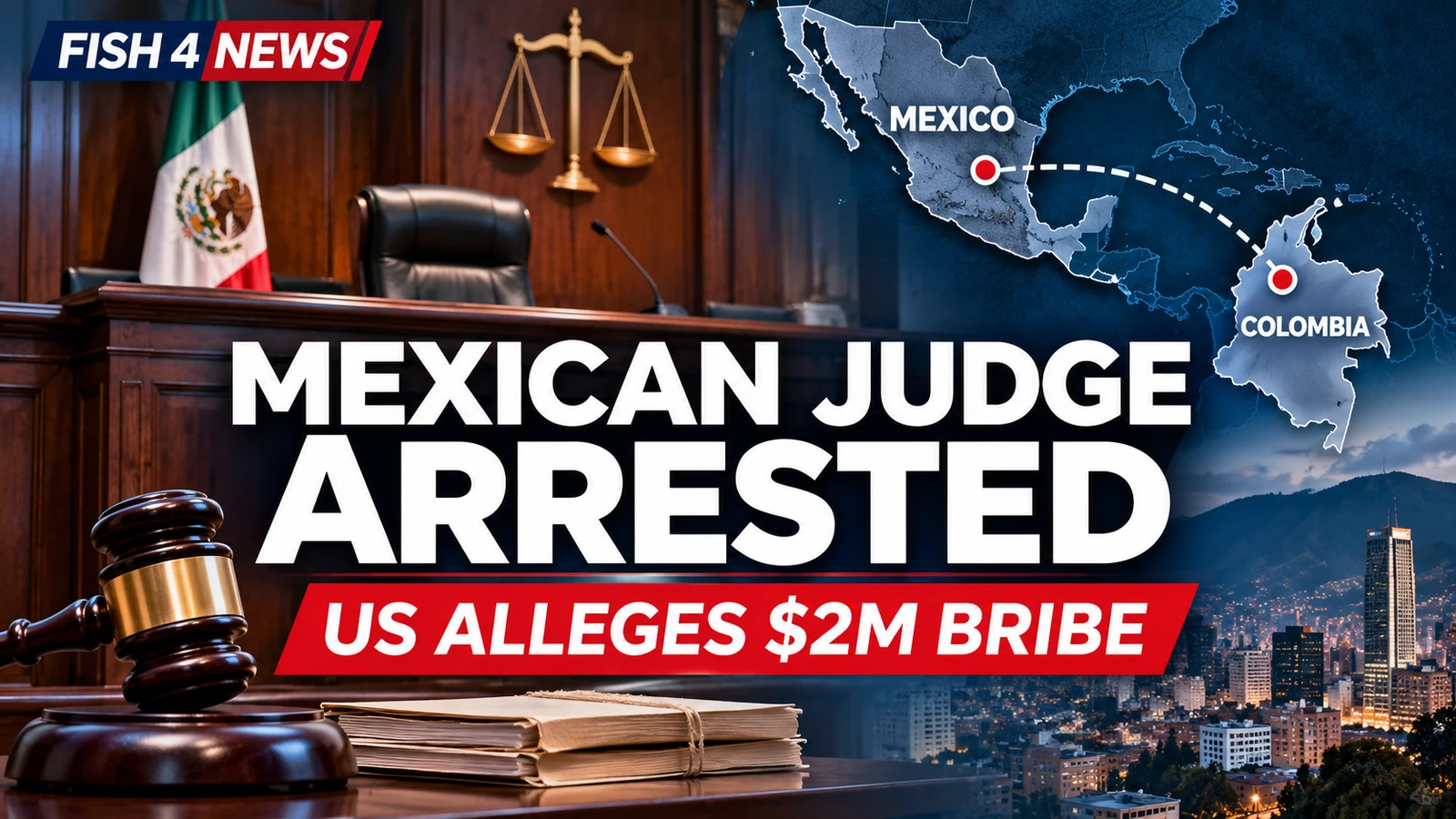
Luis Benítez Alcántara, 49, was detained in Colombia on Sunday 1 November 2026, according to the US Department of Justice (DOJ), which announced the case on 5 November. The United States says it intends to seek his extradition. He has not been convicted, and his lawyer disputes the prosecution’s account.
Why American prosecutors are pursuing a Mexican judge
The allegation centres on Andrew Clark, 36, a Canadian accused in the United States of involvement in an international cocaine-trafficking organisation allegedly led by former Olympic snowboarder Ryan Wedding. US authorities describe Clark as Wedding’s second-in-command. Both men face separate US criminal proceedings; the allegations against them remain subject to those proceedings.
Clark was arrested in Mexico in October 2024. Benítez was the Mexico City district judge overseeing his extradition proceedings after the United States formally requested his transfer in November that year.
According to a second superseding indictment filed in California on 4 September 2026, Clark transferred approximately $2.75 million through intermediaries between November 2024 and February 2025 to secure his release. Prosecutors allege that an agreement was reached to pay the judge approximately $2 million.
The indictment claims Benítez received the full $2 million on 24 February 2025, the same day he granted Clark bail and ordered him released. Clark was arrested again days later and transferred to the United States, where his case remains pending. These are prosecution allegations, not established findings of fact.
What has the judge actually been charged with?
Benítez is charged with nine counts of being an accessory after the fact under US federal law. Prosecutors allege that his actions helped Clark avoid detention and impeded his possible prosecution or punishment. Despite the bribery allegations, the announced US indictment does not list a separate substantive bribery count against Benítez.
The DOJ says each count carries a maximum sentence of 15 years if he is convicted. Adding those maximums produces a theoretical 135-year total, a figure circulated in online videos. It is not a sentence imposed by any court, nor does it establish that all nine maximum terms would be served consecutively.
The case is being pursued in the Central District of California because of the underlying US criminal proceedings. Benítez was a judge in Mexico City, not California. His arrest took place in Colombia.
Four other investigations in Mexico
Mexico’s Judicial Discipline Tribunal has confirmed that four investigations were already open concerning alleged irregularities in Benítez’s work as a judge. The tribunal said those complaints were different in nature from the new US allegations and announced a further inquiry following news of his arrest.
The tribunal has not publicly detailed the allegations or outcomes of those four earlier investigations, according to reporting by El País México. Their existence should not be taken as proof of wrongdoing in the US case.
Judge’s lawyer challenges US prosecution
Benítez’s lawyer, Miguel González Sánchez, has rejected the assertion that his client released Clark to help him evade justice. In a statement reported by the Associated Press on 6 November, he argued that any potential responsibility arising from the exercise of Mexican judicial duties should be determined in Mexico under Mexican law.
The defence maintains that the judicial decision was made lawfully and says that Benítez must receive due process and the presumption of innocence. It is not yet clear whether Colombia will agree to extradition, or when proceedings on that request might be resolved.
How the Ryan Wedding case fits in
Wedding, a former Canadian Olympic snowboarder, is accused by US prosecutors of leading a large transnational cocaine-trafficking operation linked to killings and attempted killings. He was apprehended in Mexico in January 2026 and transferred to US custody. He has pleaded not guilty to the charges against him.
According to the DOJ’s 5 November announcement, Wedding is scheduled for two separate trials on 31 March and 26 October 2027. Clark’s criminal case also remains pending. Their alleged activities provide the background to the charge against Benítez, but none of those allegations should be treated as proven merely because an indictment has been filed.
What happens next?
The next significant step is the proposed US extradition request to Colombia. That process is distinct from any Mexican disciplinary proceedings and from the criminal cases against Clark and Wedding.
As of 9 November 2026, Fish 4 News has not independently confirmed a Colombian court ruling on the extradition request or any finding of guilt against Benítez. The key unresolved questions are whether he will be sent to the United States, what evidence prosecutors will present and what emerges from Mexico’s separate investigations.
Watch the report
A video circulating about the case refers to a possible 135-year sentence. That figure represents adding together the statutory maximum for the nine charges, not an actual sentence. The verified court and DOJ material below is the basis for this report.