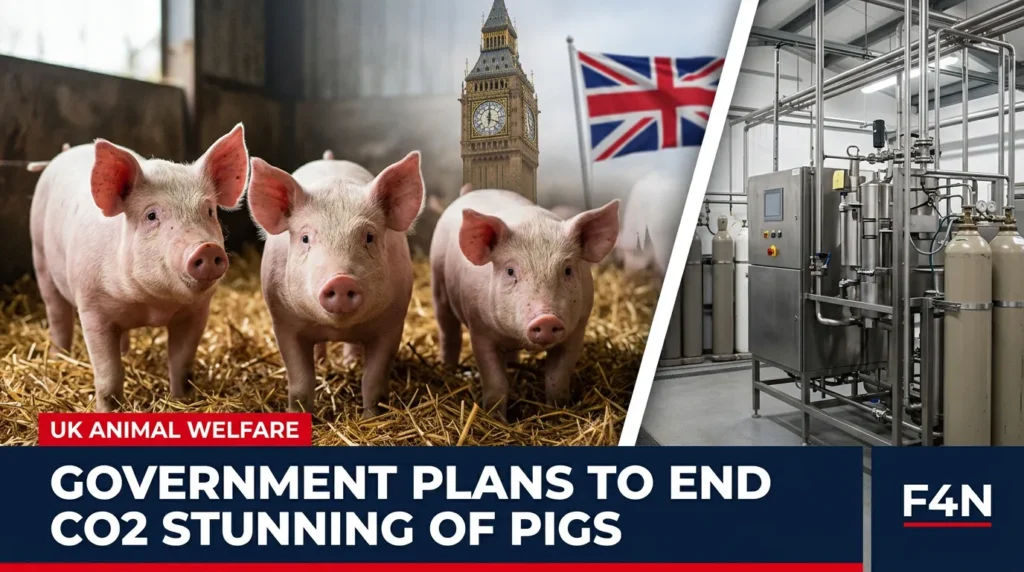
The government has opened a consultation on replacing high-concentration carbon dioxide stunning of pigs. Welfare experts say the method causes avoidable suffering, but processors warn that alternative systems will require investment, testing and careful planning.
The government has set out plans to phase out the use of high-concentration carbon dioxide (CO2) to stun pigs before slaughter. Defra announced the consultation on Monday 26 October 2026, with possible alternatives including argon gas and automated electrical stunning. No ban has yet taken effect, and no legally binding phase-out date has been agreed.
What is the government proposing?
The proposals follow the government’s animal welfare strategy for England, published in December 2025, which explicitly committed to banning carbon dioxide stunning of pigs, subject to consultation. The latest Defra announcement is a step towards that commitment, rather than a ban already written into law.
Ministers are seeking views on animal welfare benefits, the costs and practicality of other methods, and how much time businesses may need to replace existing equipment.
Key points:
- The public consultation opened on 26 October 2026 and closes on 21 December 2026.
- The Food Standards Agency’s February 2024 survey found 90% of pigs were stunned using high-concentration CO2 in England and Wales.
- The independent Animal Welfare Committee recommends a transition within five years, but this is advice, not a legal deadline.
- Northern Ireland’s agriculture minister has referred to a possible three-year phase-out in a UK-wide consultation. The timetable is not settled.
Why is CO2 stunning being challenged?
High-concentration CO2 systems are widely used in larger pig-processing facilities because pigs can be moved through the gas system in groups. However, animals do not lose consciousness immediately, and experts say exposure can cause respiratory distress, fear and pain before stunning takes effect.
The Food Standards Agency’s 2024/25 animal welfare report reproduces results from a slaughter-sector survey conducted in February 2024. It found 90% of pigs in England and Wales were stunned using high-concentration CO2 and 10% by electrical stunning to the head. The figure is a survey result from 2024, not a new count for 2026.
In an independent assessment published in October 2025, the Animal Welfare Committee recommended prohibiting high-concentration CO2 as a stunning method for pigs, as well as mixtures of CO2 and inert gases.
Animal welfare concerns were raised more than 20 years ago
The recommendation is not new. As far back as 2003, the Animal Welfare Committee’s predecessor, the Farm Animal Welfare Council, concluded that high-concentration CO2 stunning was unacceptable and recommended phasing out aversive gas mixtures within five years.
The committee’s 2025 assessment revisited that history and again called for change. The fact that the earlier recommendation was not implemented illustrates how long the debate over welfare, commercial feasibility and replacement technology has continued. A 2022 parliamentary answer also acknowledged the longstanding concerns and practical difficulties associated with alternatives.
Which alternatives could be used?
Defra identifies argon gas and automated electrical stunning as potential alternatives, while recognising that every method needs appropriate safeguards.
Argon reduces the oxygen available to the animal. The Animal Welfare Committee reports that inert gases can reduce aversive reactions compared with high-concentration CO2, although loss of consciousness can take longer. Operators must ensure that animals remain exposed long enough to become irrecoverably unconscious.
Properly applied electrical stunning can produce near-immediate unconsciousness. However, individual restraint, pre-stun handling, reliable electrode positioning and staff competence are essential to avoid other welfare problems.
Replacing CO2 would therefore not remove every risk at slaughter. How systems are designed, tested and operated would remain critical.
When could the practice end?
The consultation runs until 21 December 2026. Ministers have not announced a binding implementation date.
The Animal Welfare Committee recommended that any transition should be as short as possible and, in any case, completed within five years. That is the committee’s recommended maximum period, not the government’s adopted timetable.
On 20 October 2026, Northern Ireland’s Agriculture Minister, Andrew Muir, told the Northern Ireland Assembly that his department had agreed to join a forthcoming UK-wide consultation on phasing out CO2 stunning of pigs over three years. His statement provides an indication of a possible timetable, but it does not establish a legal deadline. The relevant devolved administrations would also need to make or coordinate decisions affecting their jurisdictions. Read the official Assembly record.
Industry warns of costs and safety risks
An independent economic assessment commissioned by the Agriculture and Horticulture Development Board (AHDB), published on 18 March 2026, examined how UK processors might switch from CO2 to alternatives.
The AHDB assessment highlighted substantial financial, logistical and operational challenges. These include new machinery, workforce training, changes to production lines, installation downtime and the risk of disruption to throughput.
It also warned that using argon in commercial abattoirs could introduce additional occupational safety risks for employees. AHDB called for properly funded, commercial-scale trials in the UK before any widespread rollout.
The report did not determine which stunning system should replace CO2 or offer a definitive judgement on the animal welfare merits of each approach. Those questions must be evaluated alongside its economic findings.
Defra says it has been working with processors, manufacturers, gas suppliers and animal welfare groups since April 2024 to assess practical options. Ministers also argue that moving away from CO2 could reduce the industry’s vulnerability to interruptions in gas supplies.
What happens next?
Following the consultation, the government will need to decide what regulatory changes to pursue, which replacement systems can be used safely and what transition period is appropriate. Until the law changes, high-concentration CO2 stunning remains permitted under existing slaughter rules.
The central question is no longer simply whether pigs experience distress from high-concentration CO2. The independent welfare findings are clear. The unresolved issue is how quickly industry can replace the practice with alternatives that improve welfare without creating other avoidable risks.