Russell Brand’s conviction was not based on a rumour or a single television documentary. A three-year Metropolitan Police investigation, testimony from independent complainants, evidence tested in open court and a jury’s unanimous verdicts led to his conviction for one rape and three sexual assaults.
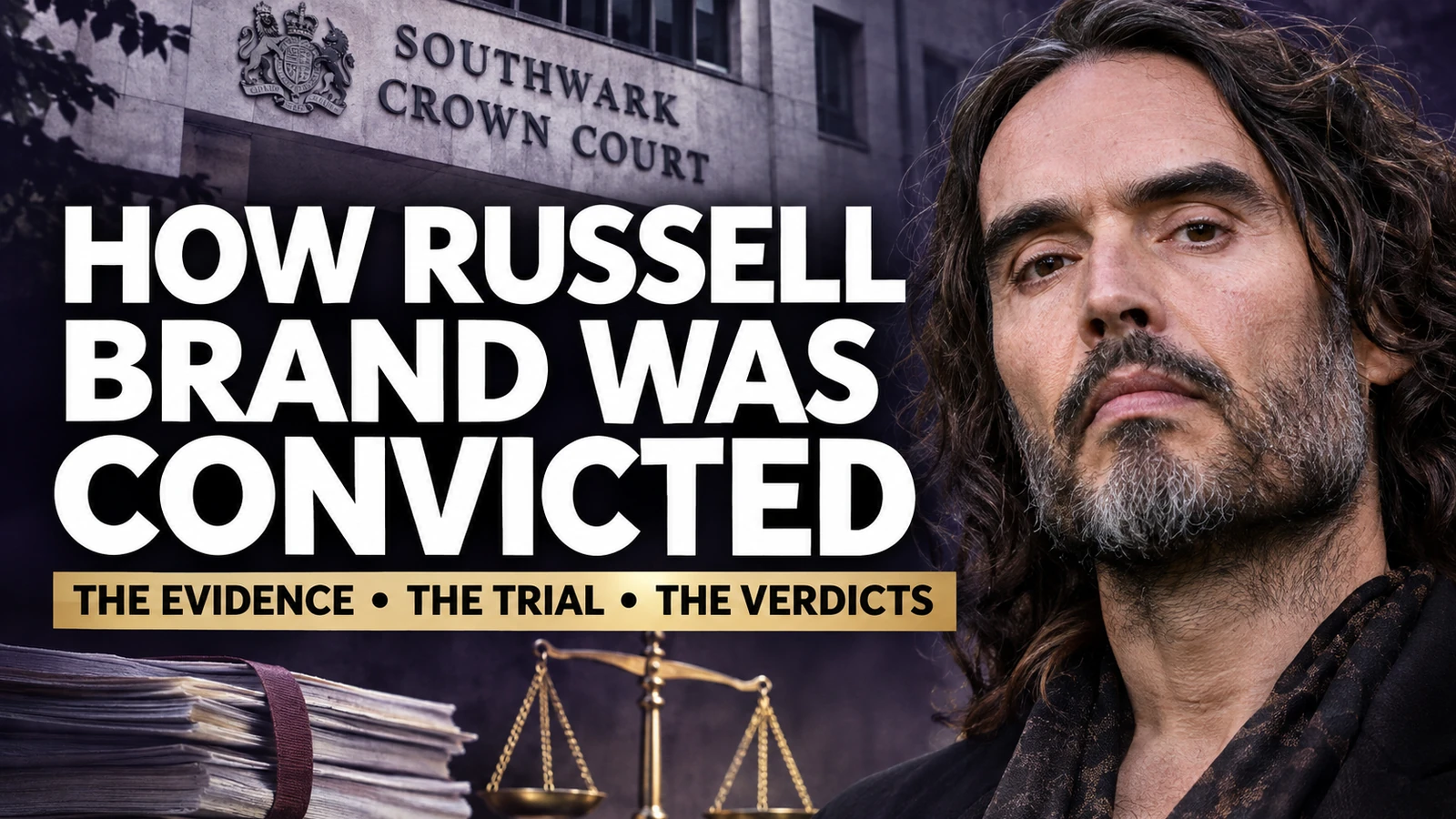
On 5 November 2026, after a four-week trial at Southwark Crown Court, Brand was found guilty of offences committed against four women between 2004 and 2009. He was acquitted of two other rape counts and an attempted indecent assault. On 9 November, Mr Justice Joel Bennathan sentenced him to 10 years and six months in prison. Brand had denied every charge and maintained that his sexual encounters were consensual. See our original verdict report and sentencing report.
The questions raised in the aftermath are reasonable to examine: what did police actually find after so many years? Was there forensic proof? Did the jury hear only accusations? Why did women wait to report? What happened to earlier warnings? And what can be said about the injunction involving Brand’s former girlfriend Jemima Goldsmith? This account separates what was proved in the criminal case from allegations, institutional findings and statements made outside the trial.
The allegations came first, then a police investigation
In September 2023, a joint investigation by Channel 4’s Dispatches, The Times and The Sunday Times reported allegations of sexual assault and abuse involving Brand. He rejected the allegations. The programme itself was journalism, not a criminal judgment, and its allegations should not be confused with the later counts tried at Southwark Crown Court.
Following the broadcast, the Metropolitan Police began investigating reports from women who, according to the Met’s account of the investigation, were not known to one another. Officers established a dedicated team, reviewed reports, interviewed Brand under caution and worked with prosecutors to determine which allegations could support criminal charges. The separate claims made in the programme were not automatically treated as proven, and not every allegation went to trial.
Investigators faced an obvious problem: the alleged events were years old. According to the Met, there was no surviving CCTV or forensic evidence available for these incidents and digital records were limited by time. Rather than filling those gaps with assumptions, police tried to reconstruct who was where, when events could have happened and how each account compared with material independently obtained.
How the detectives built the case
The Met says officers traced and spoke to more than 100 witnesses, took more than 400 witness statements and reviewed over 1,400 documents. They checked historical photographs and floor plans, including those of one of Brand’s former homes and a former workplace, and constructed detailed timelines. They also examined hundreds of hours of performances, broadcasts, interviews and podcasts, alongside Brand’s published books. Source: Metropolitan Police, 5 November 2026.
Those totals describe police investigative work. They do not mean 400 witnesses appeared before the jury or that every document was admitted as evidence. Police enquiries can verify background details, expose inconsistencies, identify possible witnesses and eliminate lines of investigation. Only the evidence admitted at trial is considered by the jury in reaching its verdict.
Brand was interviewed by police on four occasions. The Met says that, when given detailed allegations, he repeatedly said he did not recognise the women. Detectives checked those assertions against the available evidence. Prosecutors later challenged what they saw as a change in his recollection as the trial approached. Brand denied having had non-consensual sexual activity, and that denial was part of the case the jury had to assess. The released police interview footage gives a direct record of how he responded.
From investigation to seven charges
In April 2025, Brand was charged with five sexual offences involving four women. Two further charges concerning two other women followed in December 2025. He pleaded not guilty. The alleged events across the seven counts ranged from 1999 to 2009, although the offences of which he was ultimately convicted occurred between 2004 and 2009. His trial began on 14 October 2026. One original indecent-assault charge was replaced during the proceedings by attempted indecent assault.
The Crown Prosecution Service had to decide whether there was a realistic prospect of conviction on the admissible evidence and whether prosecution was in the public interest. That is not the same test as a verdict. At trial, the prosecution still had to prove each count so that the jury was sure of guilt. See the CPS explanation of rape prosecutions.
What the jury heard in court
Six women gave accounts of alleged offences. Their testimony was challenged in cross-examination, and Brand gave evidence himself. The prosecution was led by Riel Karmy-Jones KC and the defence by Ian Winter KC. The CPS says the women did not know each other and that the prosecution used their accounts alongside supporting witnesses to explain alleged similarities in behaviour. CPS explanation of its case.
The jury also heard from a former friend of Brand who described his pursuit of sexual encounters and claimed he had spoken about an ambition to sleep with 5,000 women. Such testimony was context presented by the prosecution, not independent proof of any particular rape or assault. The legal question remained whether the elements of each charged offence were proved.
The first proved sexual assault: a social event in 2004
In his sentencing remarks, Mr Justice Bennathan described a woman who had wanted to meet the television personality at a social gathering in July 2004. The jury found that Brand sexually assaulted her by grabbing her breasts. The judge referred to the distress she experienced afterwards, but also acknowledged that Brand had been acquitted of a separate, more serious allegation involving that same woman. The judge did not sentence him for the acquitted allegation.
The second: a radio-station worker
The court heard how a woman working at a London radio station was suddenly grabbed, kissed and sexually touched by Brand while his companions stood nearby. The judge accepted her account of being pushed against a wall and touched without consent, describing the conduct as a criminal sexual offence rather than simply outrageous behaviour. He also referred to the distress caused by the presence and reaction of other people. Source: the judge’s sentencing remarks.
The third: rape at Brand’s home in 2009
The rape conviction concerned a woman who had previously engaged in consensual sexual activity with Brand. She later visited his home. The judge said she had agreed to vaginal sex with a condom, but Brand then removed it and anally penetrated her without consent despite her requests to stop. At sentencing, the judge described the resulting pain and lasting harm. Consent to one sexual activity is not consent to another, and consent can be withdrawn.
Reporting of the trial described the woman’s account of a later exchange in which she confronted Brand by text and recalled an apologetic response. It is important not to describe that as a recovered, independently authenticated text exchange unless that is established: it was evidence of what the woman said happened. The judge’s findings and jury verdict, not a claimed screenshot, are the basis for saying this rape was proved.
The fourth: a worker on a television production
Another conviction related to a woman working on a promotional production in late 2009. According to the sentencing remarks, she was told Brand would not continue working unless she gave him a massage. The judge described how Brand then placed his face in her lap and behaved in a sexualised, humiliating manner, with associates present. The jury found the sexual assault proved. Read the sentencing remarks.
Brand’s defence was heard and tested
The defence did not simply concede the prosecution’s case. Brand gave evidence, said he had never engaged in non-consensual sex and disputed the charges. His wife, Laura Brand, also gave evidence for the defence. His barrister argued that a reckless, promiscuous or unkind sexual history was not itself proof of a criminal offence. That legal distinction is correct: bad behaviour does not automatically establish rape or sexual assault.
Mr Winter also argued that the 2023 documentary might have influenced memories, encouraging people to reinterpret past encounters, and questioned why earlier public campaigns such as #MeToo had not prompted reports. Prosecutors argued that the six women did not know one another and that the similarities in their accounts were important. These were competing arguments presented to the jury, not findings to be assumed in advance. Contemporaneous court reporting of the closing cases.
The jury deliberated for around eight and a half hours. On 5 November, it returned four unanimous guilty verdicts but three not-guilty verdicts. Those acquittals are a central part of an accurate account. They show the jury did not convict on every allegation, although they do not reveal the precise reasons for its decisions on individual counts.
Why ‘there was no evidence’ is wrong
A recurring objection is that the absence of DNA, video footage or other forensic material means Brand was convicted on hearsay. That confuses several different concepts. First-hand testimony by a witness about what happened to them is evidence. It is not hearsay merely because it is spoken rather than photographed or recorded.
Hearsay generally involves a statement made outside court being relied upon to prove the truth of what it asserts, subject to important legal exceptions. When a complainant describes an event in court under oath, is questioned and cross-examined, that is direct witness evidence. The jury decides whether it is credible and reliable. The CPS expressly says that independent corroboration is not a legal requirement for a rape prosecution. Read the CPS guidance.
That does not mean an allegation must be believed. Prosecutors must examine alternative explanations and material that could undermine a complaint. In Brand’s case, detectives also checked dates, places, historical records and his own responses. The jury’s question was whether the admissible evidence established each charged offence beyond reasonable doubt, expressed in England and Wales as being sure.
Why didn’t the women report it at the time?
Some women do report immediately; others tell a friend or manager; some report years later or never make a formal complaint. Delay alone cannot establish whether an allegation is true or false. Shame, fear, uncertainty about whether anyone will believe them, dependence on work and the power of the person complained about can all be factors. These are possible explanations, not a substitute for assessing evidence in any individual case.
Crucially, in Brand’s case the claim that nobody spoke up is contradicted by documented industry reviews. A serious complaint was made by a Channel 4 employee in 2009, according to the broadcaster’s own later inquiry, but was not properly investigated or escalated. Channel 4 apologised. Its review also found no evidence that senior Channel 4 management knew about the sexual-offence allegations contained in the 2023 documentary. Both findings matter. Channel 4’s published findings.
Banijay, successor to the company that produced Brand’s earlier television work, reported that it had found evidence of informal complaints to more senior production staff about requests for audience members’ phone numbers and women feeling uncomfortable. The concerns were not adequately addressed. Its review said it found no formal complaints during the period it examined, and its findings do not establish that executives knew about the offences later proved in court. Banijay’s investigation summary.
A separate BBC review of Brand’s time on Radio 2 and 6 Music examined eight complaints and concluded that some staff had felt unable to raise concerns. The BBC apologised and acknowledged that a formal complaint from 2007 was not effectively handled. The review also drew distinctions between conduct it could substantiate and rumours it could not. Reporting on the BBC review.
So there are two different questions: whether Brand committed the offences tried in court, answered by the jury; and whether media workplaces dealt responsibly with earlier complaints, addressed in the BBC, Channel 4 and Banijay reviews. Neither should be presented as proof of the other.
The verdict and sentence
On 9 November, Mr Justice Bennathan imposed a total sentence of 10 years and six months: nine years for rape, with a further 18 months for the sexual assault offences structured consecutively, while the individual sexual-assault sentences ran concurrently with one another. Brand will be subject to the sex offenders’ notification requirements for life. Metropolitan Police sentencing statement.
The judge said he was sentencing only for crimes proven against the four women. He expressly excluded allegations in the documentary and the three charges on which the jury acquitted Brand. In the judge’s account, Brand’s celebrity and entourage had enabled conduct showing disregard for women’s right to refuse. These are sentencing findings about the proved offences, not judicial endorsement of every allegation ever made about Brand. Full sentencing remarks.
The objections, examined
‘It was just hearsay’
No. The jury heard first-hand accounts that were tested in court, along with other evidence. Lack of forensic material is not the same as lack of evidence. A jury can acquit where it is not sure, as it did on three counts.
‘They waited too long, so the accounts cannot be trusted’
The delay creates legitimate investigative difficulties, which police acknowledged. It is not, by itself, proof that a complainant is lying. Historical cases are investigated by looking for other material that helps test dates, recollections, opportunities and consistency. The jury had to assess the quality of each account, including its limitations.
‘The documentary told them what to say’
That was a defence argument, and it was put before the jury. Prosecutors said the women were independent of each other. The jury accepted the case on four counts and rejected three. The verdicts do not establish what each witness remembered before the documentary, and it would be wrong to claim they do, but the jury was not prevented from considering the risk of influenced memory.
‘He admitted being promiscuous, not a rapist’
Promiscuity is not a crime, and the prosecution did not have to prove it was. What mattered was whether there was consent to the specific acts charged and whether the prosecution proved the offence. The jury found that four specific criminal offences occurred.
‘Women were paid to accuse him’
Claims of payments or compensation influencing these verdicts require evidence. In closing, the prosecutor said the complainants had not come forward seeking financial compensation. We have not found reliable evidence substantiating the claim that these convictions were bought. That is different from saying no woman connected with Brand has ever received a payment for any reason. Source: court reporting.
‘If he was guilty, he would have been convicted on all seven charges’
Criminal juries assess counts individually. An acquittal on one charge does not cancel a guilty verdict on another. Conversely, a conviction on one charge does not prove any other allegation. The judge explicitly respected that distinction at sentencing.
‘His father says the jury was wrong’
Brand’s father has publicly criticised the verdicts and described his son as a victim. Family members can express their views, but those statements are not a legal reversal or new evidence in themselves. Our separate report covers his reaction.
What women and former colleagues said outside court
Claims circulating after the verdict also refer to comedians and former colleagues saying that people in the entertainment industry had known about Brand’s behaviour. Those reactions are relevant to the culture surrounding him, but they should not be folded into the criminal evidence unless a person actually testified or provided admissible material in this case.
Scottish comedian Daniel Sloss told Dispatches in 2023 that women in comedy had warned each other about Brand for years, and that groups existed in which female comedians warned one another about certain men. This was an account of warnings and reputation, not Sloss claiming to have witnessed the four crimes. Watch the 2023 interview extract.
Former assistant Helen Berger told Dispatches that Brand asked staff to obtain phone numbers for women in his audiences and that concerns were raised with managers. Unlike some other commentators, Berger also provided a witness statement that was read to the jury during the criminal trial. She described people around Brand normalising behaviour she found troubling but did not claim to have witnessed the four offences of which he was convicted. Her evidence and Banijay’s later findings illuminate the workplace culture, not independent proof of every allegation. See ITV’s report of her trial evidence.
Comedian Katherine Ryan described feelings of grief and relief following the guilty verdicts and discussed the private conversations women had been having about the case. It would nevertheless be inaccurate to say she had publicly confirmed that an earlier allegation she made about an unnamed comedian referred to Brand. Reporting of Ryan’s response.
Jemima Goldsmith, a later allegation and the court injunction
On 9 November 2026, Jemima Goldsmith, who was Brand’s former girlfriend rather than his wife, alleged publicly that he had physically assaulted her in 2014 and subjected her to coercive control and abuse. She said she had called police to remove him from her house, had not pressed charges and had kept quiet partly to protect her teenage children from publicity. Goldsmith said she supported the women who testified and had assisted journalists investigating Brand. These are her allegations and her account, not additional criminal convictions. Read reporting of Goldsmith’s statement.
Her statement revived scrutiny of a distinct 2014 civil case. Massage therapist Szilvia (Sylvie) Berki made allegations following a visit to Goldsmith’s home arranged as a birthday gift for Brand. Brand and Goldsmith disputed her account and alleged she had embarked on a campaign of harassment and unwanted communications. Thames Valley Police investigated her complaint and took no further action. The 2014 High Court judgment records the disputed accounts; it does not prove that Berki’s original allegation was true.
Brand and Goldsmith obtained interim anti-harassment relief in 2014 and a final order in 2015. Berki represented herself in the High Court proceedings. The case ended in summary judgment rather than a trial in which the underlying incident was resolved by witness testimony. In November 2026, tax lawyer Dan Neidle published and analysed the final order, arguing that its restrictions on Berki’s communications extended far beyond preventing harassment. See the order and legal analysis.
The 2015 injunction is particularly controversial because, on its face, it appears to restrict Berki from speaking even privately about the incident, potentially including reporting to police. A Court of Appeal judge noted concerns about the breadth of the order in September 2026 but did not reopen the earlier appeal; the order remained in force. That is a serious question about access to justice and free expression, not proof that the disputed 2014 incident took place. Our dedicated investigation of the injunction sets out the legal history in more detail.
Goldsmith has rejected suggestions that she knowingly helped conceal sexual wrongdoing. She says she saw nothing improper during Berki’s visit and believed the injunction was sought to stop harassment. Her position and Berki’s disputed account both belong in any fair account of this episode.
What remains unresolved
Brand has denied non-consensual sexual activity. His legal rights, including any challenge to his conviction, must be respected. Two additional rape allegations are also being investigated by the Metropolitan Police and have not been resolved in court. They are not convictions and should not be described as proved. Details that could identify any of the complainants are legally protected.
The full trial transcript has not been used as a primary source for this explainer. This account draws on the Met and CPS statements, the judge’s published sentencing remarks, publicly available court reporting and the organisations’ own investigation summaries. It therefore does not claim to list every individual exhibit the jury saw. Where the record does not establish a detail, it is not presented as fact.
What the case actually shows
The most defensible conclusion is also the simplest. Police investigated allegations made years after the events, assembled extensive background material and referred charges for prosecution. Six women gave evidence. Brand contested the case. A jury of 12 considered seven charges and returned four unanimous guilty verdicts and three acquittals. The judge sentenced Brand for the four proved offences, not for rumour or the unproved allegations.
Separately, the responses of broadcasters and production companies reveal that some women did raise concerns and that parts of the industry failed to handle them properly. Those institutional failures help explain why the question ‘why did nobody say anything?’ is misleading. They do not excuse a failure to test each criminal allegation on its own evidence.
Key sources and further reading
- Metropolitan Police: how the case was investigated
- CPS: how the prosecution built the case
- CPS: statement following sentencing on 9 November
- Mr Justice Bennathan’s sentencing remarks
- ABC News: prosecution and defence closing arguments
- CPS: evidence and corroboration in rape cases
- Channel 4: investigation into complaint handling
- Banijay: workplace investigation findings
- BBC: findings of the broadcaster’s review
- High Court: 2014 Berki injunction judgment
- Tax Policy Associates: 2015 order and 2026 appeal analysis
- Jemima Goldsmith’s response and allegations
Support: Anyone affected by sexual violence can contact the free, confidential Rape Crisis 24/7 support service or call 0808 500 2222. The women involved in the trial are legally entitled to anonymity.