A High Court injunction obtained by Russell Brand and Jemima Goldsmith in 2015 has come under renewed scrutiny after an appeal judge acknowledged that it appeared to restrict a woman’s ability to speak to the police and medical professionals. The order followed a dispute with massage therapist Szilvia Berki, also known as Sylvie Berki, who had accused Brand of assault during a visit to Goldsmith’s home in June 2014. Her allegation was never established in court.
The controversy concerns the reach of the injunction, not a new finding about what happened during that visit. On 3 September 2026, Lady Justice Falk identified concerns about its breadth while refusing to reopen an earlier decision denying Berki permission to appeal. The order was obtained in a harassment case, and a High Court judge had ruled that Berki’s subsequent conduct amounted to harassment.
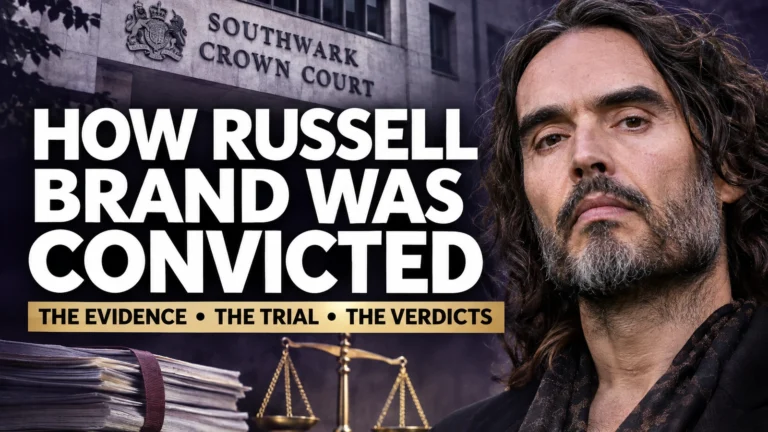
The documents have attracted fresh attention following a separate criminal trial in which Brand was convicted and, on 9 November 2026, sentenced to 10 years and six months in prison for rape and three sexual assaults. Those convictions concern offences against other women between 2004 and 2009. They do not prove Berki’s 2014 allegation.
What happened between Russell Brand and Szilvia Berki?
According to the court record, Goldsmith arranged for Berki to attend her Oxfordshire home on 7 June 2014 to provide Brand with a professional massage. The massage did not take place. The parties disputed what happened during the visit. Berki said she had experienced wrongdoing, including assault. Brand and Goldsmith denied the allegations.
Berki reported the matter to Thames Valley Police, which took no further criminal action. That decision did not amount to a judicial finding that Berki had lied. She also approached media organisations and made public allegations. Brand and Goldsmith considered the resulting communications to be harassment and brought civil proceedings.
In August 2014 the High Court granted an urgent interim anti-harassment injunction. In September, Mrs Justice Carr continued interim protections. The proceedings culminated in a final injunction made by Mr Justice Jay on 28 October 2015. Berki represented herself at that hearing, although she had previously received some assistance preparing her defence.
What did the 2015 injunction prohibit?
The redacted final order, published by former tax lawyer Dan Neidle’s Tax Policy Associates on 7 November 2026, prohibits certain communications about Brand and Goldsmith, including contact with journalists. It also contains broad restrictions on disclosing information about the events at Goldsmith’s home, with only limited exceptions.
The order carries a penal notice: a person who breaches it may face contempt proceedings, potentially resulting in imprisonment, a fine or seizure of assets. That is a warning about possible consequences, not evidence that Berki has been imprisoned or punished for a breach.
Neidle argues that the restrictions extend far beyond preventing unwanted contact or harassment. In particular, he questions how a permanent order could appear to prevent private discussion with friends, family members, police officers or treating professionals.
An important qualification is that the effect of the order is not merely Neidle’s interpretation. In September, Lady Justice Falk said that its wording on its face appeared to restrict further communication with the police, contact with other potential civil claimants and disclosures to doctors or therapists. The named medical exceptions were no longer useful because the professionals listed no longer treated Berki.
Why did the High Court grant an injunction without a full trial?
The injunction arose under harassment law, not a criminal prosecution. Mr Justice Jay granted summary judgment in October 2015, meaning the case was decided without proceeding to the four-to-five-day trial then anticipated.
The court concluded that Berki had no realistic prospect of successfully defending the harassment claim in relation to her subsequent communications. That finding is significant: the original proceedings were not simply an attempt to suppress an allegation without any judicial assessment of the conduct that followed it.
However, the court did not resolve the competing accounts of the June 2014 visit or determine whether the underlying accusation against Brand was true. In the 2026 appeal order, Lady Justice Falk expressly explained that the earlier judgment had not decided that disputed factual question.
The injunction also required Berki to make an initial £50,000 payment towards Brand and Goldsmith’s legal costs and included provision for bankruptcy proceedings if the amount was not paid. The existence of that provision must not be confused with confirmation that bankruptcy occurred.
What did the Court of Appeal decide in September 2026?
Berki sought permission to appeal after the 2015 judgment. The Court of Appeal refused permission on the papers in 2016 and again after an oral hearing in March 2017. In 2026, with pro bono legal assistance, she asked the court to reopen the earlier refusal.
Lady Justice Falk refused the application on 3 September 2026. Her reasons were not a fresh endorsement of every restriction in the original injunction. She concluded that the exceptionally demanding legal test for reopening a final appeal decision had not been met.
Addressing the scope of the order, the judge said the appropriate route was an application to the High Court to vary its terms in light of changed circumstances. Her decision recorded that an application to amend the injunction had already been made but had not yet been determined at the time.
Fish 4 News has not established the outcome, if any, of that separate High Court application as of 9 November 2026. It would therefore be premature to report that the original wording has been lifted, or to say with certainty that the variation proceedings remain unresolved.
What has Jemima Goldsmith said?
Goldsmith has defended the original decision to seek legal protection. In comments reported on 9 November by The Sun, she said she cooperated with the police investigation, including by supplying CCTV, and alleged that Berki subsequently engaged in threatening harassment and antisemitic abuse directed at her and her family.
Those are Goldsmith’s stated reasons for supporting the injunction. The court did find that Berki’s course of conduct amounted to harassment, although that does not itself establish the truth of every detail now alleged by either side. Goldsmith’s brother Zac has also publicly defended the use of an anti-harassment order, distinguishing it from a privacy injunction.
Goldsmith has separately alleged that Brand subjected her to violence and coercive control while they were in a relationship. These are allegations she has made publicly, not findings in Brand’s recent criminal trial. Her account, and her explanation for supporting the injunction, are relevant to understanding why the 2015 case was brought.
Neidle reports that Goldsmith has indicated she would be open to varying the order. That is distinct from confirmation that the court has approved any changes.
What Dan Neidle told Times Radio
Speaking to Kate McCann and Stig Abell on Times Radio Breakfast on Monday 9 November, Neidle described the breadth of the injunction as legally extraordinary. He called for scrutiny of how many other orders might restrict people from discussing allegations or seeking help in private.
The interview is part of the wider debate about how harassment law, freedom of expression and access to police or medical care interact. An injunction can protect people against genuine harassment while still raising questions about whether individual restrictions are proportionate.
What is established, and what remains unknown?
- Established: Brand and Goldsmith obtained an interim injunction in 2014 and a final anti-harassment injunction in 2015. The High Court found that Berki’s subsequent course of conduct amounted to harassment.
- Established: The 2026 Court of Appeal order identified apparent restrictions affecting contact with police and medical professionals, but refused to reopen the 2017 appeal decision.
- Not established: Whether Brand committed the separate alleged assault in June 2014. No criminal conviction or civil finding determines that question.
- Not yet verified: The current status of the separate application to vary the 2015 injunction and whether its terms have since changed.
The wider public-interest issue is whether a court order intended to prevent harassment can be drafted so broadly that it also inhibits legitimate requests for help or the reporting of alleged crimes. That question can be examined without assuming Berki’s underlying allegations were proved, or dismissing the harassment concerns raised by Goldsmith.
Sources and court documents
- Tax Policy Associates: Dan Neidle’s investigation and redacted 2015 injunction, 7 November 2026
- Court of Appeal: Lady Justice Falk’s decision, 3 September 2026 (PDF)
- 5RB: Brand and Goldsmith v Berki, 28 October 2015
- 5RB: Brand v Berki, 11 September 2014
- The Sun: Goldsmith’s response, 9 November 2026
- Crown Prosecution Service: Russell Brand sentencing, 9 November 2026
- Times Radio: Dan Neidle interview, 9 November 2026