Two confrontations between CNN journalist Kaitlan Collins and JD Vance, two years apart, raise a continuing question about how the US vice president distinguishes criminal conduct from alleged unfair treatment of January 6 defendants.
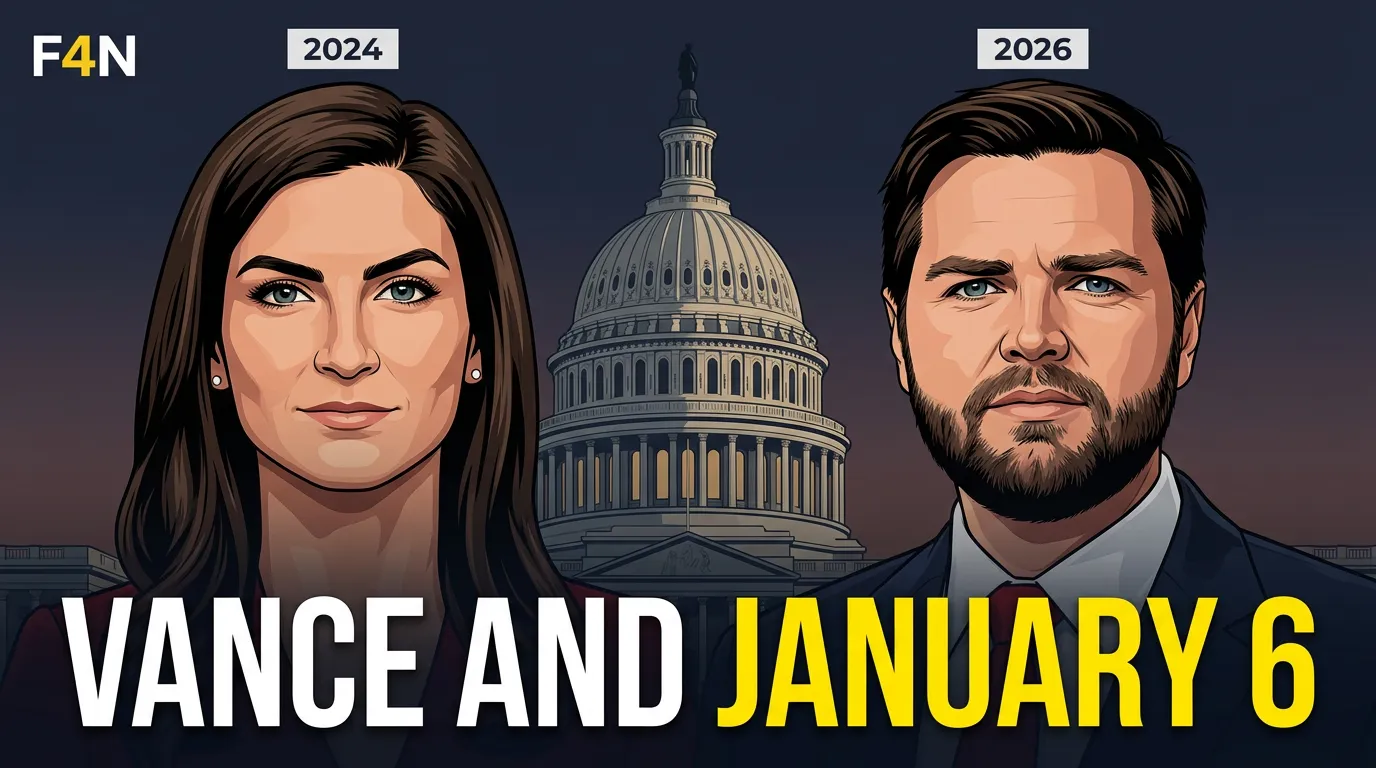
A quotation card circulating on social media shows Collins questioning Vance about prosecuting people who break into and vandalise buildings. The exchange is genuine, but it is not new: the interview took place on 1 May 2024, when Vance was an Ohio senator. In May 2026, after he became vice president, Collins returned to a related question involving possible taxpayer-funded compensation for January 6 defendants.
What Kaitlan Collins asked JD Vance in 2024
During a discussion about protests on university campuses, Vance said the right to free speech did not extend to violence or preventing students from attending classes. Collins asked whether people who broke into and vandalised a building should be prosecuted. According to CNN’s original broadcast transcript, Vance replied: “Exactly.”
Collins then noted that he had helped promote fundraising for people linked to the 6 January 2021 attack on the US Capitol. Vance objected to the comparison, arguing that some January 6 defendants had faced excessive punishment for comparatively minor offences, while acknowledging that anyone who attacked a police officer deserved imprisonment.
One popular graphic renders his answer as “Yes”. That conveys the same general agreement, but it is not a word-for-word quotation from CNN’s transcript. The point of Collins’ question was whether Vance was applying the same standard to different groups of protesters.
Did Vance raise money for January 6 defendants?
There is an identifiable basis for the fundraising criticism, although the wording needs care. In January 2022, Vance posted a link encouraging support for the Patriot Freedom Project, an organisation that sought donations for people charged over the Capitol attack and their families. PolitiFact documented the post during his Ohio Senate campaign.
The link was promoted alongside Vance’s claims about people being held without charges. A CNN fact-check published in January 2022 found those claims inaccurate: the detainees it examined had been charged, and Vance subsequently posted a correction distinguishing being charged from being convicted.
Sharing a donation appeal is not the same as making a personal financial contribution. Nor does it establish that Vance specifically paid the legal bills of anybody convicted of attacking police or vandalising the Capitol. The supported claim is that he publicly encouraged donations to a group helping January 6 defendants.
Why Collins confronted him again in May 2026
The issue returned on 19 May 2026, this time in a White House exchange over a Justice Department proposal for an Anti-Weaponization Fund. The proposal envisaged compensation for people who alleged they had been unfairly targeted by federal government investigations or prosecutions.
The 18 May order specified a proposed transfer of $1.776 billion to support the fund. A central unresolved issue at the time was whether people convicted of assaulting Capitol police officers on January 6 could qualify.
Collins reminded Vance of his 2024 remarks and asked why he would not categorically exclude such defendants from taxpayer-funded compensation. In the recorded 19 May exchange, Vance said decisions should be considered on a case-by-case basis and that he would not rule out claims without knowing individual circumstances.
Vance also said no commitment had been made to give any particular person money. His answer did not say violent offenders should automatically be compensated, but neither did he give Collins the blanket exclusion she was seeking.
What happened to the proposed $1.776bn compensation fund?
The proposal did not proceed as originally announced. On 2 August 2026, Acting Attorney General Todd Blanche formally rescinded the order establishing the fund.
That rescission is decisive context for any discussion of potential payouts. The Justice Department said no members had been appointed to administer the fund, no funds had been transferred, no claims process had been established and no claims had been paid.
The department also acknowledged litigation relating to the scheme. A public case summary maintained by the Civil Rights Litigation Clearinghouse records subsequent disputes over the settlement and related orders. Those broader legal questions should not be confused with an operative compensation scheme: the August order expressly stated that the May funding order had no force or effect.
A double standard, or two different questions?
There is a legitimate distinction between whether somebody deserves punishment for an offence and whether a particular prosecution involved improper government conduct. An individual can, in principle, have committed a crime and still raise a separate claim about how authorities handled the case.
That distinction forms the strongest version of Vance’s position. In 2024 he said police assaults warranted imprisonment; in 2026 he argued that possible compensation claims required individual review. Those propositions are not automatically mutually exclusive.
But Collins’ questions exposed a genuine issue of consistency. Vance had spoken unequivocally about prosecuting campus vandalism, yet publicly advocated fundraising assistance for January 6 defendants. Later, he would not categorically exclude people convicted of police assaults from a proposed taxpayer-funded scheme.
The fair conclusion is not that Vance personally funded violent offenders or that violent rioters received compensation. Neither is established by the evidence here. It is that he has repeatedly been asked to explain how his stated principles on violence, prosecution and alleged political persecution apply when the defendants are people he has supported politically.
What is established
- The campus-protest and January 6 exchange was broadcast on CNN on 1 May 2024, not in November 2026.
- Vance promoted a January 6 defendants’ fundraising organisation in January 2022; a personal donation has not been established by the cited material.
- Collins questioned Vance again on 19 May 2026 about possible compensation for people convicted of assaulting Capitol police.
- The proposed $1.776bn fund was formally rescinded on 2 August 2026. The Justice Department said no payouts had been made.
Sources
- CNN: The Source with Kaitlan Collins transcript, 1 May 2024
- PolitiFact: Vance’s January 6 fundraising appeal, October 2022
- CNN: Collins questions Vance at the White House, 19 May 2026
- US Justice Department: Anti-Weaponization Fund order, 18 May 2026
- US Justice Department: rescission order, 2 August 2026
- Civil Rights Litigation Clearinghouse: Floyd v Department of Justice case history
Follow this story: Find subsequent verified developments in our JD Vance and January 6 coverage.