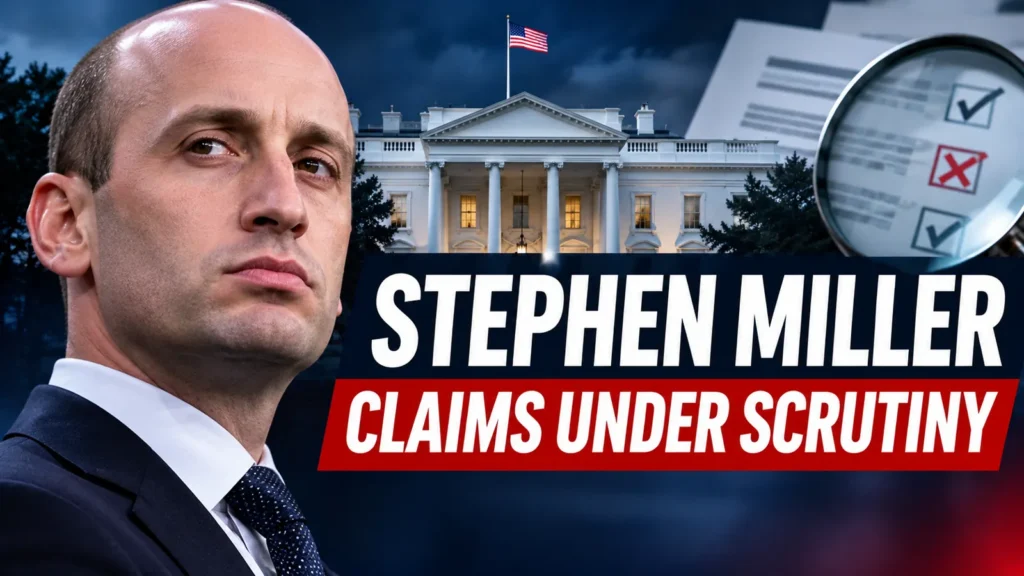
Stephen Miller now runs Donald Trump’s White House staff. His appointment on 9 November 2026 puts fresh attention on a record of disputed public statements about crime, immigration, policing and the powers of the courts.
In September 2024, a journalist repeatedly asked Miller to explain the evidence behind a claim about Venezuela. The exchange, now circulating again online, was confrontational. But the more consequential question is whether Miller’s claims withstand scrutiny, especially now that he occupies one of the most powerful unelected jobs in American government.
Why Miller’s appointment matters
Trump announced on 6 November that Miller would replace Susie Wiles as White House chief of staff. He began the job on 9 November, after Republicans lost control of both chambers of Congress in the US midterm elections. Miller had already played a leading role in the administration’s immigration and domestic-policy agenda. The White House announcement praised his experience and loyalty; Reuters reported that the promotion signalled continued confrontation with congressional Democrats.
A chief of staff controls access to the president, coordinates senior officials and helps turn policy preferences into government action. That makes the accuracy of the arguments used to justify those policies a matter of public interest.
1. Venezuela: the reporter who kept asking for evidence
Following the Trump-Harris presidential debate in September 2024, Miller claimed Venezuela’s crime rate had fallen substantially. NTN24 journalist José María del Pino pressed him on the source of the figures and whether he was relying on information from Nicolás Maduro’s government. Miller repeatedly switched to discussing violent crimes committed by migrants in the United States instead of supplying the comparative data del Pino requested.
The discussion grew heated and Miller eventually walked away. Del Pino’s original September 2024 video and a contemporaneous account document the exchange. The question was not whether a migrant had ever committed a serious crime; it was whether Miller could substantiate his wider statistical comparison.
Violence in Venezuela had indeed declined. That did not establish the separate allegation that the Venezuelan government was deliberately sending prisoners to America. FactCheck.org interviewed Venezuelan crime researchers who said they had seen no evidence of such a programme and identified other explanations for declining crime, including mass emigration and economic collapse.
2. Chicago: a police department that had not shut down
On Fox News’s Hannity in August 2025, Miller said of Chicago: “They’ve shut down the police department.” Read literally, that was false. Chicago Police Department officers were operating that month; the department published a detailed August 2025 activity report documenting investigations, arrests and firearms seizures.
Miller paired the statement with criticism of Chicago’s approach to crime and immigration. Those subjects are legitimate matters for debate, and the city has experienced serious violent crime. But disagreement over policing strategy does not amount to the police department having closed.
In the same interview Miller called the Democratic Party a “domestic extremist organization”. That is a political characterisation, not an established legal designation or a verifiable crime statistic. A social-media impersonation circulating in November 2026 appears to repeat Miller’s actual words rather than inventing them.
Original video: Miller’s August 2025 Hannity remarks. View the original Fox News clip.
3. Immigration courts: an overstatement of legal authority
On 9 May 2025, Miller said the Immigration and Nationality Act had stripped federal Article III courts of jurisdiction over immigration cases. Immigration law restricts certain judicial reviews and establishes particular procedures. But it does not eliminate federal courts’ constitutional role in examining executive immigration actions. PolitiFact rated the broad statement false after consulting legal specialists.
At the same recorded White House exchange, Miller said the administration was actively considering suspending habeas corpus, the means by which detained people may challenge the lawfulness of their confinement. Suspension faces much stricter constitutional constraints than simple disagreement with judges. PBS NewsHour’s video report includes his comments and legal context.
4. ICE: the claim of ‘federal immunity’
On 24 October 2025, Miller told immigration officers they had federal immunity in the conduct of their duties. Federal officers do have substantial legal protections when lawfully performing federal functions. Those protections are not blanket immunity from prosecution for unlawful conduct.
PolitiFact reviewed the statement and rated it mostly false, explaining that federal officers can be prosecuted for federal crimes and, in certain circumstances, under state law. That distinction is important when officials address armed agents involved in contentious enforcement operations.
5. Washington: a homicide-free record that already existed
At a White House event on 25 August 2025, Miller said officials could not find a comparable period without murders in Washington, DC, under Trump’s leadership. Yet the city’s police data already recorded a 16-day stretch without a homicide from 25 February to 12 March 2025. FactCheck.org confirmed that earlier period, contradicting the claim.
The shorter late-August stretch was genuine. Washington’s crime improvements deserve recognition and analysis. But a real improvement does not make a claim of historical uniqueness accurate or show that one government intervention alone caused a reduction that had already begun.
6. Democrats: rhetoric presented as an absolute
Miller’s description of Democrats as an extremist organisation was not an isolated remark. In the same original interview, he depicted the entire party as concerned only with defending criminals and indifferent to American citizens.
That is sweeping partisan rhetoric, not a measurable statistic. Democrats advocate varying approaches to crime, immigration enforcement and constitutional protections. Presenting the party as uniformly devoted to criminals overlooks that variation. It also matters when such descriptions come from someone responsible for helping the White House work with an opposition-controlled Congress.
A record that extends beyond television interviews
Miller helped shape deportations, immigration enforcement and the administration’s approach to executive authority. An Associated Press review of his public record documents positions on family separation, birthright citizenship, habeas corpus and other controversies. The practical consequences of those policies are more substantial than the viral confrontations themselves.
His promotion has drawn criticism from Democrats and some Republicans. Capital News Service reported on 13 November that Republican senators John Cornyn and Thom Tillis criticised Miller’s influence on policies associated with their party’s midterm defeats. Supporters, including senior Trump officials, describe him as a disciplined, experienced and loyal advocate for the president’s programme, as reflected in the official White House announcement.
What this record establishes, and what it does not
The examples above show repeated statements that were false, unsupported or presented without crucial qualifications. Some concern verifiable statistics and legal institutions. Others, particularly attacks on Democrats, are political opinions expressed as sweeping declarations.
That record alone does not prove Miller knowingly lied. Establishing deliberate deception requires evidence of what a speaker knew and intended at the time. It does, however, justify examining why contradictory records and corrections have not stopped such claims being used to defend government policy.
The test for Miller as chief of staff is not whether he speaks forcefully. It is whether the White House can defend its actions with evidence, accurately describe the law and accept accountability when assertions are wrong.
Sources and original footage
- White House: appointment announcement
- Reuters: appointment context
- José María del Pino: original Venezuela video
- Mediaite: contemporaneous confrontation account
- FactCheck.org: Venezuela crime allegation
- Fox News: original Chicago interview
- Chicago Police Department: August 2025 report
- PolitiFact: judicial jurisdiction claim
- PBS NewsHour: habeas corpus video
- PolitiFact: ICE immunity claim
- FactCheck.org: Washington homicide streak
- Associated Press: Miller’s wider record
Follow the story
For background on Miller’s appointment and the departure of Susie Wiles, read our earlier report: Trump Replaces Susie Wiles With Stephen Miller Three Weeks After Denying Shake-Up.