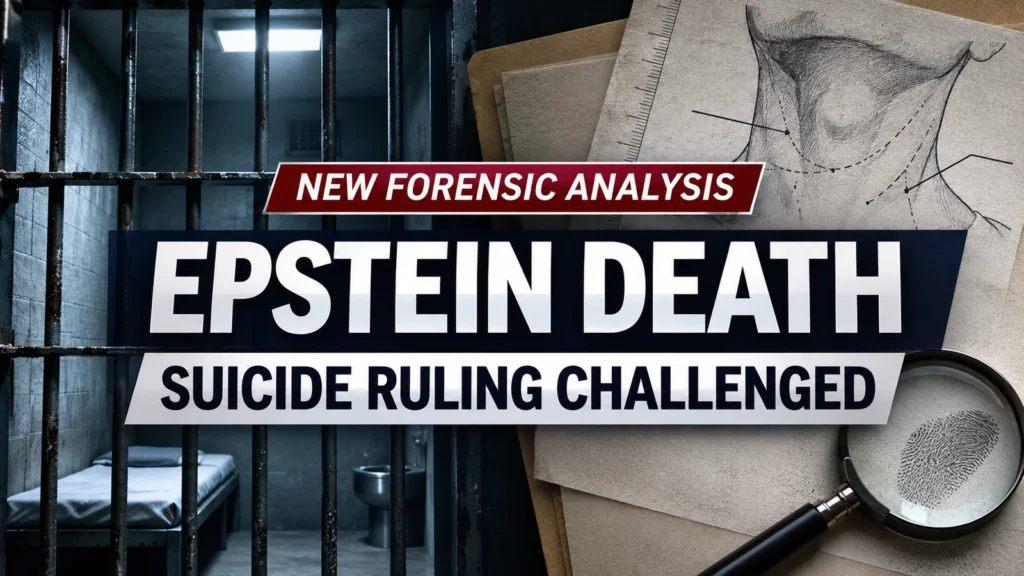
A new forensic review of Jeffrey Epstein’s death has challenged the official finding of suicide, but the New York City medical examiner continues to stand by its 2019 ruling.
Forensic medicine specialist Professor Michael Freeman says the injury patterns shown in autopsy photographs and records are more consistent with strangulation than a self-inflicted hanging. His findings were presented in London on Monday 16 November 2026 and reported by CBS News. They have not been peer-reviewed or accepted by the authorities.
Epstein, a convicted sex offender who was awaiting trial on federal sex-trafficking charges, was found dead at the Metropolitan Correctional Center in Manhattan on 10 August 2019. His death was officially classified as suicide by hanging.
What the new forensic analysis claims
Freeman reviewed medical examiner records and photographs supplied by Epstein’s brother, Mark Epstein. He worked with forensic pathology professor Anders Eriksson, of Umeå University in Sweden, and researcher Itiel Dror, who specialises in cognitive bias in forensic decisions. The team presented its work at a London legal event.
Their interpretation focuses on several features of the recorded injuries:
- Two differently angled marks on Epstein’s neck. Freeman argues that the lower mark is difficult to reconcile with the hanging mechanism described in the official account.
- Bleeding deep within the left shoulder and other injuries that Freeman believes may indicate blunt-force trauma.
- Marks above the ligature injury that he says might be consistent with fingernail scratches sustained during an attempt to remove a cord or fabric.
- A narrow, knotted piece of fabric photographed inside the cell which Freeman believes could explain some of the markings. CBS reports that this item was not collected for the medical examiner.
Freeman used a three-dimensional reconstruction based on photographs and an officer’s later description of how Epstein was found. He argues that the combined injury pattern fits an assault and strangulation from behind. These are his conclusions from the available material, not findings established by a court or a new official investigation.
The original suicide ruling has not changed
The New York City Office of Chief Medical Examiner conducted the autopsy on 11 August 2019. The examining pathologist, Dr Kristin Roman, concluded that the cause of death was hanging and the manner of death was suicide. The then chief medical examiner, Dr Barbara Sampson, supported that decision.
Asked about Freeman’s work, the medical examiner’s office told CBS News that it stands by its determination. The examiner’s account, recorded in the US Department of Justice inspector general’s 2023 report, said the injuries were more consistent with hanging than homicidal strangulation and that the expected signs of a physical struggle were absent.
Freeman did not examine Epstein’s body. His analysis relies on records, photographs and a reconstruction produced years after the death. He has acknowledged that a journal declined to publish his work; it has not undergone completed independent peer review. That does not automatically disprove it, but it limits the weight that can be placed on its conclusions.
Forensic experts can disagree about the meaning of neck injuries. CBS also reported on a separate 2026 examination of records by The New York Times that found indications Epstein intended to end his life, while noting that the medical evidence alone may not conclusively determine suicide or homicide.
What the prison investigation established
A June 2023 report by the Department of Justice Office of the Inspector General documented serious failures at the prison. Its findings included:
- Epstein was taken off suicide watch on 24 July 2019 and off psychological observation on 30 July. He was not on suicide watch when he died.
- Prison staff failed to provide a replacement cellmate after his previous cellmate was transferred on 9 August, despite an instruction that he should not be housed alone.
- Required overnight checks were not carried out and prison records were falsified to make it appear that rounds had taken place.
- Surveillance recording failures left investigators with limited footage. The available camera did not show Epstein’s cell door.
- Staff had not removed excess prison linen from the cell, despite procedures intended to identify safety hazards.
Those failures raise significant questions about prison management and the preservation of evidence. Crucially, however, the inspector general said it found no evidence contradicting the FBI’s determination that there was no criminality connected with Epstein’s death. Operational failures are not, on their own, proof of murder.
Watch: CBS News examines the forensic claims
Content warning: The CBS investigation discusses suicide, strangulation and injuries. The footage may include graphic autopsy images.
If the embedded video does not play, watch the supplied CBS investigation on YouTube or view CBS News’ forensic interview.
What remains unknown
No new official determination of homicide has been announced. The new analysis does not establish who could have attacked Epstein, how an attacker might have entered or left the cell, or whether any new investigation will be opened. Freeman has not named a suspect or offered a substantiated account of a conspiracy.
The forensic evidence and the circumstances of Epstein’s confinement remain disputed. The question now is whether the newly publicised records receive independent scientific examination or prompt any formal review. Until then, the official conclusion remains suicide, and Freeman’s homicide explanation remains a contested expert interpretation.