US Homeland Security Secretary Markwayne Mullin has defended travelling on a government aircraft to a college football game while airlines were still recovering from a nationwide flight shutdown, telling Congress the trip was planned weeks earlier and the airspace had already reopened.
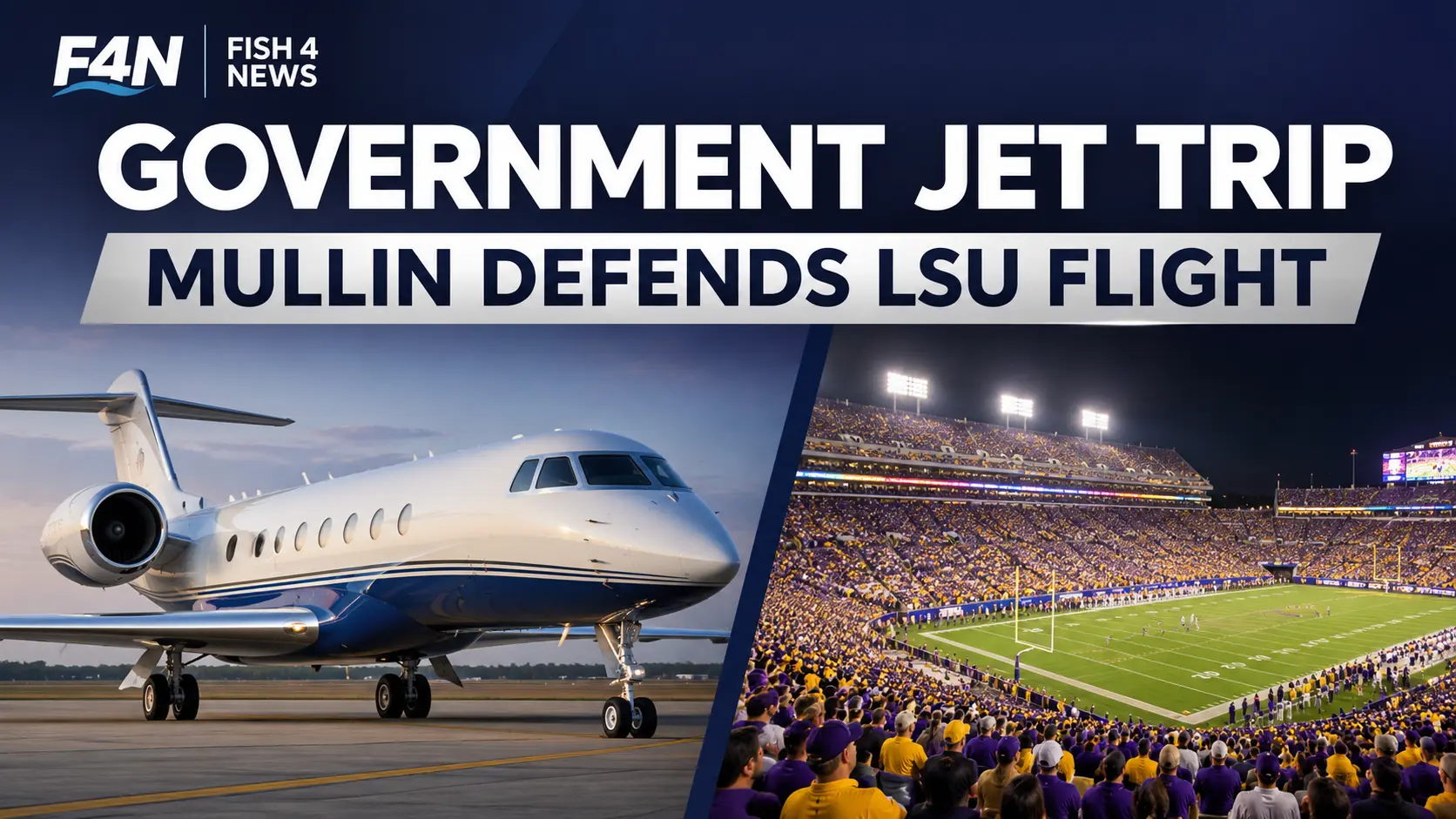
Mullin attended the Louisiana State University (LSU) game against Texas on Saturday 14 November, after a technical failure forced the Federal Aviation Administration (FAA) to stop departures nationwide for several hours the previous day. His journey prompted questions about the use of government aircraft, the cost to taxpayers and his attendance in a suite associated with a major Coast Guard contractor.
The ground stop had ended before Mullin flew
The FAA says a technical problem began at about 3.30pm Eastern Time on Friday 13 November. Air traffic resumed at 8.15pm, following a ground stop lasting approximately four hours and 45 minutes. The agency reported around 12,462 cancelled flights that day, while making clear that not every cancellation was directly caused by the ground stop.
The disruption did not end when restrictions were lifted. Airlines were still repositioning crews and aircraft on Saturday, and passengers continued to experience delays and cancellations.
According to flight records described by The Washington Post, a Department of Homeland Security Gulfstream 700 left Washington shortly after 5pm on Saturday, stopped in Atlanta and arrived in Baton Rouge at 8.03pm. The football game had kicked off at 7.49pm. The aircraft subsequently flew to Tulsa and returned to Washington on Monday.
Mullin did not fly during the nationwide ground stop. The FAA had reopened airspace almost 21 hours before his departure. The criticism concerns his decision to travel while the effects of the disruption continued.
What Mullin told Congress
At a House Homeland Security Committee hearing on Wednesday 18 November, Democratic congressman Bennie Thompson criticised the journey as irresponsible and insensitive to travellers who had been left stranded.
Mullin said he had arranged to take family members, including a great-niece who had never attended an LSU game, and had discussed cancelling the trip on Saturday morning. He said he was also due to meet Louisiana Governor Jeff Landry and other people.
He argued that withdrawing from the journey despite the airspace being open could have sent the wrong message about confidence in the aviation system. Earlier, speaking to CNBC, he said he would not have flown had the airways remained closed.
The committee’s published video shows the exchange. Mullin’s comments are his explanation for the decision; they do not independently establish how the trip was classified for government accounting purposes.
Who pays for a government aircraft used for personal travel?
The Department of Homeland Security says its secretary is required to use a government aircraft because of security arrangements and the need to maintain secure communications and continuity of government. The department says Mullin pays personally for travel unrelated to his duties and complies with ethics requirements.
There is an important distinction between reimbursing the government under the rules and meeting the full cost of operating an aircraft. The federal travel rules for authorised ‘required-use’ journeys generally calculate repayment for wholly personal travel using the full commercial coach fare, not the government aircraft’s operating cost.
The rule is set out in 41 CFR §301-10.264. An earlier DHS Inspector General review also describes presidential authorisation dating from 2004 for the secretary to use government aircraft for official and personal journeys.
Mullin says he reimbursed the government. F4N has not independently verified the reimbursement amount, the full cost of the journey or the formal breakdown between any official and personal elements. It would therefore be inaccurate to claim a specific taxpayer cost, or that the flight itself breached the travel rules.
Why the football suite has attracted attention
The trip has also drawn scrutiny because Mullin was reportedly seen in a private suite associated with Ben Bordelon, president and chief executive of Louisiana-based Bollinger Shipyards. The company is a longstanding US Coast Guard supplier. The Coast Guard operates within Mullin’s Department of Homeland Security.
Bollinger was selected in December 2025 for a programme involving four Arctic Security Cutters. The shipbuilder announced final contract terms on 2 July 2026 and included supportive remarks from Mullin in its public statement. Reporting has put the four-vessel agreement at approximately $2.2 billion.
Mullin told CNBC he had not met Bordelon before the game and said the contract awards predated his appointment. DHS has emphasised Bollinger’s decades-long relationship with the Coast Guard. Mullin also says the match tickets were paid for at fair market value.
The suite visit and the existing contracts do not establish wrongdoing. There is no verified evidence that the football game affected procurement decisions or that improper government business was discussed. But the encounter adds to questions about transparency around a trip involving a senior official and a major contractor to his department.
What remains unanswered
- How much Mullin and any accompanying travellers reimbursed the government, and how the amount was calculated.
- What the aircraft’s total operating cost was and which parts, if any, were classified as official government business.
- Whether the reported planned meeting with Governor Jeff Landry took place and what official business, if any, was conducted.
- Whether any ethics or travel-compliance review has examined the journey.
Neither the cost questions nor the contractor connection should be taken as proof of illegal conduct. They are outstanding issues of public accountability.
The wider FAA disruption
The FAA says the ground stop followed instability in an ageing communications network, with unusually heavy connection attempts affecting systems used by air traffic controllers. Its preliminary investigation identified potential contributing locations in Texas and Arkansas, including work by communications supplier L3Harris. The agency said it had paused installation of affected router equipment while the cause was investigated.
F4N previously reported on questions surrounding the FAA upgrade work and comments from Transportation Secretary Sean Duffy and Mullin. The latest dispute is distinct: it concerns Mullin’s use of official transport following the aviation disruption.
Sources
- Federal Aviation Administration: nationwide ground stop questions and answers, 15 November 2026
- US House Homeland Security Committee: hearing and video, 18 November 2026
- Associated Press: Mullin’s defence of the LSU trip
- The Washington Post: flight records and contractor questions
- US federal travel regulations, 41 CFR §301-10.264
- Bollinger Shipyards: Coast Guard contract announcement, 2 July 2026