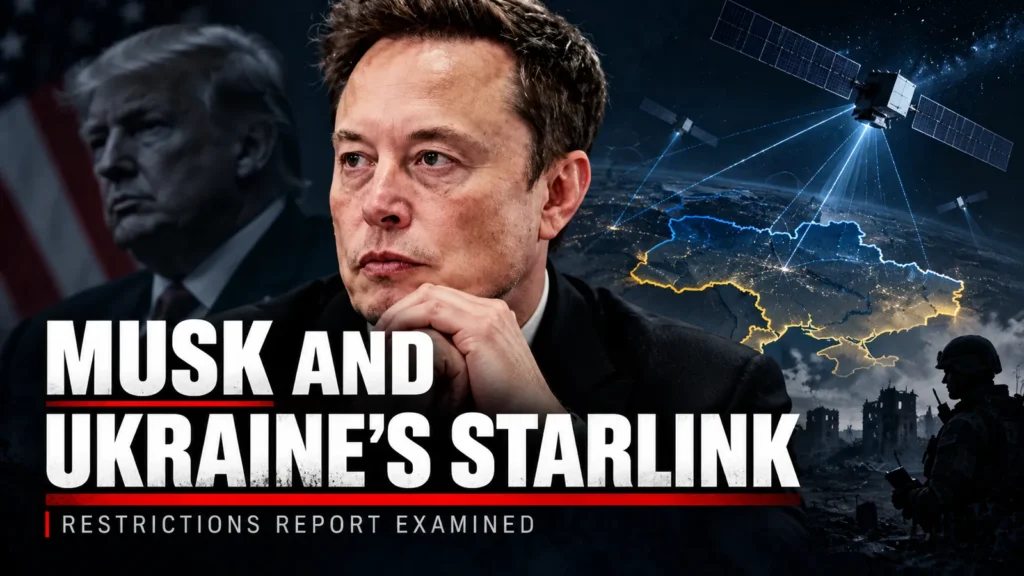
An investigation alleges Elon Musk personally suggested restricting satellite communications used by Ukraine’s military, with Donald Trump agreeing to the proposal. Washington denies responsibility, but Ukrainian officials say critical restrictions remain in place.
Elon Musk personally approached US President Donald Trump with a proposal to restrict satellite communications used by Ukraine’s military, according to an investigation by The Telegraph published on 16 October 2026. The report, citing four sources familiar with the discussions, alleges Trump agreed to the proposal before restrictions were implemented on the military-grade Starshield service. The claims follow confirmed reports of serious disruption to Ukrainian drone operations, although both Trump and the White House deny responsibility.
What Happened?
Ukraine’s armed forces experienced unexpected restrictions on satellite communications during the week beginning 12 October, disrupting military drones operating at high speeds.
The affected technology is supplied through SpaceX, the aerospace company founded by Elon Musk.
While Starlink is widely known as a commercial satellite internet service, Starshield is its specialist military counterpart, developed for government and national-security customers.
Ukrainian forces rely on these systems for battlefield communications, reconnaissance, logistics and the operation of drones used to intercept Russian attacks.
The new restrictions reportedly disconnected communications equipment when it travelled faster than approximately 160 kilometres per hour.
For Ukraine’s drone operators, this was a significant operational problem.
Some Russian jet-powered Shahed drones can exceed 400 kilometres per hour, meaning Ukrainian interceptor drones may require satellite communications while travelling substantially faster than the imposed limit.
Ukrainian officials reported that the restrictions interfered with both defensive and offensive missions.
The Allegation Against Elon Musk
On 16 October, journalist Joe Barnes reported in The Telegraph that Musk had personally approached Trump with the proposal to impose speed restrictions.
The newspaper attributed its account to four sources familiar with the discussions.
One source alleged Trump had agreed to Musk’s suggestion, allowing the Pentagon to implement restrictions on Starshield.
A high-ranking European official and two Ukrainian sources reportedly supported the newspaper’s account.
The allegation raises a distinction between two stages of the decision: who originally proposed the restrictions and who subsequently authorised or implemented them.
Two days earlier, Musk had publicly emphasised the US government’s control of Starshield.
In a post on X, he stated that operational limits were ultimately decisions for the American military and the president.
However, that statement did not address whether Musk himself had proposed the change.
The Telegraph’s subsequent reporting alleges that he had.
The allegation of Musk’s personal involvement remains disputed. No publicly released instruction or decision record has independently established who initiated the restrictions.
Timeline: How the Starlink Dispute Developed
| Date | Reported development |
|---|---|
| 9 October | US and Ukrainian representatives met in Miami amid disagreement over Ukraine’s attacks on Russian oil infrastructure. |
| 14 October | Ukrainian officials reported unexpected satellite restrictions affecting drone missions. Musk publicly pointed to US government control of Starshield. |
| 15 October | Reuters reported that an instruction to slow Starshield had originated inside the White House, citing US and Western officials. |
| 16 October | The Telegraph alleged Musk had proposed the restrictions to Trump. Trump denied that either man was responsible. |
| 16 October | A Ukrainian presidential adviser told Associated Press that Kyiv was negotiating with SpaceX and the Pentagon to remove the speed limit. |
| 17 October | Zelenskyy said restrictions remained in force in Ukraine. The White House rejected the Telegraph’s account, while Secretary of State Marco Rubio denied a US government order. |
What Does the Evidence Establish?
There are several important distinctions between what has been reported, what officials have acknowledged and what remains unproven.
F4N Fact File
| Question | Evidence and current position |
|---|---|
| Were satellite communications restricted? | Ukrainian military officials have documented and publicly described speed restrictions. Multiple international news organisations have reported the disruption. |
| Did the restrictions affect Ukraine’s military? | Ukrainian officials report interference with drone interception, reconnaissance and battlefield operations. |
| Did the order come from the White House? | Reuters cited two US officials and a Western official who said the instruction originated there. The White House denies ordering the slowdown. |
| Did Musk personally propose the restrictions? | The Telegraph reported this based on four sources. It remains a contested allegation. |
| Did Trump agree? | One Telegraph source alleged that he did. Axios separately cited a source saying Trump did not oppose the proposal. Trump denies responsibility. |
| Why were the restrictions imposed? | No independently verified explanation of the original decision has been made public. |
What Did Reuters Discover?
Before the Telegraph published its investigation, Reuters had independently examined the origins of the Starshield restrictions.
In a report dated 15 October, journalists Erin Banco and Gram Slattery cited two American officials and a Western official who said the instruction originated within the White House.
According to those officials, the Department of Defense had been told that the service supplied to Ukraine needed to be slowed.
However, Reuters could not establish who inside the White House made the decision or exactly who implemented it.
A senior US official denied that Trump personally requested the restrictions.
This distinction matters.
The Reuters reporting supports the allegation that the order originated within the administration, but it does not independently establish that Trump or Musk initiated it.
The Telegraph’s subsequent investigation goes further, identifying Musk as the alleged originator.
What Have Musk and Trump Said?
Musk has emphasised that Starshield is a government-controlled service and that decisions about its operational limitations are ultimately made by the US military and the president.
He has also distinguished Starshield from commercial Starlink, which SpaceX controls and restricts to civilian and defensive applications.
Trump has denied responsibility for the disruption.
Speaking to reporters on 16 October, he said:
“It wasn’t me, and I don’t think it was Elon.”
The White House subsequently rejected the Telegraph’s account, insisting that the administration had not slowed the service.
On 17 October, Secretary of State Marco Rubio also denied that anyone in the US government had ordered Starlink to be slowed.
Despite those denials, Ukraine continued to report restrictions.
The Pentagon has not publicly provided a detailed explanation establishing who authorised the speed cap, why it was introduced or whether the restrictions were intended to be temporary.
Ukraine Says the Restrictions Are Still Active
Ukrainian President Volodymyr Zelenskyy challenged suggestions that the satellite communications problem had been fully resolved.
On 17 October, he described testing carried out with satellite equipment in vehicles travelling through European Union countries and Ukraine.
According to Zelenskyy, the equipment continued functioning at approximately 180 kilometres per hour outside Ukraine but disconnected at around 161 kilometres per hour after crossing the Ukrainian border.
He interpreted the result as evidence of a deliberate geographical restriction.
That interpretation has not been independently verified, but it raises an important technical question: why would the same equipment behave differently depending on which country it was operating in?
Zelenskyy also said the continuing limits prevented Ukraine from using certain interceptor drones against high-speed Russian attacks.
Separately, Ukrainian presidential adviser Serhii Beskrestnov told Associated Press that Kyiv was negotiating with SpaceX, the Pentagon and the US government to restore full capabilities.
He said connectivity outages had improved, but the speed cap remained.
Why the Timing Matters
The restrictions appeared during a period of worsening relations between Washington and Kyiv.
Trump had been pressing Ukraine to stop attacking Russian oil refineries, arguing that the strikes were contributing to rising energy prices.
His administration had also reached an agreement involving Russian diesel supplies, drawing criticism from Ukraine and some American lawmakers.
Reuters reported that US representatives had expressed frustration with Ukraine’s continued refinery attacks during a meeting in Miami on 9 October.
The satellite restrictions followed within days.
The sequence raises questions about whether access to military communications was being used as leverage in wider negotiations.
However, the timing alone does not prove retaliation, and there is currently no publicly verified evidence establishing that punishing Ukraine over refinery attacks was the purpose of the restrictions.
Why This Matters Beyond Ukraine
The dispute highlights a significant vulnerability in modern warfare: essential military capabilities can depend on communications infrastructure controlled by external governments and private companies.
Ukraine’s experience demonstrates the operational consequences of losing access to a satellite network, even temporarily.
It also raises questions for European governments that rely on American-controlled infrastructure for defence and national security.
Polish Foreign Minister Radosław Sikorski publicly challenged Musk over the restrictions, warning that European customers were watching developments closely.
Ukraine is now exploring alternative satellite services, including European networks, while attempting to restore its existing capabilities.
Building independent alternatives would be expensive and technically demanding. In the meantime, the country remains heavily dependent on infrastructure it does not fully control.
What We Still Don’t Know
Four questions remain central to establishing accountability.
1. Who proposed the restrictions?
The Telegraph alleges Musk initiated the proposal. There is no publicly released record independently confirming that account.
2. Who authorised the order?
Reuters traced the instruction to the White House through official sources, but the identity of the decision-maker remains disputed.
3. Why was the speed limit imposed?
The restrictions coincided with political disagreements over Ukrainian attacks on Russian energy facilities. That relationship is not proof of the motive.
4. What was the full military impact?
Ukraine has described disrupted operations, but the number of affected missions and any resulting casualties have not been independently established.
What Happens Next?
The immediate issue is whether SpaceX and the Pentagon restore the communications capabilities Ukrainian forces previously used.
There is also a growing question of political accountability.
An investigation into the Pentagon’s handling of the restrictions could establish whether formal instructions were issued, who authorised them and whether Ukraine was given advance notice.
Until those questions are answered, the available evidence supports two conclusions.
Ukraine’s military experienced significant satellite communications restrictions, and credible news organisations have reported allegations of high-level American involvement.
Whether Elon Musk personally initiated those restrictions with Donald Trump’s approval remains the central unresolved allegation.
Sources and Further Reading
- The Telegraph, 16 October 2026: Musk approached Trump to slow down Starlink in Ukraine
- Reuters, 15 October 2026: Order to limit Starshield came from inside the White House, sources say
- Associated Press, 16 October 2026: Ukraine in talks to lift military satellite speed limit
- Axios, 17 October 2026: Zelensky says satellite restrictions remain
- CBS News, 17 October 2026: Ukraine reports continuing impact on drone interception