Elon Musk declared himself “Dark MAGA” while campaigning for Donald Trump in 2024. Following the Republicans’ heavy defeat in the 2026 midterms, he now says he is “not MAGA” and regrets spending hundreds of millions of dollars supporting the party. His change in language is documented. Whether it reflects a genuine change in outlook, electoral disappointment or concern about the scrutiny facing his businesses is a separate question.
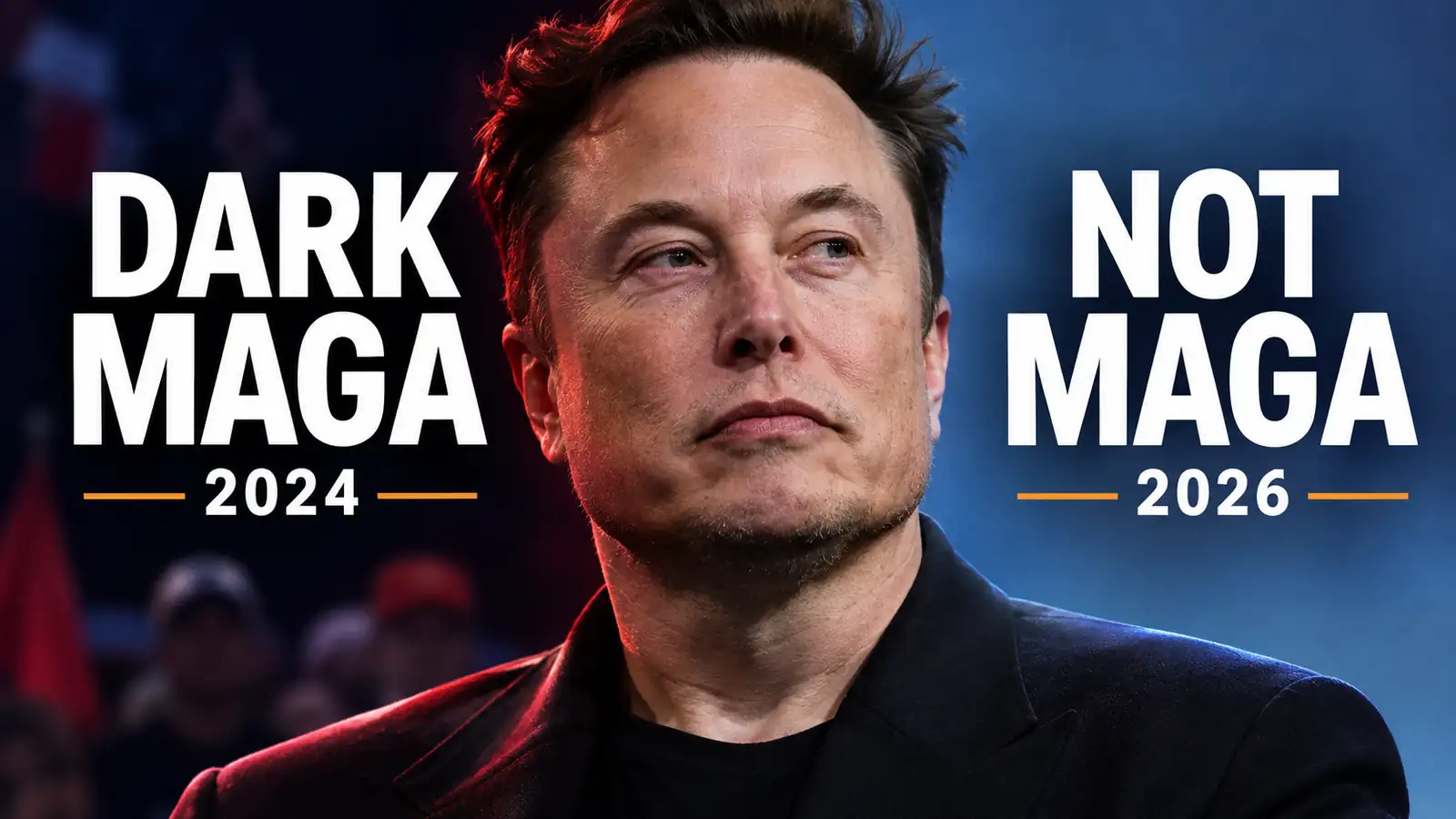
Speaking remotely from China to Andrew Ross Sorkin at the New York Times DealBook Summit on 18 November, Musk described himself as politically moderate. He said he did not accept blind allegiance to Republican policies. The remarks came just over two weeks after Democrats won control of the US House of Representatives and Senate. Watch the original DealBook interview.
Watch: Musk says he is ‘not MAGA’ at DealBook
If the player is unavailable, watch the full interview directly on the New York Times YouTube channel. The discussion of his political spending begins about six minutes into the interview and his “not MAGA” remarks follow later.
Musk also said he felt “pretty foolish” about the scale of his political spending and suggested he would have spent less if given another chance. This is not a formal withdrawal of support for Trump or an announcement that he will stop funding Republican candidates. It is a change in the way he is publicly describing his involvement. Reuters reports his remarks.
From ‘Dark MAGA’ to ‘not MAGA’
On 5 October 2024, at a Trump campaign rally in Butler, Pennsylvania, Musk appeared wearing a black MAGA cap and told the crowd: “I’m not just MAGA. I’m Dark MAGA.” He warned supporters that Trump had to win and urged them to register voters. The declaration is preserved in Associated Press footage of the rally.
That was not a one-off remark. Musk spent heavily to elect Trump and other Republicans in 2024, subsequently joined the Trump administration’s Department of Government Efficiency (DOGE) initiative and became a prominent participant in the debate over federal spending and government staffing.
In May 2025, Musk appeared to retreat from campaign financing, saying he planned to spend much less on politics because he believed he had already done enough. The Associated Press reported those comments at the Qatar Economic Forum.
The restraint did not last. In the autumn of 2026 he was again spending heavily to help Republicans retain Congress. On 30 October he warned that a hypothetical Democratic sweep in 2028 could create a permanent one-party state. That prediction was disputed in F4N’s earlier examination of the evidence.
His election-day message encouraging Americans to vote Republican subsequently disappeared from X. F4N reported the missing posts after the election. Their removal was observed, but Musk did not establish a reason for it.
How much did Musk spend?
An October analysis by The Washington Post, using federal election filings, counted $446 million in Musk’s donations during the 2026 midterm cycle, most of it to Republican-aligned groups. That figure reflects the reported scope and cut-off of the Post’s analysis. It should not be confused with a final audited sum of all spending connected to Musk, nor with the separate amount he contributed during the 2024 presidential cycle.
Republicans nevertheless lost control of both chambers. In Texas, where Tesla and SpaceX have major operations, Democratic victories included the governor’s race. Musk told DealBook that he viewed Democratic governor-elect Gina Hinojosa as moderate and expected Texas to be fine under her leadership. The Wall Street Journal reported the exchange.
There is no way to calculate reliably how the election would have differed without Musk’s spending. Even Musk allowed for the possibility that Republican losses might have been worse without it. What is certain is that a very large financial intervention did not deliver the congressional outcome he supported.
Why government contracts matter
The political stakes are not confined to campaign donations. SpaceX is a major supplier to the US government, particularly NASA and the defence establishment. Its Starlink and Starshield satellite systems also have national-security significance.
A Senate Permanent Subcommittee on Investigations minority-staff memorandum recorded approximately $10.07 billion in SpaceX federal contract obligations across 673 contract actions as of 5 April 2025. It also identified a potential award valuation of up to $47 billion. These are different measures: obligations are funds committed under contracts, while potential award values are not money already paid or guaranteed. The figures are historical, not a current November 2026 contract inventory.
Congress can investigate contracts, request information, hold hearings and scrutinise federal spending. But a Democratic majority cannot automatically terminate valid SpaceX agreements or strip the company of revenue simply because Musk backed Republican candidates. Contract terms, procurement rules, agency decisions and national-security needs would all matter. The federal government’s reliance on SpaceX may itself limit the practical alternatives.
The broader potential conflict of interest is nevertheless a legitimate public-interest question. A corporate executive who helps shape government policy while managing businesses regulated and paid by the same government faces a level of scrutiny that goes beyond ordinary party politics. Our previous report explained the new congressional oversight landscape.
The investigations already under way
Democratic lawmakers have signalled that Musk’s DOGE activities and business connections may come under examination when the new Congress takes office in January 2027. Representative Robert Garcia, the senior Democrat on the House Oversight Committee, discussed possible scrutiny of Trump associates and Musk in comments reported on 8 November.
One specific inquiry predates that change in congressional control. On 13 November, senators Jeanne Shaheen and Chris Coons wrote to Musk and SpaceX demanding preservation of records concerning reported restrictions affecting Ukraine’s access to Starlink and Starshield. They requested written confirmation and answers by 30 November 2026.
The senators described serious concerns about battlefield communications and asked who authorised changes, what contracts allowed and what consequences were assessed. Their letter is evidence of an active oversight demand, not proof that Musk personally ordered unlawful restrictions. Conflicting accounts about whether decisions lay with SpaceX or US officials have yet to be fully resolved. F4N has previously examined the disputed authorisation.
At DealBook, Musk disputed claims about the disruptions and argued that the US government controls Starshield’s military uses. Those statements should be considered alongside the senators’ questions and the reported effects on Ukrainian forces, rather than treated as a settled account of events.
What about the possibility of prosecution?
Sorkin also raised the possibility of investigations, a presidential pardon and calls for Musk to be prosecuted. Musk responded: “I don’t think I need a pardon,” and said he had committed no crimes. He criticised politicians calling for his imprisonment without identifying a specific offence. TechCrunch reported the exchange from the interview.
A congressional hearing or document request is not a criminal charge. Congress can pursue oversight, while criminal charges require a separate legal process and evidence of an offence. This investigation has not established a current criminal case against Musk arising from his election spending, DOGE role or SpaceX contracts. His political donations and government business relationships alone do not establish criminal wrongdoing.
A 2025 Senate minority-staff report estimated billions in possible civil and regulatory exposure for several Musk companies at that time. That was a partisan staff estimate of potential liabilities, not a court finding or proof of offences, and it cannot be treated as a November 2026 balance sheet of outstanding penalties.
Is this a political conversion or a tactical repositioning?
Three explanations remain plausible on the evidence currently available. Musk may genuinely have become disillusioned with partisan politics; he may be reacting to the limited electoral return from his enormous donations; or he may see practical advantages in maintaining relationships with both parties as Democrats gain congressional power. Those explanations are not mutually exclusive.
The timing invites scrutiny, but it cannot by itself establish motive. Musk was speaking from China, where he was travelling with Trump on the president’s Asia visit. That is a reminder that his change of language should not be confused with a complete break from the president. Nor does his description of himself as moderate erase his campaign conduct or policy statements.
The distinction is straightforward: what Musk said in 2024, what he spent in 2026 and what lawmakers are now investigating can be documented. Why he chose this moment to say he is “not MAGA” remains his to explain.
What happens next?
The next clear checkpoint is 30 November, when Shaheen and Coons expect SpaceX to confirm preservation of records and answer their questions. After the new Congress takes office in January, the scope and form of any further DOGE or contract inquiries should become clearer. F4N will report material developments separately as evidence emerges.
Sources and further reading
- New York Times: Musk’s 18 November 2026 DealBook interview
- Associated Press: Musk’s 5 October 2024 Butler rally remarks
- Washington Post: 2026 political donor analysis
- US Senate minority staff: April 2025 SpaceX contracts and regulatory analysis
- US Senate Foreign Relations Committee: 13 November Starlink and Starshield letter
- Washington Post: Garcia’s comments on potential oversight