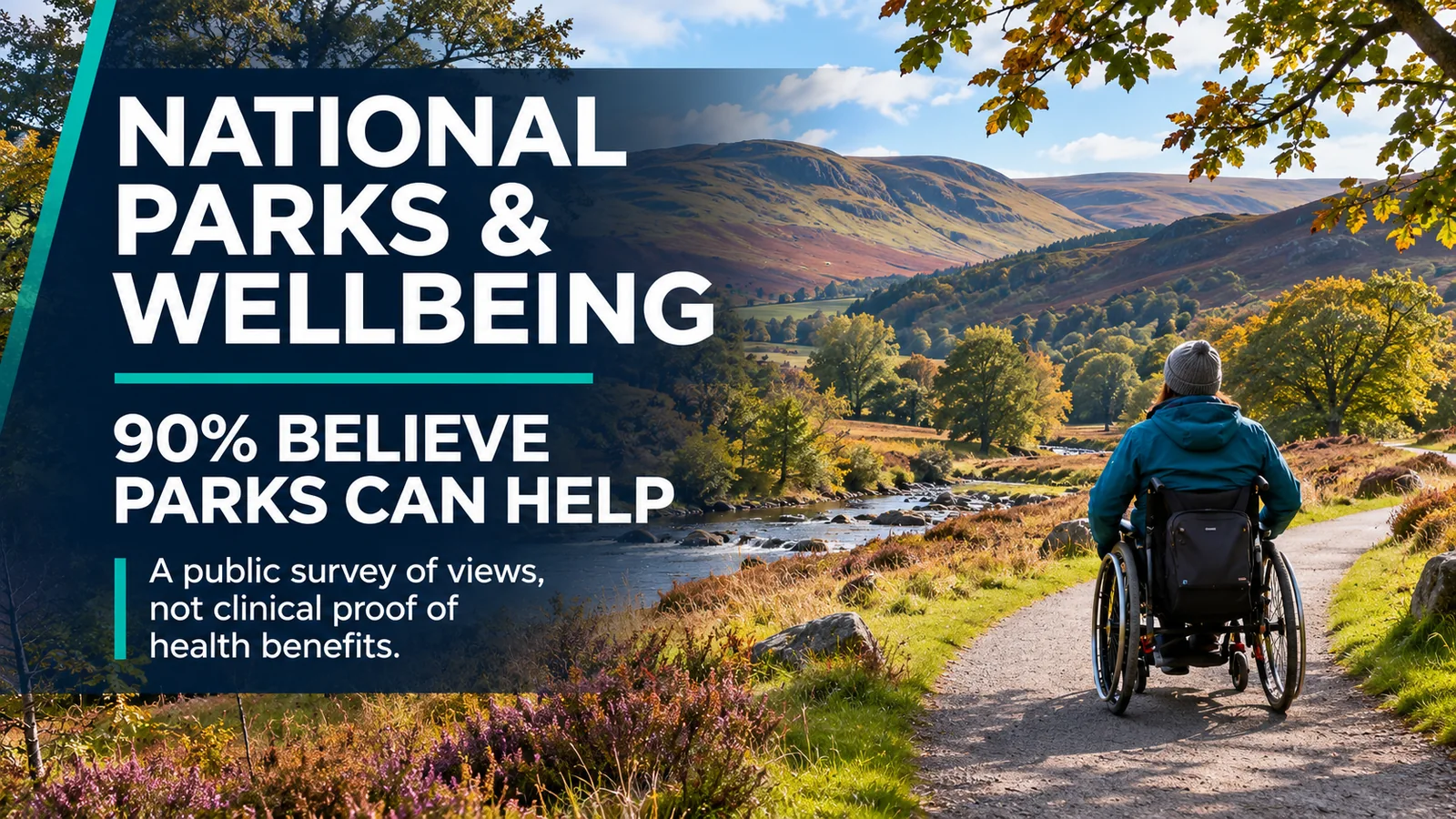
Nine in ten people surveyed believe Britain’s National Parks can support mental health and wellbeing, but the findings also raise a practical question: who can get out and enjoy them?
Research published by National Parks UK on 3 November found strong support for the role of protected landscapes in improving everyday life, restoring nature and preparing for climate change. It was based on an online survey of 3,000 people aged 16 and over across England, Scotland and Wales, alongside 30 in-depth interviews.
What the National Parks survey found
According to the National Parks UK report, the main findings included:
- 90% believe National Parks can help support mental health and wellbeing.
- 89% say reducing stress and pressure in daily life is important.
- 75% say feeling connected to nature is important.
- 80% agree National Parks are taking action on climate and nature.
- 76% care strongly about pollution, litter and damage to natural places.
The research used quotas for age, gender, socio-economic group and ethnicity, with the survey responses weighted to reflect the population of the three countries. The accompanying interviews were divided equally between England, Scotland and Wales.
What the 90% figure does, and does not, show
The headline figure measures what respondents believe National Parks can do. It does not mean 90% of people visited a National Park and experienced an improvement in their mental health. Nor does this survey establish a clinical treatment effect.
There is wider evidence that people value time outdoors. In a separate Natural England survey for 2025–26, 89% of adults in England who had visited a green or natural space in the preceding fortnight agreed that spending time outdoors was good for their mental health. This measures reported perceptions among recent visitors, not diagnosed outcomes, and covers all sorts of green spaces rather than National Parks alone.
The NHS also supports green social prescribing, which can connect people with activities such as walking, gardening and conservation volunteering. That evidence is separate from the new National Parks UK opinion survey.
A National Park is not accessible to everyone
The benefits people associate with nature depend on being able to reach it. Public transport, the cost of a day out, the availability of accessible toilets, reliable route information and suitable equipment can all affect whether a visit is realistic.
National Parks UK’s own access and communities programme highlights efforts to address those barriers. The Pembrokeshire Coast Outdoor Mobility Scheme provides specialist beach wheelchairs through 17 locations, with equipment free to use. In 2026, the scheme also introduced a self-drive beach wheelchair designed to give users more independence.
In the Yorkshire Dales, the organisation highlights all-terrain scooters, Changing Places toilets and 18 Miles Without Stiles routes, alongside an online access hub to help visitors decide in advance whether a journey will work for them.
Access is relevant well beyond remote beauty spots. Natural England’s latest survey found that poor physical health was a significant barrier to visiting green spaces, while local urban green spaces remained the most commonly visited type. For many people, an accessible park near home may be more useful than a distant National Park.
What is happening in the parks?
The National Parks UK case studies include the Outdoor Brain Health and Dementia Resource Centre at Badaguish in the Cairngorms, which provides opportunities for gardening, all-ability cycling, crafts and storytelling for people living with dementia and their carers.
Closer to home for readers in southern England, the New Forest’s PEDALL inclusive cycling project is reported by National Parks UK to provide around 6,000 rides a year using specialist cycles and trained ride leaders. The National Park also promotes links between health services, volunteering and outdoor activities through its Green Health Hub.
Nature restoration is another theme of the report. On the North York Moors, the GrubsUp! project works with landowners and communities to restore grassland, plant hedgerows and create ponds and insect habitats. National Parks UK also points to woodland recovery projects in Loch Lomond & The Trossachs.
The question behind the findings
The new figures suggest considerable public goodwill towards National Parks, particularly when it comes to wellbeing, wildlife and the future of the countryside. But they are not a scorecard showing whether those ambitions have been achieved.
The more revealing test may be whether National Parks and public bodies can turn that goodwill into accessible, affordable opportunities to spend time outdoors, while providing measurable results for wildlife and communities.