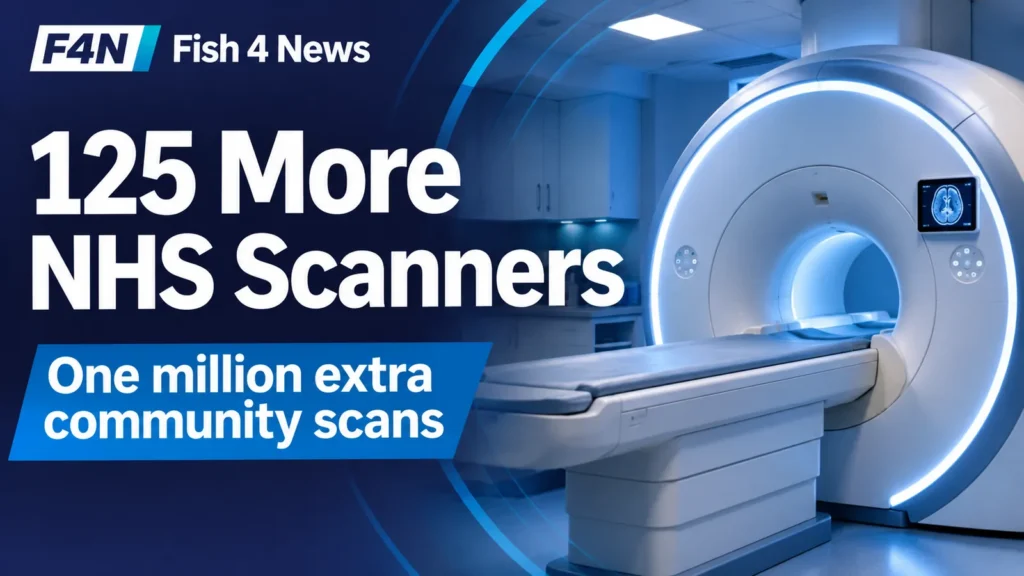
England’s NHS has 125 more CT and MRI scanners than it did two years ago, while community diagnostic centres are carrying out around one million more scans a year, according to figures released on Tuesday, 3 November.
The Department of Health and Social Care says the expansion is designed to help doctors investigate cancer and other serious conditions sooner. However, the rise in scanning activity does not mean one million additional people have been tested or one million more cancers have been detected.
What has changed in NHS scanning?
NHS England’s imaging figures show that the combined number of CT and MRI scanners rose by 125 between March 2024 and March 2026. Of those additional machines, 107 were placed in community diagnostic centres, which offer tests away from major hospital settings.
Those centres carried out nearly 2.2 million CT and MRI scans in the 12 months to March 2026. That was approximately one million more than in the equivalent 12-month period ending in March 2024.
The comparison measures activity in community diagnostic centres. It does not establish that all of the extra scans were additional to the NHS’s overall workload rather than scans carried out in a different location.
How is AI speeding up MRI scans?
The government says AI-based MRI acceleration software has been installed in 54% of compatible NHS MRI scanners. The technology uses less scan data to produce usable images more quickly, allowing services to offer additional appointments.
According to the department, services using the technology have carried out an average of 14% more scans while maintaining image quality. This is software to speed up imaging, not evidence that an AI system is independently diagnosing cancer.
NHS trusts are to be offered upgrades for compatible scanners by 2029. The government estimates that a complete rollout could support up to 162,000 additional checks each year, but this remains a projection.
Patients are still facing long waits
The expansion comes despite continuing pressure on diagnostic services. In August 2026, approximately 1.83 million patients in England were waiting for one of 15 key diagnostic tests. About 24.7% had been waiting for six weeks or more, against an NHS operational standard of fewer than 1%.
Among patients awaiting MRI scans, 22% had waited at least six weeks, while the equivalent figure for CT scans was 11.2%, according to figures compiled from NHS England’s monthly diagnostics data.
The government’s announcement says diagnostic waiting lists have fallen in three of the five months since April, and cancer waiting times have improved compared with a year earlier. It does not provide evidence showing how much of those changes can be attributed specifically to the additional scanners or AI software.
Will the extra scans help detect cancer sooner?
CT and MRI scans can be important in investigating suspected cancers, but they also help clinicians diagnose a wide range of other conditions. More capacity can reduce delays to testing, but an increase in scan numbers alone cannot demonstrate earlier cancer diagnoses or improved survival rates.
Dr Stephen Harden, president of the Royal College of Radiologists, welcomed newer imaging equipment but emphasised the need for the workforce to scan, diagnose and treat patients safely and efficiently. Radiologists and other clinicians still need to review findings and arrange further care.
The government also highlighted the £19.2 million Manchester and Trafford Community Diagnostic Centre, which opened on 29 October 2026.
Featured image: Walter Davies / Wikimedia Commons, CC BY-SA 4.0. Illustrative photograph, not one of the newly added scanners.