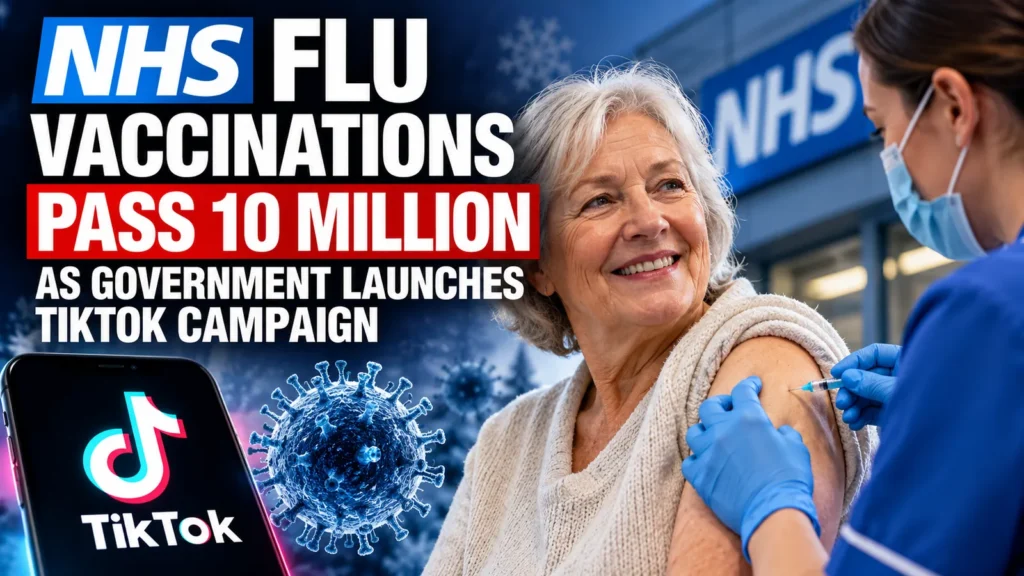
More than 10 million flu vaccinations have been delivered in England ahead of winter, with the government launching a new social media campaign to encourage millions more eligible people to come forward. The campaign, announced on 22 October 2026, will appear on TikTok for the first time alongside Facebook, Instagram and Snapchat, while new NHS App features aim to make checking eligibility and booking appointments easier.
More than 10 million flu vaccinations delivered
The Department of Health and Social Care confirmed that more than 10 million flu vaccinations had been administered since the vaccination programme began in September, including 2.7 million reported during the week of its announcement.
Although the figures represent a substantial start to this year’s vaccination programme, millions of eligible people have still not received their flu vaccine.
The latest campaign is intended to reach those who may be unaware they qualify for a free NHS vaccination, have not yet made an appointment or may find traditional booking methods inconvenient.
The government is particularly keen to reach people who are more vulnerable to serious complications from influenza, including older adults, pregnant women and people living with certain long-term health conditions.
Health Minister James Frith said:
Vaccines save lives.
He urged those eligible to come forward, highlighting improvements to appointment booking and the importance of reducing avoidable pressure on health services during winter.
TikTok joins the government’s winter vaccination campaign
For the first time, TikTok is being included in the government’s flu vaccination social media campaign.
Advertisements will also appear across Facebook, Instagram and Snapchat, extending the campaign beyond traditional NHS communications.
The government hopes this approach will reach people who might otherwise overlook vaccination reminders or be unaware that they qualify for a free flu jab.
The campaign also promotes a new feature within the NHS App that helps people check their eligibility and book appointments at participating community pharmacies.
Importantly, people do not need to use TikTok, social media or the NHS App to receive a vaccination. Existing booking methods remain available.
Who qualifies for a free NHS flu vaccination in winter 2026?
Under the NHS programme in England, free flu vaccinations are available to several groups considered more vulnerable to serious illness.
These include:
- Adults aged 65 and over, including those who will turn 65 by 31 March 2027.
- Pregnant women at any stage of pregnancy.
- People with certain long-term medical conditions, including qualifying respiratory, heart, kidney, liver, neurological and immune conditions.
- People living in care homes.
- Main carers of older or disabled people, including qualifying unpaid carers.
- People living with someone who has a weakened immune system.
- People aged 16 and over who are sleeping rough or staying in homeless accommodation.
Frontline health and social care workers are also offered flu vaccination, usually through their employers.
Medical conditions that may qualify someone for a free vaccine include diabetes, chronic obstructive pulmonary disease (COPD), some forms of asthma, Parkinson’s disease, multiple sclerosis and certain heart conditions.
Not every medical condition automatically qualifies. Anyone unsure about their eligibility should check with their GP, pharmacist or healthcare specialist.
The full eligibility criteria are available on the NHS flu vaccination website.
Children’s flu vaccinations expanded through schools and pharmacies
Children are another major focus of the winter vaccination programme.
The NHS offers free flu vaccinations to children aged two and three, eligible four-year-olds, pupils from reception to Year 11, and children aged six months to 17 years with certain long-term health conditions.
Most school-age children receive the vaccine through their school immunisation programme, generally as a nasal spray rather than an injection.
The government says its Manage a Vaccination in School (MAVIS) programme has been expanded to cover approximately 14,000 schools this year.
The digital system is designed to simplify the vaccination process, including parental consent.
School vaccination teams have been asked to visit every school by the end of November, with second visits completed by 11 December.
New pharmacy catch-up service from 1 December
From 1 December 2026, participating community pharmacies will begin offering catch-up flu vaccination appointments to school-age children who missed their original vaccination.
The new service should provide another option for families whose children were absent on vaccination day or were unable to receive their vaccine at school.
Participating pharmacies already offer flu vaccinations to some younger children and children with qualifying medical conditions.
Parents can check the NHS guidance on children’s flu vaccinations for the available options.
How effective is the flu vaccination?
Although no flu vaccination provides complete protection, evidence indicates that vaccination reduces the risk of serious illness, hospital admission and death.
The UK Health Security Agency’s report covering winter 2025–26 estimated that England’s influenza vaccination programme prevented approximately:
- 104,000 hospital admissions
- 7,100 deaths
These figures are estimates produced through epidemiological modelling. They represent the estimated difference between what happened with the vaccination programme and what might have happened without it. They are not directly counted cases.
Vaccine effectiveness can also vary between flu seasons, depending partly on circulating influenza strains.
According to the NHS, people can still develop flu after vaccination, but vaccination can reduce the likelihood of serious complications.
Flu can be particularly dangerous for people with existing respiratory conditions, cardiovascular disease, weakened immune systems and other underlying health problems.
The annual vaccination programme is therefore intended both to protect individuals and to reduce avoidable hospital admissions during the busiest months for health services.
The detailed evidence is available in the UKHSA influenza report for winter 2025–26.
Charities back the vaccination campaign
The Department of Health and Social Care is also working with national health charities to encourage people with long-term conditions to take up vaccinations.
Organisations supporting the campaign include the British Heart Foundation, Parkinson’s UK, Asthma + Lung UK, Diabetes UK, Macmillan Cancer Support, the Stroke Association, the Cystic Fibrosis Trust, the National Kidney Federation and the MS Society.
The organisations are particularly concerned about people whose existing health conditions can become significantly worse following a respiratory infection.
The campaign also highlights the importance of carers receiving appropriate vaccinations, particularly where they support someone who could be seriously affected by influenza.
How to book your free NHS flu vaccination
People eligible for a free NHS flu vaccination in England have several booking options.
1. Book online
Use the NHS flu vaccination booking service to check eligibility and arrange an appointment.
2. Use the NHS App
Eligible users can book through the NHS App, which also offers access to other NHS services.
3. Contact your GP surgery
GP practices can advise on eligibility and local vaccination arrangements.
4. Visit a participating pharmacy
Many community pharmacies provide NHS flu vaccinations, and some offer walk-in appointments.
5. Telephone NHS 119
People unable to use online booking can call 119 free of charge. Interpreter and accessibility services are also available.
Pregnant women may also be able to arrange vaccination through maternity services, while eligible children usually receive their vaccinations through schools, GP practices or participating pharmacies.
The NHS says flu vaccination will remain available until 31 March 2027, although online booking is scheduled to close on 30 March.
People are encouraged to arrange their vaccination before winter flu activity increases rather than waiting until the end of the programme.
Is the flu vaccine the same as the COVID-19 winter booster?
No. The flu vaccine and COVID-19 vaccine protect against different viruses.
Although both may be offered during the autumn and winter months, eligibility criteria are not identical.
Some people will qualify for both vaccinations, while others may only qualify for a flu vaccine.
For example, the 2026–27 NHS flu programme includes adults aged 65 and over, while the winter COVID-19 vaccination programme generally focuses on adults aged 75 and over, older adult care home residents and people with qualifying immunosuppression.
People should check the separate NHS COVID-19 vaccination guidance rather than assume eligibility for one vaccine automatically means eligibility for the other.
Why the NHS is acting before winter
Winter brings additional pressure on hospitals, GP practices, ambulance services and community healthcare.
Influenza is one of several seasonal health threats that can increase demand for treatment, particularly among vulnerable patients.
By encouraging vaccinations before the main winter period, health officials hope to reduce avoidable illness and the resulting pressure on healthcare services.
The government’s new campaign combines social media advertising, simpler digital booking, school vaccination improvements and expanded pharmacy access.
However, whether the new TikTok advertising and NHS App features lead to a measurable increase in vaccination uptake remains to be seen.
For eligible patients, the immediate message is straightforward: free NHS flu vaccinations are available now, and appointments can be arranged through several different routes.