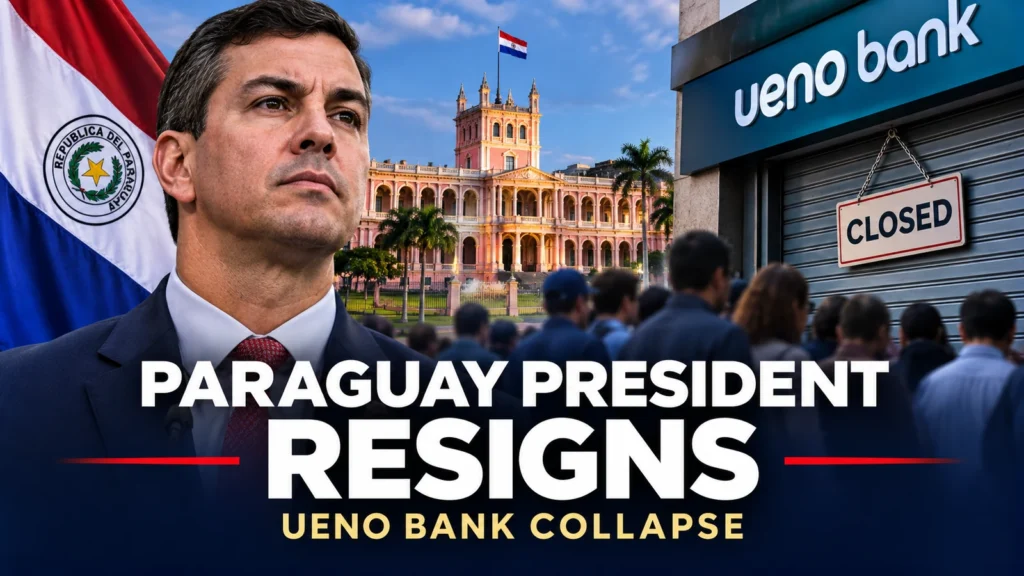
Paraguay’s president, Santiago Peña, has announced his resignation after the collapse of Ueno Bank froze access to accounts used by almost three million customers and triggered a political crisis.
The announcement on Thursday 5 November came as lawmakers were preparing to impeach him and protesters demanded the return of their savings. Minutes later, Paraguay’s lower house voted 78–0 to approve impeachment proceedings against the president.
The banking crisis has raised questions over public money deposited with Ueno, the relationship between political leaders and financial regulators, and the protection available to people whose wages and savings have been caught up in the collapse.
Why Santiago Peña resigned
Peña said in a recorded statement that he had decided to submit his resignation in the interests of national stability, social peace and democratic institutions. He apologised to Paraguayans if he had failed them, but did not accept responsibility for the bank’s collapse.
He had lost the support of leading figures in his governing Colorado Party. Former president Horacio Cartes, a powerful party figure and previously a Peña ally, also backed moves to impeach him.
The lower house backed impeachment by 78 votes to none, according to the Associated Press. The matter moved to the Senate, where lawmakers also had to consider the president’s resignation. At the time of writing, the precise timing of a formal transfer of power had not been settled.
How Ueno Bank’s collapse affected millions
Paraguay’s central bank took control of the fast-growing digital lender on Tuesday after its solvency ratio fell below half the required legal minimum. Regulators identified problems involving poorly documented loans, lending to businesses connected with bank owners and the treatment of some expenses as assets.
Ueno says it has around three million customers, in a country with a population of roughly 6.5 million. Customers found themselves unable to use the bank’s app, cards and transfers, while branches were closed. The disruption led to queues outside branches and protests in Asunción.
The bank held roughly $800 million to $850 million in public-sector deposits, according to international reporting, including money belonging to state pension and health bodies. Its failure has therefore raised concerns beyond the accounts of individual savers.
What depositors can expect
In a statement published on 5 November, the Banco Central del Paraguay said its first guarantee payments would cover customers who have deposits of up to 10 million guaraníes, have no debts with Ueno and hold an account at another Paraguayan bank or finance company.
The regulator said customers meeting those conditions would receive the full amount of their qualifying deposits. It would announce payments to other groups separately through official channels.
The wider deposit guarantee covers balances up to a specified statutory limit, and the central bank estimates that around 97% of Ueno customers should have their deposits covered in full. However, the timing of payments and the recovery of larger balances remain important uncertainties.
Affected customers should consult the central bank’s official deposit guarantee payment page rather than relying on social-media claims.
What is alleged, and what has been established
Peña previously held shares in Grupo Vázquez, the corporate group associated with Ueno, until March 2025. The existence of that past business connection is documented; it is not, by itself, proof that Peña committed an offence.
Opposition lawmakers have accused him of conflicts of interest, mishandling public pension money and covering up problems at the bank. Peña has denied improper dealings and said responsibility for any wrongdoing should be established by the courts.
Prosecutors have also launched proceedings involving Ueno officials and associates over alleged breaches of trust and attempted fraud. The Associated Press reported that 27 people had been charged, six executives ordered held pending trial and two others placed under house arrest. These are allegations and legal proceedings, not convictions.
Questions have also been raised about the appointment of Carlos Carvallo, who previously headed Ueno’s predecessor and later became president of Paraguay’s central bank. Carvallo resigned as the financial crisis developed.
What happens next
Vice-president Pedro Alliana is next in line to take over and, if the succession is completed, would serve the remainder of the presidential term to August 2028. Lawmakers must still resolve the constitutional and impeachment proceedings surrounding Peña’s departure. A key dispute is whether accepting his resignation could allow him to take up a lifetime Senate seat, which carries parliamentary immunity. Some lawmakers argue impeachment should proceed instead. The Senate’s decision will determine how the competing processes are handled.
For many Paraguayans, the immediate concern is more practical: when they can access their money. The labour ministry estimates that about 7,000 direct and indirect jobs have been affected by the bank’s failure, while workers and depositors have continued demanding wages, repayments and accountability.
The crisis has also drawn the attention of international investors. Paraguay’s sovereign bond prices fell following news of Peña’s resignation, according to Reuters.