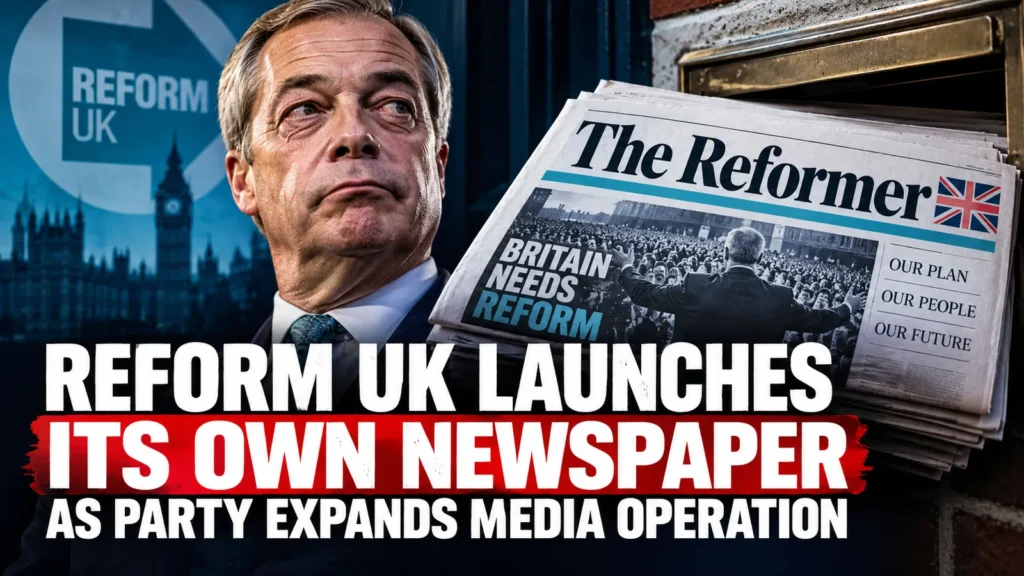
Nigel Farage’s Reform UK is launching its own newspaper, The Reformer, with plans to reach approximately 15 million households across Britain. The eight-page publication forms part of a wider expansion into party-controlled news and video content, announced as Reform faces damaging revelations from an ITV investigation into the behaviour of some of its councillors, candidates and officials.
Image note: The featured illustration includes a mock-up of The Reformer, not a photograph of the actual newspaper.
What is The Reformer?
Reform UK is preparing one of the largest political newspaper distribution campaigns in recent British politics, seeking to deliver its message directly to millions of voters.
The publication, called The Reformer, will feature party policies, announcements and commentary from leader Nigel Farage.
According to The Spectator’s report published on 9 October, the newspaper is expected to have eight pages and reach approximately 15 million households.
Former Spiked editor and Times columnist Mick Hume, who has worked for Reform, is expected to play a significant role in producing the newspaper.
Reform has promoted the publication by questioning the reliability of established news organisations. In a promotional video circulated online, the party asks:
Do you trust the mainstream media to tell it like it is? We certainly don’t.
It then announces that its own newspaper will soon be arriving through household letterboxes. The publication is being presented as an alternative way for voters to receive information about Reform’s policies and activities.
However, there is an important distinction between independent journalism and a newspaper produced by a political party. The Reformer is a party-controlled publication intended to communicate Reform UK’s political message. Its material should therefore be understood as political communication rather than independent news reporting.
ITV investigation puts Reform under scrutiny
The newspaper campaign has attracted particular attention because of its timing alongside an extensive ITV investigation.
On 14 October, ITV News began publishing findings from Undercover: A Year in Reform, an investigation in which reporters secretly recorded conversations with Reform councillors, candidates and officials. The full documentary was broadcast on ITV1 and ITVX on 18 October.
The recordings captured individuals associated with the party making racist, sexist and violent remarks. Among the findings were comments describing Black children as animals and Asian families as parasites. Other recordings included discussions about concealing controversial views from voters and concerns over the party’s candidate selection procedures.
ITV also obtained recordings from inside Reform’s communications operation, including discussions about how senior officials handled accusations against party figures.
The investigation raised significant questions about Reform’s internal vetting, accountability and the handling of inappropriate behaviour by elected representatives.
Reform said investigations had begun and that some individuals had been suspended. The party insisted there was no room for racism within its organisation and maintained that its vetting procedures had improved.
Several councillors subsequently left the party, while some remained in public office as independents.
Did Reform launch the newspaper because of ITV?
Although the newspaper’s launch coincides with the controversy surrounding the documentary, there is no evidence that The Reformer was created specifically in response to ITV’s investigation.
Plans for the publication were publicly reported by The Spectator on 9 October, five days before ITV released its first findings. The project therefore predates the documentary’s publication.
Nevertheless, the overlap highlights an important development in Reform’s media strategy. The party is investing in channels through which it can present its own account of events directly to voters, without relying entirely on established newspapers or broadcasters.
This offers greater control over how policies, announcements and controversies are presented, although it does not remove the possibility of independent scrutiny.
Reform also plans its own television operation
The newspaper is only one element of a much larger communications expansion. On 22 October, Reuters reported that Reform had begun recruiting staff for a YouTube-based television operation.
The plans reportedly include around 25 journalists and editors, with an initial budget exceeding £10 million.
Rather than creating a conventional rolling television news channel, the party intends to develop interviews, documentaries, video programmes and other digital material.
The wider operation is intended to strengthen Reform’s online presence and provide opportunities to communicate without depending on coverage from traditional broadcasters.
Reuters reported that the expansion follows substantial financial contributions from cryptocurrency entrepreneurs Christopher Harborne and Ben Delo. The two donors contributed a combined £72 million in September, according to Reuters.
Those funds are supporting a broader programme of party activities, including staffing, policy development, campaigning and the media expansion. The precise cost of printing and distributing The Reformer has not been independently established.
Reform challenges ITV as police assess complaints
The relationship between Reform and established news organisations has become increasingly confrontational.
On 21 October, Reform’s home affairs spokesperson Zia Yusuf announced that the party had reported ITV journalists to the police and intended to pursue legal action.
Reform alleged that undercover reporting methods used during the documentary’s production may have breached fraud and electoral laws. ITV rejected allegations of wrongdoing and defended its investigation.
By 24 October, the Metropolitan Police and Hampshire Constabulary were reviewing material relating to Reform’s complaints, according to LBC. The police assessments do not establish that ITV or its journalists committed any offence.
The dispute illustrates the increasingly difficult relationship between the party and sections of the news media scrutinising its activities.
Is The Reformer a newspaper or political advertising?
There is nothing inherently unlawful about a political party producing material designed to resemble a newspaper.
Political parties regularly use newsletters, printed publications and digital channels to communicate with voters. However, campaign material that resembles independent news reporting can raise questions about transparency, particularly when readers may not immediately understand who controls the content.
The Electoral Commission confirms that election campaign material may be designed to look like a newspaper. The rules require qualifying printed political campaign material to carry an imprint identifying who is responsible for producing and promoting it.
Those rules concern transparency over the source of political material. They do not require a party publication to operate with the editorial independence of a conventional newspaper.
The central question is therefore not whether Reform is entitled to publish The Reformer. It is whether readers clearly understand that the information comes directly from a political organisation seeking their support.
What happens next?
Reform UK intends to establish a much larger direct-to-voter communications network through its newspaper, online publishing and video operations.
The planned distribution of 15 million copies would give The Reformer substantial potential reach, although the full number of copies actually delivered remains to be established.
For Reform, the strategy offers an opportunity to communicate its policies and positions without depending entirely on traditional media coverage.
For voters, it creates another source of political information at a time when questions about media trust, party accountability and political campaigning are becoming increasingly prominent.
The distinction remains straightforward: political parties are entitled to make their case directly to the public, but their publications are not a substitute for independent scrutiny.
As Reform expands its own media operation, the challenge for readers will be to distinguish party messaging from independently verified reporting.
Sources
- The Spectator: Reform’s new media strategy (9 October)
- ITV News: Inside Reform investigation (14 October)
- ITV News: Party officials and response (15 October)
- Reuters: Reform media expansion (22 October)
- LBC: Police assessments of Reform complaints (24 October)
- Electoral Commission: Campaigning tactics
Watch: Commentary on The Reformer
The following video discusses Reform UK’s newspaper launch and its timing alongside the ITV documentary. It contains political commentary and criticism of the party, rather than independent news reporting.