More than a century after women secured constitutional voting protections in the United States, conservative activists and religious figures are again questioning whether women should vote independently. Their arguments have gained attention in influential Republican circles, but new polling shows overwhelming opposition to household voting, including among Republican voters.
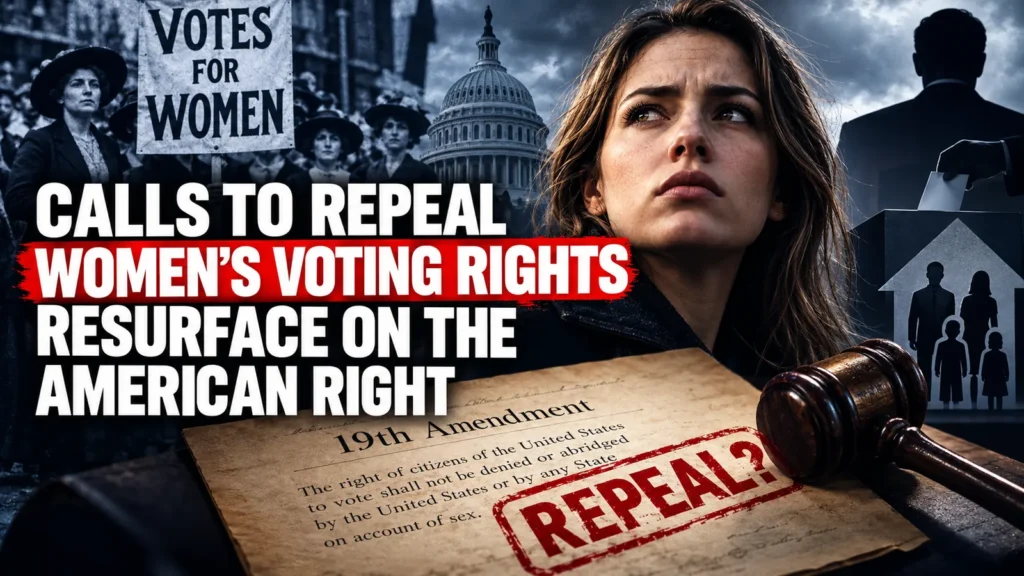
Calls to repeal America’s 19th Amendment, which prohibits denying voting rights on the basis of sex, have resurfaced among sections of the religious and political right. A pastor invited to preach at the Pentagon, a conservative influencer given a prominent platform at Turning Point USA and advocates of one vote per household have brought renewed attention to a position long associated with the political fringes. However, polling published in September 2026 found that 72% of Americans, including 71% of Republicans, oppose replacing individual voting rights with household voting.
Why are women’s voting rights being questioned again?
When the United States ratified the 19th Amendment on 18 August 1920, it marked a decisive constitutional victory following decades of campaigning by women’s suffrage organisations.
The amendment prevents federal and state governments from denying or restricting citizens’ voting rights because of their sex.
More than 106 years later, a small but increasingly visible group of conservative commentators and Christian nationalist activists is questioning whether individual voting rights should remain the foundation of American democracy.
Some argue for repealing the amendment outright. Others advocate a system in which a household receives a single vote, generally exercised by the person recognised as its head.
The debate has attracted renewed scrutiny because some advocates have appeared alongside influential conservative organisations or established connections with senior figures in President Donald Trump’s administration.
But there is an important distinction between an idea receiving political attention and that idea enjoying widespread public or party support.
The available evidence establishes that anti-suffrage arguments are being advanced in conservative circles. It does not establish that repealing the 19th Amendment is official Republican Party policy.
The pastor invited to the Pentagon who wants household voting
One of the most prominent advocates is Doug Wilson, a self-described Christian nationalist pastor based in Moscow, Idaho.
In February 2026, US Defence Secretary Pete Hegseth invited Wilson to deliver a sermon at a Christian worship service at the Pentagon.
Wilson’s appearance attracted controversy because of his previously expressed positions on women’s rights, religion and government.
During a July interview with NPR journalist Leila Fadel, Wilson was asked directly why he supported repealing the 19th Amendment.
“Because it’s a good idea,” he replied.
Wilson explained that he favours a system under which households, rather than individual adults, exercise voting rights.
He said his church already uses a similar arrangement for internal elections, with approximately 7% of votes cast by women who are recognised as household heads.
Wilson insisted that his proposal was not simply about excluding women. Under his system, men who were not household heads would also lose an independent vote, while some women could retain voting rights.
Nevertheless, replacing individual voting with household representation would remove the independent franchise of married women in households where their husbands were designated as heads.
Wilson has acknowledged that his wider vision for the United States is a long-term objective rather than an immediately achievable political programme.
In the same interview, he also denied using his relationship with Hegseth to provide policy advice.
The Pentagon invitation therefore does not prove that Hegseth or the Trump administration supports repealing women’s voting rights.
It does, however, establish that a public advocate of restricting individual suffrage has been welcomed into an influential government setting.
Turning Point USA and the debate among conservative women
The controversy has also reached Turning Point USA, a conservative organisation with significant influence among young American activists.
At its Women’s Leadership Summit in San Antonio in June 2026, conservative influencer Savanna Faith Stone appeared as a speaker.
Stone had previously advocated replacing individual voting with one vote per household, generally giving the husband the final say.
Other women interviewed around the conference expressed willingness to surrender their own individual voting rights.
One participant told Canadian broadcaster CBC that she would be comfortable with her husband voting on her behalf because she trusted him to represent her views.
Such statements illustrate how traditional religious ideas about marriage and family authority can overlap with proposals for restricting political participation.
But reporting from the event also revealed significant disagreement.
Journalist Elaine Godfrey, writing for The Atlantic, reported that Stone did not promote her anti-suffrage position during her conference speech.
The event itself included a video celebrating women’s suffrage and the 19th Amendment.
Conference merchandise encouraged women to participate in elections, while attendees interviewed by the magazine defended their voting rights.
The evidence therefore points to competing positions within conservative women’s political networks, rather than a unified movement to remove the vote.
Stone’s inclusion as a speaker demonstrates that individuals advocating restrictions can gain access to major conservative platforms. It does not mean the organisation has formally endorsed repeal.
What does one vote per household actually mean?
Under the present American system, eligible adult citizens have individual voting rights, subject to the applicable registration and election laws.
A household-voting system would fundamentally alter that principle.
Rather than every eligible adult casting a separate ballot, a household would exercise only one vote.
Depending on how such a system was designed, married couples, adult children living with parents and other people sharing a household could lose their ability to vote independently.
In proposals placing the husband at the head of the household, the effect would fall particularly heavily on married women.
Supporters such as Wilson argue that the household should function as a political unit and that recognising female household heads means their proposal is not exclusively about sex.
Critics argue that independent political representation should not depend on marital status, domestic arrangements or a person’s position within a family.
The distinction is consequential.
The 19th Amendment addresses discrimination in voting on the basis of sex. A household system would also raise broader constitutional questions about equal representation and individual voting rights.
Polling shows overwhelming opposition, including among Republicans
Despite renewed discussion of household voting, public opinion is firmly against the idea.
A national survey conducted by YouGov for the nonprofit newsroom The 19th between 18 and 24 September 2026 asked Americans whether they would support replacing individual voting with one vote per household.
The survey involved 2,357 US adults.
The results showed:
- 72% of all American adults opposed household voting, while 10% supported it.
- 71% of Republicans opposed the proposal, compared with 14% who supported it.
- 82% of Democrats opposed household voting, while 10% supported it.
- 75% of independents opposed the proposal, compared with 9% who supported it.
Opposition was therefore substantial across party lines.
The survey also found that 64% of adults strongly opposed the proposal.
For Republicans, the results are particularly significant.
Although influential conservative individuals have advocated household voting, the overwhelming majority of Republican respondents rejected the idea.
The poll provides evidence of the proposal’s limited public appeal, rather than evidence of a Republican electorate moving collectively against women’s voting rights.
It also measures attitudes at a particular point in time. Without comparable historical polling, it cannot establish whether support is growing or declining.
Are Republican lawmakers trying to restrict voting rights through legislation?
There is a separate, more immediate debate over voting access in Congress.
On 11 February 2026, the Republican-controlled House of Representatives passed the SAVE America Act by 218 votes to 213.
The legislation would require documentary proof of American citizenship when registering for federal elections and impose additional identification requirements for voting.
Republican supporters argue that these measures would strengthen election security and help prevent ineligible people from voting.
Opponents warn that the rules could create additional administrative barriers for eligible citizens, including women whose surnames changed following marriage or divorce.
For example, an applicant whose current legal name differs from the name on their birth certificate could need to complete additional verification steps.
The legislation includes procedures for handling name discrepancies, so claims that it would automatically prevent married women from voting are inaccurate.
However, election experts have questioned how consistently or easily those procedures could be implemented.
The distinction matters because this legislation is not a proposal to repeal the 19th Amendment.
It does not formally remove women’s constitutional right to vote, although critics argue that the registration requirements could make exercising that right more difficult for some people.
The measure encountered opposition in the Senate, where a key procedural vote failed on 26 March 2026.
The history of the 19th Amendment and the women it did not fully protect
The amendment’s ratification in 1920 was an extraordinary achievement, but it did not immediately secure equal voting access for every American woman.
Black women in southern states continued to face literacy tests, poll taxes, intimidation and other discriminatory practices.
Many Native American women faced additional obstacles linked to citizenship and state voting restrictions.
Other minority women also encountered legal or practical barriers.
The Voting Rights Act of 1965 became another major milestone in addressing racial discrimination at the ballot box.
This history explains why voting-rights advocates distinguish between having a constitutional protection and being able to exercise that protection in practice.
It also demonstrates that women’s suffrage has never been a single, completed event. The legal and political struggle over access to the ballot continued long after 1920.
Could the 19th Amendment actually be repealed?
Repealing a constitutional amendment is considerably more difficult than changing an ordinary law.
Under Article V of the US Constitution, an amendment can normally be proposed by a two-thirds majority in both houses of Congress.
It must then be ratified by three-quarters of the states, currently 38 out of 50.
An alternative proposal route exists through a constitutional convention called by two-thirds of state legislatures, but ratification by three-quarters of states would still be required.
The widespread public opposition demonstrated in September’s polling, together with the absence of an established congressional repeal campaign, highlights the substantial obstacles facing advocates of removing the 19th Amendment.
No credible evidence reviewed for this report establishes that repeal is close to becoming federal policy.
Is the movement growing or losing influence?
The evidence presents a complicated picture.
Figures such as Doug Wilson have gained access to senior officials and a larger national audience.
Influencers promoting household voting have appeared at high-profile conservative gatherings.
Their proposals are receiving attention from journalists, commentators and political organisations.
Those developments support the conclusion that anti-suffrage arguments have become more visible in some conservative political circles.
However, visibility is not the same as public acceptance.
The Turning Point USA summit demonstrated that even within strongly conservative communities, there are women who reject restrictions on their own voting rights.
The September polling also indicates that opposition is not confined to Democrats or progressive activists.
A clear majority of Republicans reject household voting.
At present, the available evidence does not establish whether support for repeal is expanding nationally, declining or remaining largely confined to a small ideological movement.
Why this debate matters in 2026
More than a century after the 19th Amendment, Americans are again hearing public arguments about whether all adult citizens should possess independent voting rights.
Those arguments are being advanced by identifiable individuals with access to established conservative audiences and, in some cases, senior government figures.
That makes them politically relevant even without evidence of majority support or an imminent legislative threat.
But the distinction between an influential minority and an entire political party remains essential.
The evidence does not support presenting Republicans collectively as seeking to abolish women’s suffrage. It supports reporting that some individuals within the broader political and religious right are advocating significant restrictions that most Americans, including most Republican respondents, oppose.
The central question is not whether women are about to lose the vote. There is no evidence of an imminent repeal. It is how proposals to replace individual voting rights with household authority have gained renewed visibility, and whether that visibility will translate into any meaningful political action.
That is a question worth continuing to investigate.
Sources and further reading
- NPR: Doug Wilson interview, July 2026
- The Atlantic: Turning Point USA Women’s Leadership Summit, June 2026
- Democracy Docket: Reports from Turning Point USA, June 2026
- The 19th / YouGov: September 2026 national survey, question 34
- Congressional Research Service: SAVE America Act
- PolitiFact: SAVE America Act and married women’s registration
- US National Archives: 19th Amendment
- US National Archives: Constitutional amendment process
Watch: The Push to Take Away Women’s Voting Rights Is Back
Errin Haines, editor-at-large of The 19th, joins Susan J. Demas to discuss calls for repealing the 19th Amendment, household voting proposals and public attitudes towards women’s suffrage.